

October 2012., 8.00 a.m. I hold onto the rusted handle of the door of the ladies’ compartment and wait for my turn to find a seat in the Sealdah Lalgola Passenger to reach Krishnanagar and observe the workings of a sweetshop. During the course of my daily commute, my fellow ‘daily passengers’ – in jest would advise me to board the Maitreyee Express and go to Opar/the other side to see who makes better sweets, them or us. Some would quiz me about my plans to go to Bangladesh to taste sweets. Little did I know I would face similar comments during my fieldwork in Bangladesh. As I look back, every time I visited any place adjacent to a land check post, my interlocutors would not miss an opportunity to point to Opar – the other side.
In this case, it was India, and include an addendum ‘In India, you add less sweet. Don’t you think?’ Degrees of sweetness, as I learned, were not only to mark the Epar and Opar but also about rural, urban and, most importantly, the cosmopolitan centres of Kolkata and Dhaka. Two Bangla phrases – ‘beshi mishti’ and ‘kom mishti’ – were used to indicate degrees of sweetness across and within borders. ‘Beshi’, or more, and ‘Kom’, or less, became taste qualifiers to indicate the taste and quotient of sweetness and also to mark ‘borders’ – ‘within’ and ‘transnational’. Making of identity, especially through food, are not unique to Indo-Bangladesh borderlands.
One Subscription.
Get 360° coverage—from daily headlines
to 100 year archives.

E-Paper

Full
Archives

Full Access to
HT App & Website

Games
Already subscribed? Login
Boundary-making through sweets becomes more transparent with how sweetness is interpreted in relation to geographies – in this case rural versus urban; India versus Bangladesh. As I entered Narendra Mishtanna Bhandar in Shibgunj market, located in the Chapainawabgunj district of Bangladesh, a worker handed me a plate of chomchom, a cylindrical-shaped sweet made from a mix of chhana and sugar boiled in sugar syrup and finished with a coat of lot (a Bangla word for crushed khoa). The owner of the sweetshop re marked, ‘Taste and see . . . In India, you are used to less sweet. Here, the quotient of sweetness is high’…
As one of the workers lifted the soaked cylindrical-shaped chhana on a specially prepared rack of wood to drain off the sugar syrup, his hands were coated with the sticky syrup. He repeated lifting the sweet from the sugar syrup and draining the excess syrup. ‘You need the right amount of sugar syrup to hold the crushed khoa’, the owner said. He quizzed me on the texture of the chomchom: ‘Did you find it sweet?’ I nodded.
Sweetness is a subjective taste. During my growing years in a sweet-loving household, a man named Balaram would visit our quarters on designated days of the week. As he rang the bell, I would wait for my mother to bring out her different-sized tiffin boxes to store wet and dry sweets. Balaram would keep an account of the sweets in a small diary with our apartment number. My mother would wait to stock up on her box of danadar. Danadar is one of the ‘sweetest’ sweets from Epar. Round in shape, sugar syrup deposits form the outer crust of the sweet and moist sugar syrup holds the ball of chhana together.
When I started my fieldwork in 2010 in Chandannagar in West Bengal’s Hooghly district, my mother peered into my field diary and asked sheepishly if Jalbhara Surjya Modak stocked danadar. In my obsession with the sweetshop’s house specialties – sandesh shaped like the kernel of the palmyra fruit – I had failed to notice that on designated days, the sweetshop did prepare danadar. I never got to observe how danadar was made, but on learning that it was my mother’s favourite sweet, Saibal Kumar Modak, the owner, would always pack two pieces of danadar for me to take home. Whenever I got upset with Shaila Bhor, the karigar in charge of sugar syrup–based sweets in Jalbhara Surjya Modak, he would comment, ‘What’s there to see in the making of danadar? You dunk the rosogolla into the right amount of slightly thicker consistency of sugar syrup and your danadar is ready’. Those were the early days of fieldwork in October 2012, also a busy time of the year as it coincided with autumnal festivities such as Durga Puja and Jagadhatri Puja which are celebrated with equal fanfare.
I stopped bothering Shaila Bhor and returned to recipe books, looking for further descriptions of danadar. Bipradas Mukhopadhyay (1911), in his recipe manual on cooking sweets, describes this sweet in three lines, a description that is almost a replica of Shaila Bhor. Mukhopadhyay writes, ‘Prepare the rosogolla and lift it from sugar syrup. After that, add the rosogolla to a thicker consistency sugar syrup. Once the sugar syrup will settle and form crystals your danadar is ready’ (1911: 147). There are different consistencies of sugar syrup which also shapes the degrees of sweetness. Later, when I would watch Shaila Bhor prepare sugar syrup, I would wait for him to give it a final check by scooping out a portion of the syrup and checking its elasticity.
One day, to display my knowledge, I asked him if this was ‘dui bondo tarer ros’ (sugar syrup that can stretch upto two strings). He said, ‘You must have read it somewhere. This is slightly thicker and is sweeter’. He was right. I came across different consistencies of sugar syrup in Bipradas Mukhopadhyay’s work. He dedicates a section in the recipe book to the preparation of sugar syrup. He advises the readers to be cautious about the proportion of sugar and water but more so after the sugar starts to bubble and a layer of froth starts to appear. He suggests that it is important to add small portions of water mixed with milk to this layer of froth to filter the sugar syrup. In workshops, I have seen experienced and senior karigars quickly sifting this froth with a long paddle.
Mukhopadhyay observes that for thicker consistencies of sugar syrup it has to be boiled for a longer duration and more importantly, to keep filtering the sugar syrup repeatedly for desired consistency. Consistency of sugar syrup can be felt visually and through touch. He writes that the consistency of hot sugar syrup can be judged from the number of strings it forms when allowed to fall from a height. He concludes that depending on one’s skill, it can go up to five strings. Workers across West Bengal and Bangladesh have consistently reminded me that the preparation of sugar syrup is crucial. I found the sugar syrup preparation for the kanchagolla of Natore in Bangladesh to be most delicate and swift. A worker scoops out a portion of sugar from the sack and adds it to the cooking vessel that has just been kept on high flame and quickly adds water, stirring swiftly with a long paddle. Once the sugar starts to bubble, he switches the paddle and takes a long spatula to give it a nice stir, removes the spatula, adds the mix of chhana and mixes in the sugar syrup, then removes from the heat.
The chhana absorbs the sugar syrup and the kanchagolla mix is ready. The time between mixing the chhana with the sugar syrup and removing it from the flame is crucial. As he folds in the chhana and sugar syrup, he observes that this syrup is thinner compared to what I might have seen in Chapainawabgunj to prepare chomchom. He is right. In Shibgunj Bazaar of Chapainawabgunj, one of the workers tells me that his job is to prepare the sugar syrup. For chomchom, the sugar syrup is thick and dense as compared to rosogolla. ‘It is sweeter’, he states.
How do workers adjust and adapt to changing degrees of sweetness across these two geographies? Does it mean each shop has its own recipes? Yes and no, says Sukumar Ghosh of Jalbhara Surjya Modak of Chandannagar. He repeatedly tells me that it is important to develop andaj (a sense of approximation) through touch, smell and sight. Apart from the texture of sweets, every sweetshop marks its distinction with its own degrees of sweetness. Sukumar Ghosh in Chandannagar, West Bengal, feels more than the proportion of sugar and water; it is also about quality products. While sweetshops use refined sugar, the wholesale refined sugar market has different grades of refined sugar. To cut costs, some sweetshops resort to a cheaper variety of slightly thicker granules of sugar compared to others who would choose the right proportion of sugar.
In one of the outsourced factory outlets of K.C. Das Private Limited in Bangalore, I was told, ‘Everyone can make rosogolla’. The factory had workers from Tamil Nadu and Karnataka. When I returned and told this to Birendranath Das who headed the K.C. Das outlet in Bangalore, he reminded me, ‘Machines, standardization doesn’t arise out of a vacuum. Human civilization has transformed bit and bit (out) of their manual work into machines. In a mechanised unit, you need to control the temperature and know the pro portion of sugar and water. But if everything can be replaced with machines, why do we use tadu, a long wooden ladle with a flat bottom to cook chhana and sugar or jaggery?’ Das took me through the quality control laboratory and showed me that standardisation of sugar syrup would not be possible without quality water, which meant testing for coliform bacteria in water.
In the scientised world of K.C. Das Private Limited, quality sugar syrup was about the supply chain of water to sugar. Sugar also holds the key to preservation, be it the crystallised layer of casing that encloses a soft moist ball of chhana and sugar mix called monohora from Janai in Hooghly district, West Bengal, to the famous chomchom of Shibgunj in Chapainawabgunj and the postokodom synonymous with Rajshahi division in Bangladesh and Murshidabad in West Bengal where small granules of poppy seeds are coated in sugar syrup and form the outer casing of the sweet.
The name postokodom comes from a fragrant seasonal flower kodom (Burflower/Neolamarckia cadamba) associated with monsoons in West Ben gal and Bangladesh. Round in shape, the innermost layer is a smaller version of rosogolla followed by a layer of desiccated milk paste and finally rolled in crystallised poppy seeds. Poppy seeds are a luxurious commodity and many sweetshops have switched to sugar globules synonymous with homeopathic medicine as the outer casing. Some sweetshops stock another version of this sweet called ksheerkodom. True to its name, instead of poppy seeds/sugar globules, thin strips of ksheer are pasted onto the creamy thick paste of desic cated khoa that holds the small ball of rosogolla inside.
Shaped exactly like the bur flower, the three sweets – postokodom, roskodom and ksheerkodom – represent the best of one of two kinds of sweet-making traditions among commercial sweetshops that revolves around boiling-related work (preparing sugar syrup, cooking chhana balls in sugar syrup, boiling and thickening of milk, etc.) and the ability to give final touches to this layered sweet without any mechanised interventions. At various junctures, when I asked karigars and sweetshop owners how they maintained consistencies of sweetness as a taste, I was repeatedly told that chhana was a versatile ingredient.
According to two senior karigars whom I interviewed in two different geographies, the success of Bengal’s sweetness and experimentation with sweetness owed to the moist and bland taste of chhana. According to one of them, ‘You can make a savory dish from this milk by-product and at the same time you can mix sugar, jaggery, and chocolate syrup’.
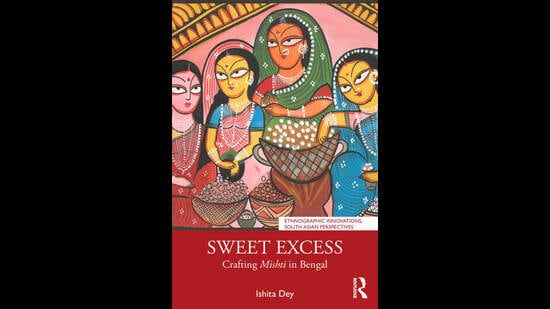
(Excerpted with permission from Sweet Excess: Crafting Mishti in Bengal by Ishita Dey, published by Routledge; 2026)