
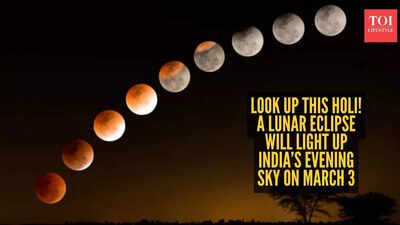
This Holi, the sky has plans of its own. As people step out to throw colours and celebrate, something quieter, but just as beautiful, will be unfolding overhead. A lunar eclipse will appear in the evening sky on March 3, 2026, and parts of India will get a brief chance to watch the Moon slip into Earth’s shadow.
It won’t be a long show. And it won’t be a full dramatic eclipse for most of the country. But that almost makes it more special.
A total lunar eclipse is happening globally on the same day. The catch? In India, the eclipse begins before the Moon even rises. So by the time the Moon appears at sunset, the event will already be nearing its final phase. What we’ll see is the closing act – a partially shadowed Moon climbing slowly into the evening sky.
And if you’re in cities like Nagpur or Chennai, keep an eye on the eastern horizon just after sunset. The Moon may look slightly darker on one side, almost as if someone has taken a bite out of it. The shadow won’t stay long though. In many places, the visible phase may last only 20 to 30 minutes before the Moon fully brightens again.
Eastern and north-eastern India could get a slightly better view since the Moon rises earlier there while the eclipse is still stronger.
But across central and southern regions – including Pune, Nagpur and Chennai, the experience will be shorter and more subtle. Blink, get distracted by Holi sweets, and you might miss it.
So what’s actually happening up there?
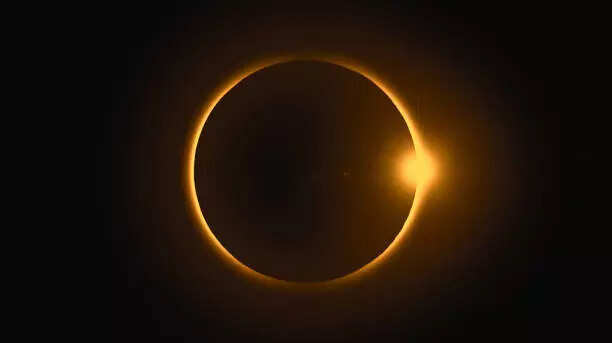
A lunar eclipse occurs when Earth moves directly between the Sun and the Moon. Our planet blocks sunlight and throws its shadow onto the lunar surface. Depending on how perfectly everything lines up, the Moon can turn coppery red, go partially dark, or simply pass through a lighter outer shadow.
The good news? You don’t need any equipment. No glasses, no telescope, no complicated planning. Lunar eclipses are completely safe to watch with the naked eye. Just find an open view of the sky and hope for clear weather.
A partial lunar eclipse, like the one India will see, happens when the alignment isn’t exact. Only part of the Moon enters Earth’s darkest shadow, known as the umbra. Instead of disappearing completely, the Moon looks as though a shadow slowly slides across it and then quietly fades away.
And maybe that’s what makes this one memorable. Holi evenings are already filled with colour, laughter and noise. But for a few minutes, if you look up, you’ll catch a softer kind of spectacle – a shadow moving across the Moon while the country celebrates below.
Short. Subtle. Easy to miss.
But worth stepping outside for.