

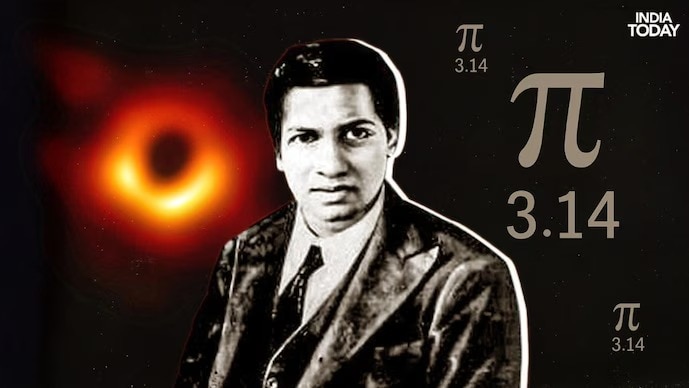
“An equation for me has no meaning unless it expresses a thought of God.”
— Srinivasa Ramanujan
THE DEEPER MEANING BEHIND THE QUOTE
This was not a metaphor for Srinivasa Ramanujan. It was a statement of how he understood mathematics itself.
To Ramanujan, equations were not merely tools to calculate or prove. They were revelations.
He believed mathematics was a way to glimpse an underlying order that already existed in the universe. His work was not driven by textbooks or laboratories, but by intuition. He often said his ideas came to him in dreams, inspired by the goddess Namagiri, his family deity.
At a time when most mathematicians followed formal proofs and established methods, Ramanujan worked differently. He wrote down results with extraordinary accuracy, often without showing the steps.
British mathematician GH Hardy, who later collaborated with him at Cambridge, admitted that many of Ramanujan’s formulas were unlike anything he had seen before.
This quote captures that difference. For Ramanujan, mathematics was not an invention. It was a discovery.
WHY THIS QUOTE REMAINS RELEVANT TODAY
More than a century later, Ramanujan’s words carry a quiet reminder in an age dominated by algorithms and artificial intelligence.
Modern education often treats mathematics as a subject to be mastered for exams or careers. Ramanujan saw it as something to be understood with wonder. His perspective reminds students that learning is not only about arriving at the correct answer. It is about asking why patterns exist in the first place.
His life also offers another lesson. Ramanujan grew up in Kumbakonam, far from global academic centres. He had no advanced degrees when he first wrote to Cambridge. Yet his ideas travelled across continents.
In today’s world, where access to knowledge is wider than ever, his journey stands as evidence that originality can emerge from unexpected places.
THE LIFE BEHIND THE WORDS
Born on December 22, 1887, in Erode, Tamil Nadu, Srinivasa Ramanujan showed early brilliance but struggled in formal education because he focused almost entirely on mathematics.
In 1913, he wrote a letter to G.H. Hardy, enclosing pages of theorems. Hardy immediately recognised his genius and invited him to Cambridge. There, Ramanujan produced some of his most important work, including contributions to number theory, partitions, and infinite series.
He was elected a Fellow of the Royal Society in 1918, one of the youngest to receive the honour.
Ramanujan died in 1920 at the age of just 32. Yet in his short life, he left behind notebooks that continue to influence research even today.
LASTING LEGACY
Ramanujan did not see mathematics as separate from life. He saw it as part of existence itself.
His quote reminds us that knowledge is not only about utility. It is also about meaning.
For students, researchers and thinkers, it offers a simple but profound idea — that learning becomes powerful when it connects with curiosity, belief and imagination.
More than a century later, Srinivasa Ramanujan’s equations continue to speak.
And through them, so does his faith in the beauty of numbers.