

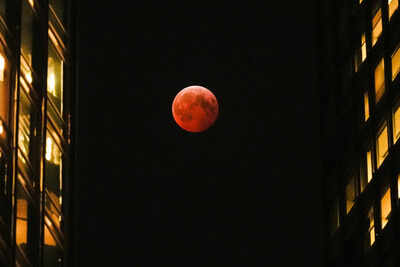
On March 3, 2026, the sky will stage a total lunar eclipse. In India, this event will coincide with Holi, which is observed on the full moon day in the Hindu lunar calendar.
For students, this is more than a cultural moment but also a chance to step into the world of astronomy and physics.
What will happen on March 3, 2026
A lunar eclipse occurs when the Earth moves directly between the Sun and the Moon. During a total lunar eclipse, the full Moon passes into the darkest part of Earth’s shadow, known as the umbra.
This alignment causes sunlight to filter through Earth’s atmosphere before reaching the Moon. Shorter blue wavelengths scatter, while longer red wavelengths bend and reach the lunar surface. As a result, the Moon appears red.
This is why it is often called a Blood Moon.
Astronomical data confirm that this will be the first lunar eclipse of 2026. It will be visible across parts of the Americas, Australia, the Asia Pacific region, and the Indian subcontinent.
In Indian Standard Time, the eclipse will unfold through the afternoon and early evening.
-
The eclipse will begin at approximately 3:20 PM IST
-
The peak viewing window will be between 6:33 PM and 6:40 PM IST
-
The eclipse will end around 6:47 PM IST
However, the Moon will rise in most Indian cities during the later stages of the eclipse. This means observers in Delhi, Mumbai, Bengaluru, and Chennai will only see the final part of the event, shortly after moonrise between 6:20 PM and 6:30 PM IST.
Students in northeastern states such as Assam, Arunachal Pradesh, Meghalaya, and West Bengal will have a better chance of viewing a larger portion because the Moon rises earlier there.
What students in India will actually see
Most viewers in central and western India will see only the final phase, when totality is ending and the Moon is already red.
In Chennai, the visible phase may last about thirty minutes after sunset. In cities such as Cuttack and Kolkata, observers may see up to ninety percent of the eclipse.
This difference is not about importance but about geography. The Earth’s rotation determines when the Moon rises at each location.
Why the Moon turns red
The red colour is not caused by fire or heat. It is the result of atmospheric filtering.
When sunlight passes through Earth’s atmosphere, shorter wavelengths such as blue scatter in different directions. Longer wavelengths such as red continue through and bend toward the Moon. This process is similar to what creates red sunsets.
Unlike a solar eclipse, a lunar eclipse is safe to watch with the naked eye. No special filters or glasses are required.
Why this matters for students
Lunar eclipses help scientists study how Earth’s atmosphere interacts with sunlight. By analysing the shade and intensity of the red light, researchers can gather information about atmospheric particles and composition.
For students, this event demonstrates:
-
Orbital motion of Earth and Moon
-
The concept of shadows, especially umbra and penumbra
-
Light scattering and wavelength behaviour
-
The relationship between astronomical cycles and calendars
The cultural intersection with Holi
The eclipse will occur on the same night as Holi. For students, this overlap offers an opportunity to understand how astronomy and culture intersect. Lunar cycles influence religious calendars, festival dates, and traditional practices.
How students can observe the eclipse
You do not need protective eyewear. To improve your viewing experience:
-
Choose a location with a clear eastern horizon
-
Avoid areas with heavy artificial lighting
-
Use binoculars or a small telescope for clearer detail
-
Compare the Moon’s colour over time
If local conditions do not allow viewing, many scientific organisations are expected to livestream the event.
What every student should take away
This is not only a sky event. It is a lesson in alignment, motion, light, and timekeeping. It shows how planetary movement shapes both scientific understanding and cultural life.
On March 3, when the Moon rises tinted red above the horizon, students across India will be watching more than a spectacle. They will be observing physics in motion.
Ready to navigate global policies? Secure your overseas future. Get expert guidance now!


