

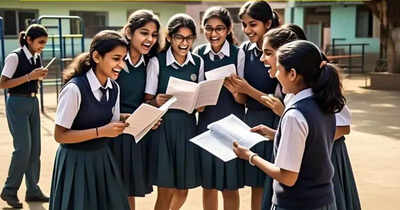
The much-awaited Central Board of Secondary Education (CBSE) Class 10 Science exam for 2026 took place today, February 25, from 10:30 AM to 1:30 PM. Over three hours, students tackled questions from Physics, Chemistry, and Biology, facing a balanced mix of numericals, diagrams, and concept-based problems. The paper was divided into sections, with Section C pushing students to think a little deeper and apply higher-order thinking skills.
Many students said time management was key — especially while solving Physics numericals and handling tricky diagrams. Chemistry and Biology were largely rooted in concepts and NCERT content, making them more comfortable for well-prepared students. Physics, however, demanded both speed and precision, keeping students on their toes throughout the exam.
- CBSE Class 10 Science Paper 2026 PDF Now Available: Download and Analyze
Across India, a total of 2,508,319 students are registered for the Class 10 Science exam, distributed across 8,075 centres. Of these, 1,408,546 are boys and 1,099,773 are girls. While not all candidates appear on the same day, these figures provide an overview of the scale of the examination. The next major exam for Class 10 students is scheduled for March 2, 2026, for the Hindi subject.
At Sarvodaya Kanya Vidyalaya, Shree Ram Colony, where girls of GGSSS Sonia Vihar appeared, students shared mixed but largely positive feedback. Soni said, “Chemistry and Biology were easy,” while Harshita added, “The paper was lengthy, especially Section C.” Students noted that Section C required more analytical thinking and careful time management.
Physics was reported to be the most time-consuming section. Soni said, “Solving numericals consumed time, and the diagrams and electric circuits were also some higher-level thinkings.” Harshita observed, “Physics required more concentration, but with proper preparation, it was manageable.”
Chemistry, on the other hand, was considered simpler. Soni explained, “Questions on balancing chemical equations were easy.” Biology emerged as the easiest part of the paper. According to Soni, “Some of the Biology questions were straight from the NCERT text book, this was easiest part of the paper, hope to get full marks in this section.” Harshita added, “I could attempt all questions confidently, as most of them were familiar from classroom study.”
Sharing a similar view, Suryansh Srivastava, Class X, Witty International School, Udaipur, said, “After the Maths exam, the Science paper came as a relief. Most of the questions were direct and strictly based on the prescribed syllabus. The Biology and Chemistry sections were straightforward and scoring, while a few questions in Physics required deeper thinking. Overall, it was an easy to moderate paper that could be completed comfortably within the given time.”
Overall, students described the paper as “easy to moderate,” with Physics requiring more effort while Chemistry and Biology remained scoring sections for those who had prepared well.
Teachers described the Class 10 Science paper as moderate, balanced, and student-friendly, with a strong focus on NCERT concepts and competency-based learning.
Priyanka Sahu, Assistant Manager, Seth M.R. Jaipuria Schools (Corporate Office), said the paper followed a clear three-section format with Biology, Chemistry, and Physics presented separately, making it organised and easy to navigate. “The paper was moderate in difficulty and closely aligned with NCERT concepts. Most questions were direct and concept-based, with no major surprises. However, it felt slightly lengthy due to the mix of MCQs, Assertion–Reason, competency-based questions, numericals, and diagram-based problems. Students with good time management were able to complete it comfortably.”
Dr. Shikha Sharma, HOD Science, Silverline Prestige School, noted, “The paper included a good mix of competency-based and moderate questions that assessed application of knowledge. The MCQs and case-based questions were of average difficulty. Students finished the paper on time and were satisfied with the level. Overall, all the sets were easy to moderate.”
Ms. Ranjana Thapar, Science faculty, Satya School, Gurugram, said the paper was comprehensive and well-structured, covering all major parts of the syllabus. “The overall level was moderate. Most questions were straightforward but required careful reading and conceptual clarity. MCQs were competency-based and slightly tricky, while case study questions tested application and analytical thinking.”
Teachers observed that the paper maintained a good balance across all three subjects, giving well-prepared students a fair opportunity to score.
According to Priyanka Sahu, the Biology section included familiar diagrams and reasoning-based questions from NCERT, while Chemistry was straightforward with standard reactions and textbook concepts. Physics contained a few numericals and ray-diagram questions that required careful formula application but followed the expected board pattern. She added that internal choices provided flexibility and helped reduce exam pressure.
Ms. Ranjana Thapar also highlighted that Physics was largely theory-based with fewer numericals, Chemistry was relatively easy with activity-based and reaction-focused questions, and Biology was concept-driven with diagrams, labelling, and explanation-based answers.
Earlier feedback from schools indicated that time management was important, especially in Physics, while Chemistry and Biology remained largely concept-based and comfortable for students who had prepared thoroughly from NCERT.
Overall, teachers agreed that the paper was fair, scoring, and easy to moderate, rewarding consistent preparation, conceptual clarity, and effective time management.
This is a developing story. Keep visiting for the latest updates, and we will soon provide the complete Science paper PDF for Class 10. We also want to hear from you! If you are a student, share your reaction to the question paper, or if you are a teacher, provide your analysis. You can do so by leaving a comment on this article as a readers’ opinion. Selected comments will be featured in the article.
Ready to navigate global policies? Secure your overseas future. Get expert guidance now!