

Amid ongoing tensions in parts of the Middle East, concerns have been growing among students and parents about whether CBSE Board exams in the region could be cancelled.
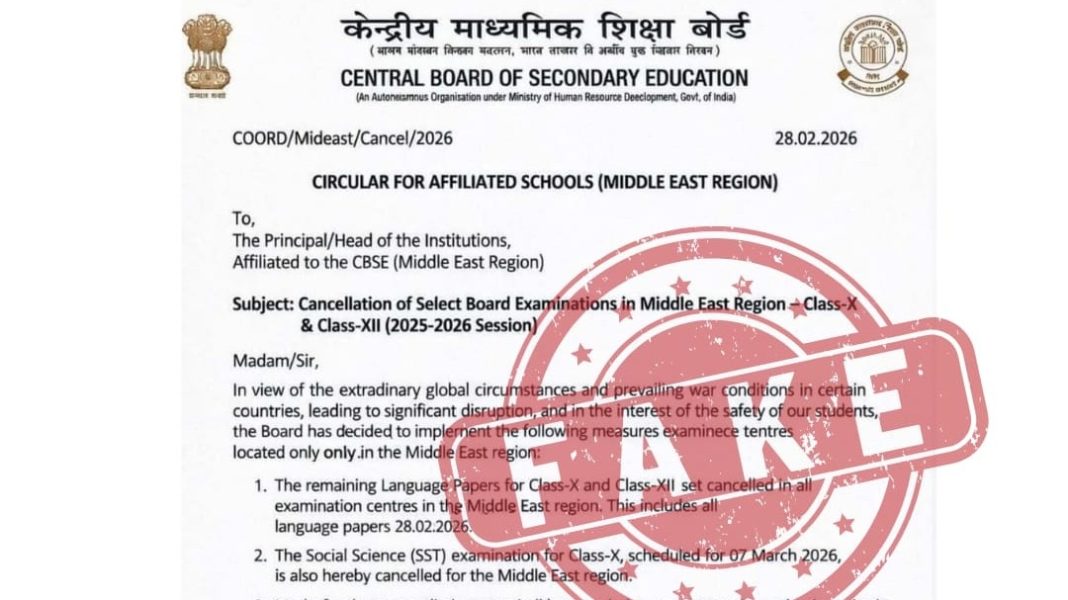
In the middle of this anxiety, a circular claiming cancellation of certain Class 10 and Class 12 examinations in the Middle East region has gone viral on social media.
However, as per leading media reports and CBSE’s own clarification, the circular is fake.
As per available data from past board cycles, CBSE conducts Class 10 and 12 exams for around 42 lakh students worldwide across 7,800+ centres, including in about 26 countries abroad — among them several in the Middle East region such as the UAE, Qatar, Oman and others.
In countries like the United Arab Emirates alone, there are about 15 CBSE-approved examination centres serving local and regional candidates.
Read: CBSE postpones March 2 board exams in Middle East amid Iran-US-Israel conflict
WHAT THE VIRAL NOTICE CLAIMED
The notice, titled “Circular for Affiliated Schools (Middle East Region)”, claimed that remaining language papers for Classes 10 and 12 scheduled after February 28, 2026, had been cancelled in the region.
It also stated that the Class 10 Social Science exam scheduled for March 7, 2026, stood cancelled for Middle East centres.
The circular further claimed that marks would be awarded through a composite evaluation method based on internal assessments, pre-board exams and continuous evaluation. It added that no student would be failed in the affected subjects.
The document carried the name of the Controller of Examinations and appeared formatted like an official CBSE communication, which added to the confusion.
CBSE CALLS IT FAKE
The Central Board of Secondary Education (CBSE) has flagged the notice as fake.
In a post on X, the board said: “Important Alert!! This is a fake circular. An official update will follow.”
As of now, there has been no official announcement from CBSE regarding cancellation of board examinations in the Middle East region.
With exams underway, students and schools have been advised to rely only on updates published through official CBSE channels.
The episode once again highlights how misinformation during high-stress periods such as board exams can spread quickly — and why official confirmation remains crucial before reacting to viral claims.