9.1 C
Delhi
Monday, December 1, 2025

Brain Adolescence Lasts Until Age 32, Cambridge Study Reveals

Key Takeaways

  • Brain development continues until age 32, redefining adolescence
  • Five distinct stages shape cognitive abilities across lifespan
  • Early 30s mark the “strongest topological turning point” in brain wiring

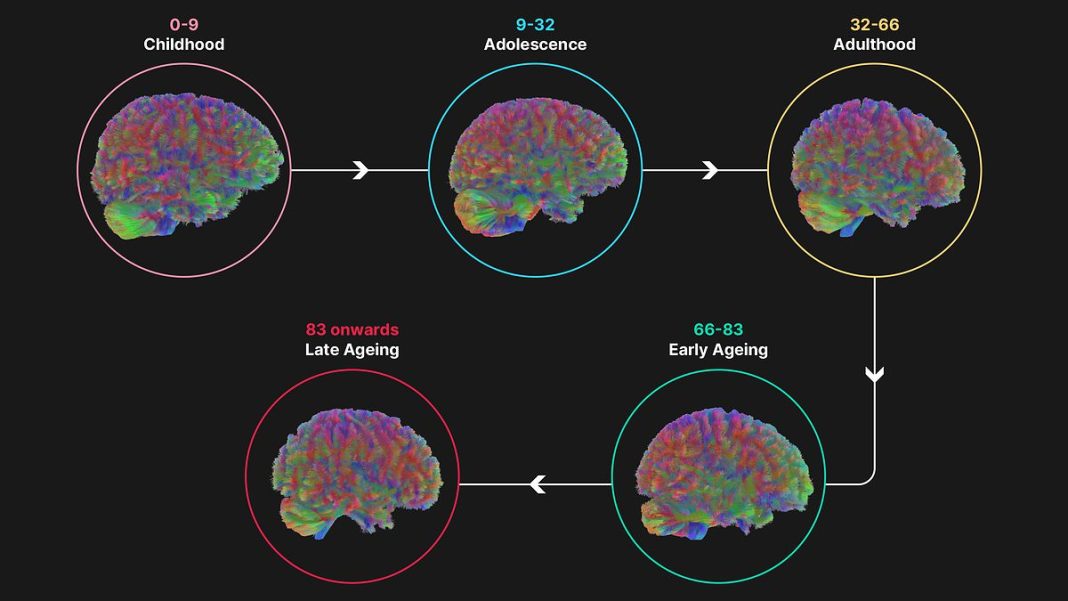
Groundbreaking research reveals the human brain progresses through five distinct developmental stages, with adolescence extending well into our early 30s. A comprehensive University of Cambridge study analyzing 3,802 brain scans from ages 0 to 90 identifies four pivotal turning points that define our neurological journey from childhood to late ageing.

The Five Brain Development Stages

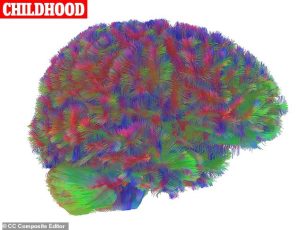
Childhood (0-9 years)

During this foundational period, the brain undergoes massive reconfiguration through “network consolidation.” Excess neural connections are pruned while only the most active synapses survive. Grey and white matter expand rapidly, and the brain’s characteristic ridges stabilize.

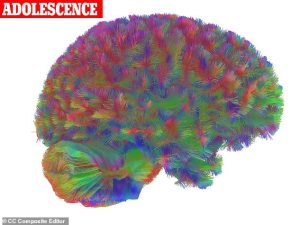
Adolescence (9-32 years)

Contrary to conventional understanding, adolescence spans nearly three decades. “The brain goes through a natural transition around puberty begins, which extends until the early 30s,” explains lead researcher Dr Alexa Mousley. This period features increasingly refined and efficient neural connections, enhancing cognitive performance.

“Efficiency in the brain is similar to how you’d think of an efficient path between two places – a short, direct route. When short paths that allow for communication between brain regions form or strengthen, the brain becomes more efficient.”

The early 30s represent the “strongest topological turning point” of our lives. However, this extended adolescence also correlates with increased mental health disorder prevalence.

The period known as ‘adolescence’ (pictured) lasts between the ages of nine and 32 and is the most active period of development. Our brains become more efficient, and connections across different regions are strengthened

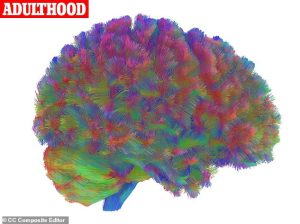
Adulthood (32-66 years)

Brain architecture stabilizes during this longest phase, with intelligence and personality reaching a plateau. Increased segregation emerges as brain regions become more compartmentalized.

During ‘adulthood’ (pictured), the brain’s structure stabilises, and our personality and intelligence reach a ‘plateau’

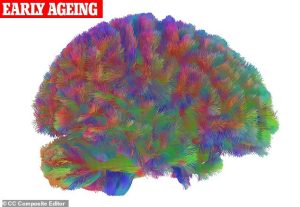
Early Ageing (66-83 years)

This mild transition period shows gradual connectivity reduction and white matter degradation. Dr Mousley notes this age brings increased risk for brain-affecting conditions like hypertension.

After adulthood, we hit the stage known as ‘early ageing’ at around 66 years old. At this time, the brain’s connectivity gradually reduces, and the white matter starts to degenerate

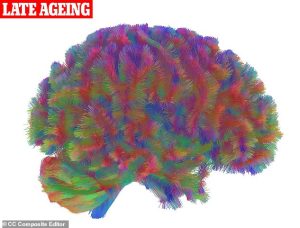
Late Ageing (83+ years)

Whole-brain connectivity declines dramatically, forcing increased reliance on specific regions. Dr Mousley illustrates: “Imagine you normally take one bus to work. If that route shuts down, you might need two buses. Suddenly, the transfer stop becomes much more important.”

The final stage, known as ‘late ageing’ (pictured), begins at around 83 years old and is associated with a deterioration of connections between the brain’s different regions

Research Methodology and Implications

The Nature Communications study utilized MRI diffusion scans tracking water molecule movement to map neural connections. Professor Duncan Astle emphasizes: “Many neurodevelopmental, mental health and neurological conditions are linked to how the brain is wired. Differences in brain wiring predict difficulties with attention, language, memory, and behaviors.”

This research provides new understanding of brain development timelines and their connection to across the lifespan.
Latest

Why HIV Remains Incurable After 40+ Years of Research

Discover the two unique properties that make HIV so difficult to cure and why current treatments require lifelong medication despite scientific advances.

Indian Scientists Discover Oral Cancer Gene in Women – Breakthrough Study

Groundbreaking research identifies CASP8 as key driver gene for oral cancer in Indian women, enabling personalized treatment approaches.

Primate Ancestors Explain Human Alcohol Preference, Research Shows

Discover how 50 million years of primate evolution wired our brains for alcohol consumption through fermented fruit seeking behavior.

Antibiotic Crisis: Common Drugs Fail Against Routine Infections in India

ICMR report reveals 75% resistance to key antibiotics for pneumonia and sepsis, with ICU superbugs showing 91% resistance to last-line treatments.

Bird Flu Mutation Could Trigger Pandemic Worse Than COVID-19, Experts Warn

French virologist warns H5 bird flu mutation could cause severe pandemic, but current human risk remains low with no need to alter daily routines.

Topics

Monsoon Apocalypse Kills Over 900 Across Sri Lanka, Indonesia, Thailand

Catastrophic floods and Cyclone Ditwah leave hundreds dead and missing. Get the latest on rescue efforts and official response across three nations.

Elon Musk: Work Will Be Optional Like a Hobby Within 20 Years

Tesla CEO predicts AI and robotics will make employment a choice, not a necessity, in less than two decades. Explore the future of work.

Study: Poems Can Trick AI Chatbots Into Bypassing Safety Filters

New research reveals a 62% success rate in using poetic prompts to jailbreak AI models like Gemini and GPT, forcing them to generate harmful content.

Xiaomi 15 Ultra Gets Android 16 Update in India with New AI Features

Xiaomi 15 Ultra users in India can now update to Android 16 via HyperOS 3. Get the installation steps and details on new AI tools and the HyperIsland feature.

Bitcoin Plunges Below $88,000 as Crypto Sell-Off Intensifies

Bitcoin and Ethereum lead a sharp crypto market decline, with traders eyeing $80,000 as the next key support level amid macro fears.

Stocks to Watch Today: ICICI Bank, Neuland Labs, Waaree Energies in Focus

Key stocks like ICICI Bank, Neuland Laboratories, and Waaree Energies are likely to see action as markets reopen. Check Friday's closing prices and trends.

New Bills to Replace GST Cess on Tobacco, Pan Masala

Government proposes new levy to replace expiring GST compensation cess on tobacco products. Current tax rates for consumers will remain unchanged.

Why HIV Remains Incurable After 40+ Years of Research

Discover the two unique properties that make HIV so difficult to cure and why current treatments require lifelong medication despite scientific advances.
spot_img

Related Articles

Popular Categories

spot_imgspot_img