

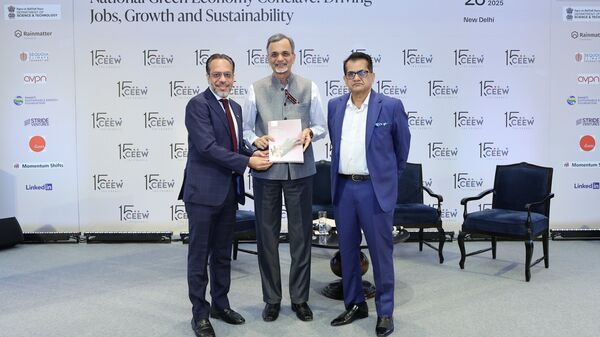
India’s Green Economy to Create 48 Million Jobs, Attract $4.1 Trillion by 2025
A groundbreaking study by the Council on Energy, Environment and Water (CEEW) reveals India could attract USD 4.1 trillion in green investments and generate 48 million full-time jobs by 2025. The analysis further projects a USD 1.1 trillion annual green market by 2047.
Key Takeaways
- 48 million green jobs and $4.1 trillion investments possible by 2025
- Electric mobility to drive 57% of energy transition jobs
- 36 identified green value chains across multiple sectors
- Bio-economy could create 23 million rural jobs
Beyond Solar and EVs: The Expanded Green Economy
The study moves beyond conventional green sectors to identify 36 value chains across energy transition, circular economy, and bio-based solutions. These include bio-materials, agroforestry, sustainable tourism, and waste-to-value industries – each with billion-dollar potential.
“India’s green transition is fundamentally net positive: it can create millions of jobs, accelerate growth, improve public health and strengthen national security by shifting to domestic energy sources,” said Jayant Sinha, president of Everstone Group.
Sector-wise Breakdown
Energy Transition Dominates
Renewables, storage, and clean mobility manufacturing could attract USD 3.79 trillion and create 16.6 million jobs. Electric mobility alone would drive over 57% of energy transition employment.
Bio-Economy’s Rural Potential
Nature-based solutions could generate 23 million jobs and USD 415 billion in market value, primarily in rural areas. Top job creators include:
- Chemical-free agriculture: 7.2 million jobs
- Agroforestry: 4.7 million jobs
- Wetland management: 3.7 million jobs
Circular Economy Opportunities
Waste management and recycling could create 8.4 million jobs with USD 132 billion annual output, offering improved wages as systems formalize.
“With much of our infrastructure yet to be built, we have a unique chance to design cities, industries and supply chains around circularity and clean energy,” said Amitabh Kant, former G20 Sherpa.
Challenges and Way Forward
The study identifies key hurdles including high capital costs, supply chain gaps, and skill development needs. Coordinated action across government, industry, and financial institutions will be crucial to realize this potential.