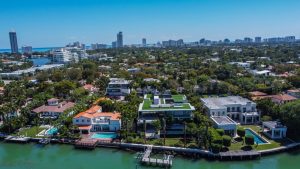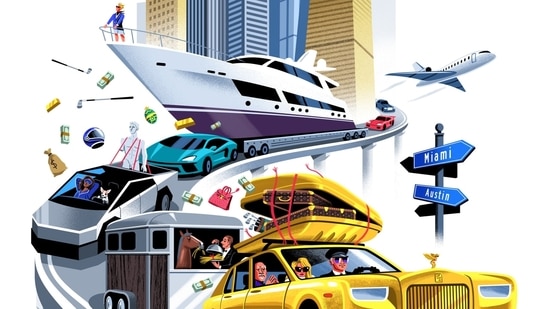
Google co-founder Larry Page recently made headlines by spending $188 million on three Miami mansions. He’s not the only billionaire looking at a big move: His Google co-founder Sergey Brin is reportedly shopping for Miami property. So is WhatsApp co-founder Jan Koum.
The shopping spree comes as California considers a wealth tax to impose a one-time retroactive levy on billionaires that has fueled speculation that they have had it with the Golden State. In New York City, where Mayor Zohran Mamdani earlier this month proposed an increase in taxes on high-income people—and short of that, a property tax increase—there is talk of a parallel exodus.
One Subscription.
Get 360° coverage—from daily headlines
to 100 year archives.

E-Paper

Full
Archives

Full Access to
HT App & Website

Games
Already subscribed? Login
The wealthy have long threatened to leave when battling local governments over taxes. In the past, they rarely did. But their threats have teeth this time—not because they are abandoning great cities, but because they have figured out they don’t have to. Now that digital technology allows them to separate where they live and pay taxes from where their businesses operate, they aren’t relocating their companies. They are relocating themselves.
This upends the basic arrangement that underwrote great cities—what they are, how they work and who pays for them. Amid this seismic shift looms an existential question: Can those cities survive without them?
For most of history, people lived where they worked—on the farm, above the shop, close to the factory. Suburbanization expanded the radius, but workers, managers and executives still had to be close to where jobs concentrated. Because people had to be there, cities could charge a premium. Residents paid it in housing costs, in taxes and in the costs of commuting or other frictions of day-to-day life. The alternative—living elsewhere—meant being cut off from their livelihoods and economic opportunity. Taxes were part of that price, and people paid because they had no choice.
When Covid hit, this social compact appeared to quake. A chorus of commentators predicted the imminent collapse of New York, London, San Francisco and other great global cities. They predicted the wealthy and their companies would be driven out by lockdowns, governance failures, crime and the sudden possibility of remote work. The cities, as a result, would hollow out.


There seemed to be something to it—at first. Ken Griffin relocated himself and the headquarters of his Citadel hedge fund from Chicago to Miami. The venture capitalists Peter Thiel and Keith Rabois bought homes in Miami Beach and opened an office for their venture capital fund in Miami, too. Jeff Bezos moved from Seattle to Miami, assembling a $200 million plus compound.
But the predicted total exodus never fully materialized.
Many of those who moved to Miami quickly came face to face with its limits. Public and private schools couldn’t match what they had left behind. Housing costs rose astronomically—making Miami now one of the most unaffordable markets in the country.
Most critically, they found it hard to recruit top talent. New York and London remained the centers of global finance. San Francisco remained the center for high technology, with the lion’s share of venture capital investment to AI startups still flowing into the Bay Area.
In 2023, Thiel admitted as much, conceding that the tech industry remained densely concentrated in California and that Miami’s housing costs had put the city out of reach for much of the talent he needed—making it far harder to move companies and their people than he initially thought. Griffin himself ended up building a massive new building in New York even as Citadel expanded in Miami.
But eventually they realized they didn’t have to move their companies at all. Digital technology enabled them to live in one place and keep their business in another. They could establish residency in Miami, which requires no particular time spent there to claim residency status, and spend much of the year wherever else they wanted—flying into New York or San Francisco for what mattered. The city where their businesses are headquartered became just that—not somewhere they needed to reside and pay taxes.
That has transformed the underlying economic logic of cities. They are no longer self-contained economic units. Digital technology is remaking them into networks—physical places connected by virtual ties and dynamic talent flows.
Economic participation now happens across places, not within them. My own research has documented the rise of what I call lifestyle tax havens—cities such as Miami, Dubai and Singapore that combine low or no income taxes with warm weather, luxury amenities and easy access to global networks.
These lifestyle tax havens do not replace the great hubs. They are satellites in their orbit, part of the networks that form around them. Miami is a critical node in New York’s financial network. Austin operates as a satellite of San Francisco’s tech network. Dubai plays a similar role for London and the financial centers of Europe and Asia.

Billionaires make headlines, but the same math applies down the economic ladder. For a high earner, a move from San Francisco, Los Angeles or New York to Miami could save 10 to 14 percentage points on income tax, based on current rates. For a professional couple earning $1 million a year, that is roughly $100,000 to $140,000 annually—adding up to more than $1 million over a decade. This is a simplification, of course—certainly, taxes can be complicated by write offs and different income types. But the income-tax rates paint a clear picture.
But what becomes of cities that are lifestyle tax havens?
They were never built to scale in the way older cities have. In the old urban system, people were anchored to place. That anchoring did more than generate tax revenue. It created loyalty, civic investment and philanthropy—the long-term commitment that built private schools, museums, hospitals, universities and cultural institutions. When people stayed, they fixed what was broken because they had no alternative.
The lifestyle tax havens often lack the civic commitment that allowed places like New York, London, Paris or Chicago to grow into fuller-spectrum cities. Places like Miami lack the integrated infrastructure and public systems, and as population and activity increase, everyday urban functions become harder to manage. Moving around becomes increasingly difficult. Housing costs rise rapidly. Schools and public services struggle to keep pace. These are not temporary growing pains. They are structural limits.
The model works well enough for wealthy residents who can buy private solutions—housing, education, transportation, security. For empty-nesters and young professionals without children, the trade-offs may be manageable. For families, they are far more consequential. And for service workers—the people who staff hospitals, schools, restaurants and local government—the barriers are often insurmountable. When the people who make a city run cannot afford to live there, the city itself begins to fray.
This is the dynamic the economist Albert Hirschman warned about: That loyalty is what turns frustration into voice—the impulse to fix what is broken rather than flee. Today, exit is cheap and reversible. When taxes rise or services disappoint, the response is no longer to press for reform but to move.

Cities, then, are pushed toward a race to the bottom—not one driven by ideology, but by mobility. As high earners leave the tax base without leaving the economy, cities face pressure to lower taxes without lowering obligations. The burden of funding schools, transit, parks and public safety shifts to those who remain. Established cities and rising stars alike are caught in this trap.
Cities cannot simply chase mobile residents by cutting taxes. That is a losing game. National governments are unlikely to solve this problem, and in any case it plays out at a global scale. Cities will have to respond on their own by rethinking what they tax. If income and wealth can move, cities must focus on what cannot: land and property, consumption and entertainment, visitors and tourism, commuters and employment, companies that operate locally and anchor institutions that are rooted in place.
For decades, great cities benefited from a relatively captive tax base. That constraint has now weakened—and in many cases, it has been broken. Cities can respond to this new competition, or they can choose not to. But they cannot opt out.
—
Richard Florida is a Distinguished Visiting Professor at Vanderbilt University, a University Professor at the University of Toronto, and a Distinguished Fellow at The Kresge Foundation. He is the author of “The Rise of the Creative Class” and “The New Urban Crisis” and is currently writing a book on how digital technology is reshaping cities and the geography of work.