
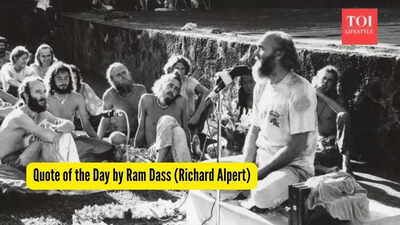
Ram Dass, also known as Baba Ram Dass, was a popular American spiritual teacher, guru of modern yoga, psychologist, and author of the bestselling book Be Here Now. Born Richard Alpert in 1931, he transformed from a Harvard professor dosing students with LSD to a bearded sage in white robes, whispering truths from an Indian ashram. His journey wasn’t just personal—it reshaped Western spirituality, blending psychedelics, yoga, and raw honesty into a message that still echoes: love everyone, serve everyone, remember God. Over his 88 years, he authored bestsellers, founded charities, and faced a massive stroke with grace, dying in 2019 on Maui. This is his story, pieced from verified lives, lectures, and his own words—no fluff, just the man who made enlightenment feel human.
He was a kid from a posh Boston suburb, son of a wealthy Jewish lawyer who later became president of the New York, New Haven & Hartford Railroad. Richard Goldberg Alpert was the eldest of three boys in a family loaded with achievement but starved for warmth. His dad, George, was a powerhouse: railroad exec by day, lawyer who defended Sacco and Vanzetti by passion. Athletic, popular, but inwardly restless, masking insecurities with charm and conquests.
“I was a terrible father figure,” he’d later admit about his own early manhood, echoing the emotional distance at home. Schooling shaped him sharp. Tufts University for a psych bachelor’s in 1952, quick master’s at Wesleyan in 1954, PhD from Stanford by 1957—brilliant, but adrift. He chased women, booze, status; therapy exposed his “pathological” need for love.
Harvard, 1960: Alpert met Leary, already experimenting with psilocybin mushrooms. They bonded over mind-expansion, launching the Harvard Psilocybin Project. LSD enters the scene—government-sourced, pure fire. They dosed grad students, prisoners, even divinity scholars in the Good Friday Experiment (1962), where 10 of 20 reported mystical peaks. Results dazzled: ego-death, unity, bliss beyond words. But scandal brewed—undergrads tripping, rumors of orgies. Dean yanked funding; by May 1963, both fired. “We were the most dangerous men on campus,” Leary quipped.
Exiled, they decamped to Millbrook, New York—a 4,000-acre estate funded by heiress Peggy Hitchcock. Acid tests galore: seminars, light shows, seekers flocking. Alpert hosted Ram Dass retreats? No, that name came later. He lectured campuses, co-authored The Psychedelic Experience (1964), Timothy’s Tibetan Book riff. Fame swelled—Time magazine cover, “psychedelic pied pipers.” But cracks showed: tolerance built, trips turned hellish. “Psychedelics are a shortcut,” he’d say, “but the road’s still yours.” By 1966, burnout hit. Fired from his path, he booked India.
Kainchi ashram, 1967: Alpert, bearded seeker, landeds in Delhi, hunteds saints via Autobiography of a Yogi. Locals point to Neem Karoli Baba—Maharajji, the “bliss bomb.” When he looked at Maharajji, a tiny man in blanket, eyes like universes he said, “I feel you know me,”. Baba replied, “How could I not?”—claiming prior meetings in visions. Baba renamed him Ram Dass: “Servant of Ram” (God). Psychedelics tossed; months of silence, seva (service), satsang followed. Baba completely chnaged him it is said.
Maharajji died in 1973, but Ram Dass returned transformed—white dhoti, mala beads, “Be Here Now” brewing. Back stateside, he lectured: Esalen, college halls, filling halls with hippies hungry for heart. No dogma; stories of guru’s love. Founded Hanuman Foundation (1974) for spiritual tools and Seva Foundation (1978) for global service—eye camps in India, Nepal blindness cures. Millions served; Ram Dass fundraised tirelessly.
Be Here Now (1971) can be described as part memoir, cookbook, scripture. Hand-lettered by Alpert, illustrated psychedelic-style by lama artist, it sold millions. “We’re all just walking each other home,” he etched eternally. Critics called it hippie bible; seekers, lifeline. Follow-ups to the book included Grist for the Mill (1977), Paths to God (2004). He taped 900+ talks—podcasts now, timeless. Ram Dass bridged East-West. Seva touched Asia, Africa; Hanuman centers thrived. He died December 22, 2019 with stroke complications, age 88.
One of his most iconic quotes, which stands relevant even today, is, “When you take off your mask, it’s easier for everyone else to do it. Our culture is so mask-driven. Imagine an office with no mask.” These lines may look simple, but they carry a deep meaning. A person has to be genuine to see others in true light. In the garb of being someone else, we actually play imposters. We are not true to ourselves. Ram Dass says that when you take off your mask it is easier for others as well to do it, he means that by being one’s genuine self, a person is able to make others more comfortable, and they too are able to drop their garb. Such behavior also makes people more comfortable with each other. Imagine a workplace with no mask! It will be a heaven of a place where every person is honest and genuine and there exists no politics, which mostly is the outcome of the artificial facade that most people carry. You would also know how to deal with whom, making things much easier.


