
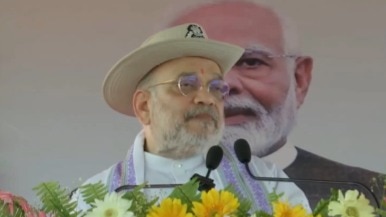
Declaring that “the Narendra Modi government is determined to “remove every infiltrator from Indian soil”, Union Home Minister Amit Shah on Thursday launched a high-stakes security and political outreach in Bihar’s sensitive Seemanchal region ahead of the high-stakes Assembly polls in West Bengal.
“Freedom from infiltrators doesn’t just mean removing their names from the voter list. We are determined to implement a program to remove every single infiltrator from Indian soil,” he said while addressing a rally in Araria, Bihar.
“The Narendra Modi government is determined to free the entire country from infiltrators, and this initiative will soon begin in the entire Seemanchal region,” Shah added.
Shah began a three-day tour of the Seemanchal region comprising Kishanganj, Araria, Purnia and Katihar districts in Bihar along the Bangladesh–Nepal frontier known for illegal migration routes, document fraud networks and cross-border smuggling.
He is scheduled to hold closed-door meetings with District Magistrates and police chiefs from seven border districts, seeking intelligence on infiltration corridors and demographic shifts.
According to security officials, infiltrators entering Bihar frequently move onward into West Bengal districts such as North Dinajpur, Malda and Murshidabad.
SIR VS NRC IN DISGUISE: A NEW FLASHPOINT
The Centre is preparing a Special Intensive Revision (SIR) of electoral rolls in the border belts to identify suspected illegal migrants. While Bengal Chief Minister Mamata Banerjee has branded the move “NRC in disguise”, the Centre argues it is essential for electoral integrity and border security.
Shah is expected to review SIR implementation mechanisms in sensitive districts during the visit, potentially escalating Centre–state confrontation between Delhi and Kolkata.
Officials acknowledge that rapid population growth pockets and settlement pattern changes in parts of Seemanchal and north Bengal have become a quiet trigger behind the renewed infiltration focus.
The BJP interprets these shifts as evidence of sustained cross-border migration and Bengal’s ruling Trinamool Congress counters that demographic rhetoric is being deployed to polarise voters before elections.
THE CHICKEN NECK FACTOR
Seemanchal sits near India’s strategic Siliguri Corridor, the narrow “Chicken Neck” linking mainland India to the Northeast. Any instability across north Bengal–Seemanchal is viewed by security planners as a potential vulnerability to this critical lifeline.
Shah’s visit, coming after migration and border reviews in Assam and Tripura, indicates the Centre is treating eastern border states as a single integrated security theatre.


