There are very few things Delhi agrees on. Pollution is terrible. Sarojini Nagar’s shopping experience isn’t overhyped. And momo is an emotion.
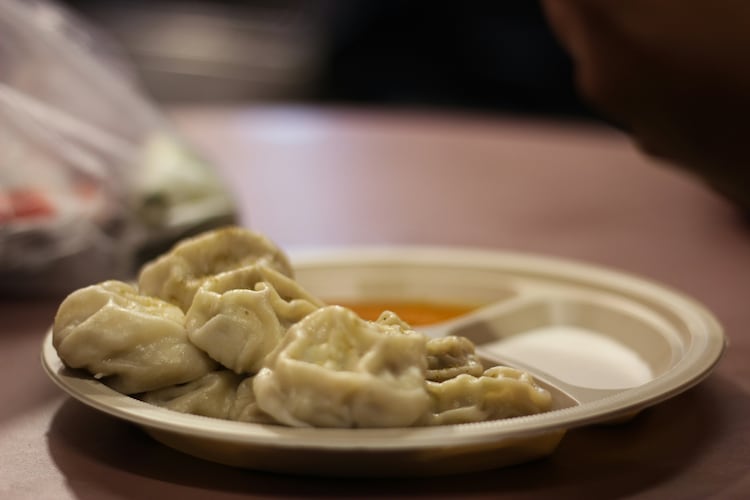
From Greater Kailash to Burari, the evening ritual is predictable: a silver-coloured paper plate, fiery red chutney, mayonnaise, and steaming hot momo. The versions have changed: Tandoori momo, Schezwan momo, Afghani momo, Chilli momo, but for an average Delhi resident, their evenings are incomplete without this now-desi dumpling.
But here’s the uncomfortable part.
The city that claims momo as its own still hesitates when it comes to fully accepting the communities that popularised it.
The latest reminder
Recently, three young women from Arunachal Pradesh were subjected to racial abuse after calling an electrician to install an air conditioner in their fourth-floor flat. Their fault? Debris from drilling fell to the floor below.
What could have ended with an apology reportedly spiralled into slurs and insinuations that the women were running a “massage parlour” or were involved in prostitution.
It was not just a housing dispute. It was identity being weaponised.
And it wasn’t new.
Love for food, hate for the people
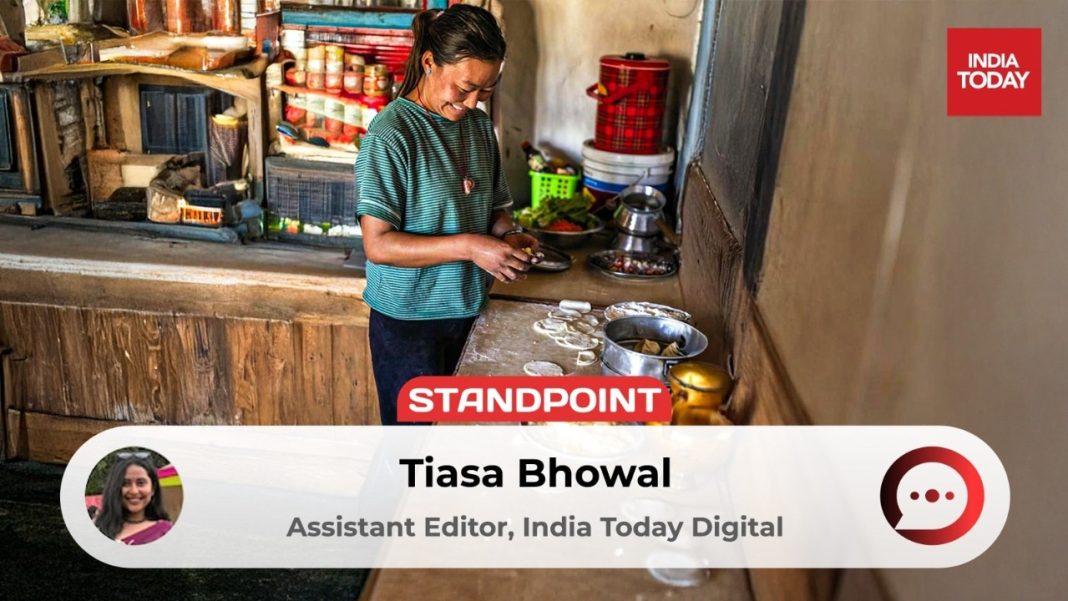
Momo did not originate in Delhi. Its roots lie in Tibet and Nepal before spreading across the Himalayan belt and embedding itself in the food cultures of Sikkim, Arunachal Pradesh, Darjeeling and other Northeastern regions. In Delhi, it was largely migrants from the Northeast and people from the Nepali and Tibetan communities who ran early stalls and eateries that made momos a street staple (like Dolma Aunty Momo).
There was a time when momo was dismissed as “kaccha khana”. Today, it has been rebranded, reinvented and, in many cases, upmarketed.
Spend a weekend at Majnu Ka Tilla or walk through Humayunpur and you’ll see how central Northeastern and Tibetan food has become to Delhi’s culinary map. Influencers routinely film food trails there. College students treat it as a rite of passage. Restaurants that began as community spaces now serve a citywide clientele.
There is no confusion about appetite.
The confusion lies elsewhere.
Because alongside this popularity, racial slurs such as “chinky” continue to surface casually. People from Arunachal Pradesh, Manipur, Nagaland, Nepal or Bhutan are routinely clubbed together based on physical features, their mongoloid features. The question “Are you Indian?” still gets asked. Northeastern women, in particular, continue to be stereotyped and hypersexualised.
The city consumes the cuisine but questions the citizenship.
We have seen this before
In 2014, 20-year-old Arunachal Pradesh student Nido Taniam was assaulted in Lajpat Nagar after shopkeepers allegedly mocked his appearance. He later died from his injuries.
The outrage that followed led to the formation of the Bezbaruah Committee, which examined discrimination faced by Northeastern people in Indian cities. The committee recommended stronger legal safeguards against racial discrimination, sensitisation of police, and faster grievance redressal.
More than a decade later, incidents continue to surface with uncomfortable regularity.
This doesn’t mean nothing has changed. Representation has increased. Northeastern food is no longer exoticised in the way it once was. Younger urban populations are more likely to call out overt racism. Social media ensures that such incidents no longer remain local whispers.
But social awareness is not the same as social security.
“I feel safer where I see my own people”
Yanku Dolma (name changed) is proud of her Tibetan roots but somewhere, her features always make her stand out and make her prone to stares, rather glares.
She tells India Today Digital that living in Delhi she feels safest in areas like Humayunpur or Safdarjung because she sees “her own people” there.
That is not simply about familiarity. It is about experience.
When housing disputes escalate into moral allegations, when landlords ask intrusive questions, when everyday interactions carry the possibility of being reduced to a stereotype, clustering becomes less about preference and more about protection.
What exactly is the problem?
Delhi is a migrant city. It absorbs Punjabis, Biharis, Bengalis, South Indians, Afghans, Tibetans. It prides itself on resilience and reinvention. Yet prejudice tied to physical features and cultural markers persists in subtle and overt ways.
Part of it stems from ignorance. Part of it stems from stereotypes around lifestyle, particularly of Northeastern women. And part of it is a familiar hierarchy — the instinct to mark someone as “other” in moments of conflict.
Food, conveniently, is easier to integrate than people.
If the city can celebrate fermented bamboo shoot, smoked pork, thukpa and pork momos on a winter evening, it can also confront the biases that still shape how it treats those who introduced these flavours.
The question is no longer whether Delhi loves momo or where you get the best ones from.
The question is whether it is ready to extend that acceptance beyond the plate.