
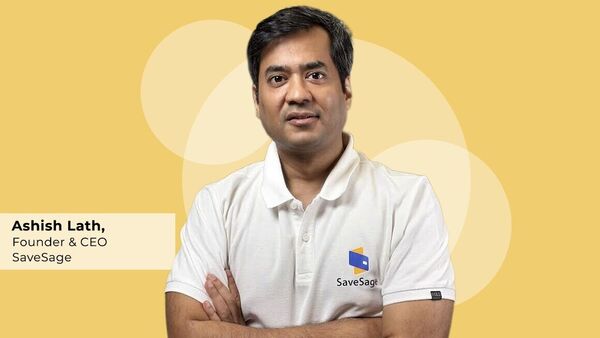
After appearing on Shark Tank India (season 5), Ashish Lath’s life has changed substantially. His name rings a bell with everyone – from customers to investors – after he featured in this reality show and bagged a cash-rich deal amounting to ₹4 crore from four of the five Sharks in exchange for 9% of his company.
Although he has yet to receive the money in his bank account, his conviction in using credit cards for everyday expenses has now received major validation.
In an interview with MintMoney, Ashish speaks about the potential growth in the credit card industry, the caution consumers must exercise when using credit, and his journey from a salaried employee to an entrepreneur.
Edited Excerpts
Why did you start this business, and how did you manage to raise money from angel investors?
I started this business because I felt that credit card penetration in India is low at 5.5%, whereas it is 40% in China and 70% in the US. Although you can get all the information related to cards on the lender’s website or app, a lender provides a host of other services as well. The market needed a specific platform, just like Nykaa for fashion, while Amazon was already there. Similarly, there was a need for a niche platform for credit card rewards.
Do you think some banks would discontinue most benefits after consumers are accustomed to using their cards? This could just be a ploy to bring them to start using their cards.
The first cashback card was launched in the USA in 1986. And now we are in 2026, while cashbacks are still there. I believe some form of user incentivisation (cashback and rewards) will always remain part of the consumer economy so long as marketing continues. Companies want to get people to use their cards.
However, this could increase or decrease, but there will always be a new challenger card offering disproportionate benefits.
In India, we seem to be following a bad example from the US, where a number of middle-class people have a huge debt problem. Donald Trump recently proposed a 10% cap on credit card interest rates to battle with this. So, do you think it’s fair to get people hooked on credit cards by incentivising with these rewards?
In India, we have multiple credit options — BNPL, personal loans, and credit cards. The question is about being disciplined. If you are disciplined, it can be a powerful tool. If you spend money and miss the timelines, the outstanding balance can become too high.
Some people also take personal loans for weddings and travel, which I will never do personally. However, I am a big proponent of letting people decide what they want to do. We should give freedom to people to decide what they want. And to prevent misuse, we should spread awareness.
There are several changes which credit card issuers bring from time to time. For example, discontinuing some discounts or reducing reward points. How does your tool map to them?
We work in the background to keep our tool up to date. Whenever there is a change, we ensure it is updated in real time.
How has your life changed after you got a ₹4 crore deal at Shark Tank India?
I am yet to get the money, but visibility has increased, and now people know about it. It validates the problem statement we are solving.
There is a SaveSage app, and then there is an assistant called Savvy. What is the difference between the two?
One is an app, the other is an AI tool. There are multiple plans with monthly subscriptions—pro, elite, and private. There is one plan that lets you talk to a human.
Before becoming an entrepreneur, you worked with famous startup founders (Kunal Bahl of Titan Capital and Amit Jain of CarDekho). What did you learn from these founders?
The founders I have worked with are also normal people. But they are quite disciplined, and they believe in showing up every single day. They think big, are smart, and hardworking.
You took 350 flights, including 80 international flights, without paying. How much did you spend in the past 10 years to accumulate so many reward points that you could do all this?
All my family’s expenses are paid with cards. Overall, I get 15-20% benefits on all the expenses, which is around ₹25-30 lakh for the entire family. I use 15 credit cards, but even if someone uses just one, s/he can still get many benefits.
You have a competitor, CheQ (with Wisor AI), that recommends the best credit card for maximum rewards. How is SaveSage different from CheQ?
CheQ was launched before us. On their platform, you can’t check your loyalty and reward points or where you can redeem them. Ours is a rewards-first platform. But they are also doing good work.
What is the future of credit card usage in urban India in 2026? Do you think this would increase or moderate over the next year or two?
This would increase. My sense is that it would literally double in the next 2 years. Soon, every card would be UPI-enabled. Either there would be a RuPay variant for each card, or Mastercard & VISA would also join (the UPI functionality).
More people will use credit cards, and more vendors will accept them. There would be no friction in using or accepting them.


