
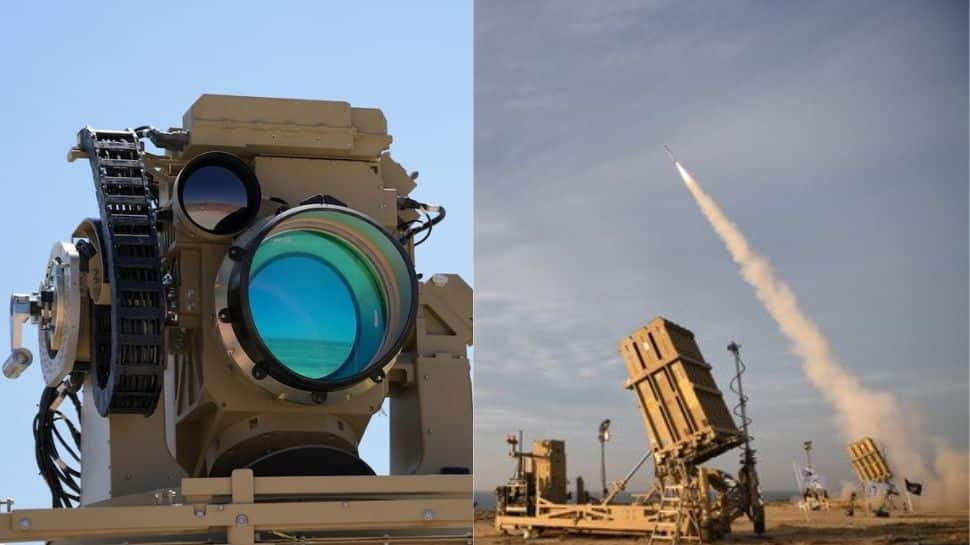
Israel has offered India a full technology transfer of its most classified air defence systems, including the missile-based Iron Dome and the cutting-edge Iron Beam laser. The high-stakes proposal comes as Prime Minister Narendra Modi arrives in Israel for a landmark visit on Wednesday.
The game changers: Iron Dome vs Iron Beam
This tech is a game-changer because it solves the “economics of attrition,” the financial trap of using expensive missiles to hit cheap drones.
Here is why this is a massive win for India:
- Insane Cost Savings: While an Iron Dome interceptor costs up to $100,000, the Iron Beam laser costs just $2 per shot.
- Infinite Ammo: Unlike traditional systems that run out of missiles, the laser fires as long as it has electricity, making it perfect for stopping “drone swarms.”
- Neutralizing Threats: It makes the financial burden of a long war irrelevant, ensuring India can protect its skies without draining the treasury.
India’s indigenous warfare system
While India’s DRDO has already tested its own Directed Energy Weapons (DEW), joining an elite club with the US, Russia, and China, the Israeli transfer is set to “supercharge” India’s flagship DURGA-II (Directionally Unrestricted Ray-Gun Array) project. This collaboration provides the critical expertise needed to intercept fast-moving ballistic and cruise missiles using a “light-based shield” that can melt airframes or fry electronic sensors at the speed of light.
Supercharging India’s indigenous ‘DURGA-II’
The Israeli transfer is expected to “supercharge” India’s flagship DURGA-II (Directionally Unrestricted Ray-Gun Array) project, providing the critical laser-weapon expertise needed to intercept fast-moving ballistic and cruise missiles. As a high-energy laser weapon, the DURGA-II acts as a “light-based shield” that can disrupt an incoming target’s electronic sensors or physically melt the airframe without using conventional ammunition.
Integration into ‘Sudarshan Chakra’
The true value of this deal lies in its integration into India’s Sudarshan Chakra, a multi-layered air defence network. By combining the Iron Dome’s short-range missile capabilities with the Iron Beam’s cost-effective laser, India creates a “near-impenetrable” shield. This layered approach ensures that high-value interceptors are saved for heavy missiles, while the laser handles low-cost “swarm drones” that have become a hallmark of modern conflict in the Middle East and Ukraine.
The ‘Make in India’ impact
Meanwhile, the full technology transfer will ensure these systems are manufactured domestically, thereby removing dependence on other countries during critical times or conflicts. This will also boost India’s “Atmanirbhar Bharat” initiative, creating a supply chain that is not vulnerable to external diplomatic pressures or sanctions.
By integrating Israel’s Iron Dome and Iron Beam into its military architecture, India will move closer to possessing the most advanced and cost-effective air defence system in the world, while ensuring that the Indian Armed Forces can neutralise emerging threats like hypersonic gliders and coordinated saturation strikes, securing the nation’s airspace against evolving 21st-century challenges for decades to come.


