
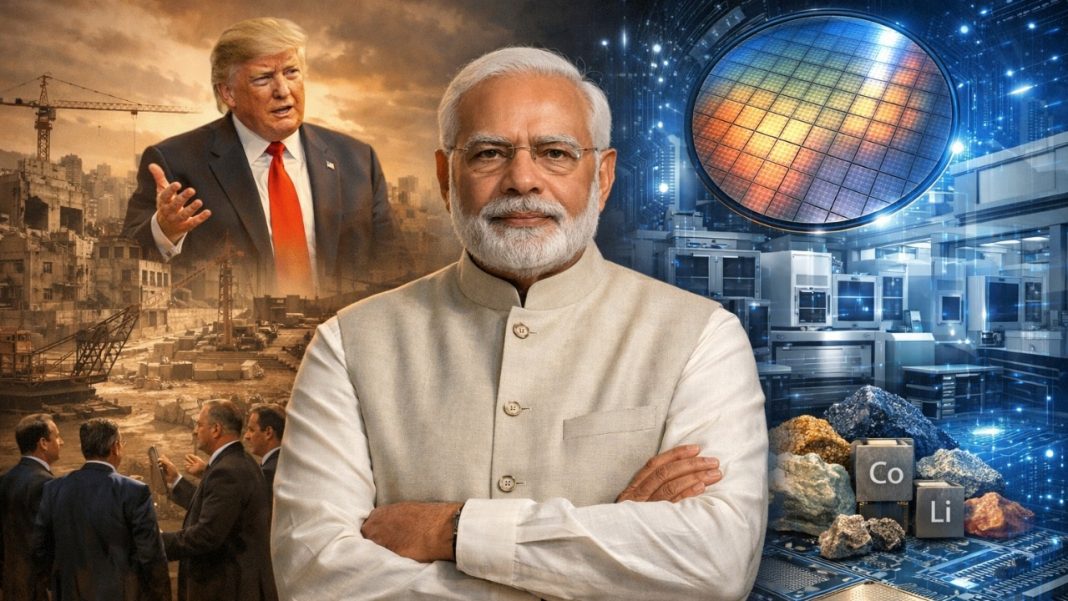
New Delhi has made its most consequential technology commitment in decades. On 20 February 2026, India formally joined Pax Silica at the India AI Impact Summit, signing onto a US-led coalition that aims to secure the entire silicon stack from critical mineral extraction to artificial intelligence deployment. Ministers Ashwini Vaishnaw and US envoy Sergio Gor formalised the agreement, capping years of semiconductor ambition and signalling a decisive shift in how India positions itself within global technology geopolitics.
Pax Silica takes its name from the Latin word for peace and silica, the core mineral refined into silicon. The symbolism is deliberate. Control over silicon, in the view of its architects, equals stability in the AI era. The alliance was launched in December 2025 under US Under Secretary Jacob Helberg as a direct response to COVID-era supply chain failures, China’s export curbs on gallium and rare earths, and the growing recognition that technological dependency had become a national security vulnerability.
The founding membership reads like a who’s who of technology capability. The United States, Australia, Japan, South Korea, the United Kingdom, Singapore, Greece, Israel, the Netherlands, Qatar and the UAE were among the early signatories. Australia brings critical minerals. The Netherlands controls the EUV lithography tools made by ASML, without which advanced chips cannot be manufactured. South Korea and Japan anchor fabrication. India, as the twelfth signatory, brings scale, talent and a population of 1.4 billion generating the data that feeds artificial intelligence.
The alliance rests on four interlocking pillars. The first addresses mining and refining. China currently refines roughly 90 percent of the world’s rare earths, gallium and germanium, materials that feed everything from semiconductors to electric vehicles to defence systems. Pax Silica encourages joint ventures in extraction and processing outside China, with India pursuing mineral acquisitions through KABIL and NCMM in Argentina and Chile. The target is to achieve 50 percent non-China sourcing by 2030.
The second pillar covers semiconductor fabrication. Advanced lithography tools from the Netherlands, ultra-pure chemicals from Japan and co-funded fabrication plants across allied nations form the backbone of this effort. Export controls are harmonised so that sensitive technology does not reach adversaries. For India, this pillar opens access to ASML equipment and Korean fabrication processes, supporting projects at Tata’s Gujarat facility and Micron’s packaging plant in Sanand under the 10 billion dollar India Semiconductor Mission.
The third pillar focuses on compute infrastructure. Artificial intelligence training demands enormous electricity and trusted data centre architecture. India contributes sovereign GPU clusters of more than 34,000 units under its IndiaAI Mission, alongside a vast engineering workforce and datasets drawn from over a billion internet users.
The fourth pillar encompasses AI deployment and advanced manufacturing, covering frontier models, robotics, ethical AI governance and joint research and development. India’s indigenous large language models feed directly into this pillar, reinforcing its ambition to be a producer of AI capability rather than merely a consumer of it.
The strategic implications run deep. India imports approximately 95 percent of its semiconductors today. Membership in Pax Silica creates pathways to reduce that dependency, attract foreign direct investment into fabrication clusters, and position India as a rare earth processing hub. Semiconductor output targets of 100 billion dollars by 2030 are now within the frame of allied support rather than isolated ambition.
Yet challenges are substantial. China will not surrender its dominance quietly. Its state subsidies exceed 150 billion dollars for domestic champions. It is investing in domestic lithography and securing mines across Africa and Latin America. Pax Silica currently lacks binding enforcement mechanisms. India holds zero percent of global rare earth refining capacity today. Scaling that requires capital, power infrastructure and environmental approvals on a significant timeline.
India has not merely attended the silicon age. It has staked a claim within it. The signing ceremony marks the beginning, not the conclusion. Factories must be built, minerals refined, GPUs deployed and standards shaped. Pax Silica offers India a seat at the silicon high table. What India does with that seat will define its technological trajectory for a generation.


