
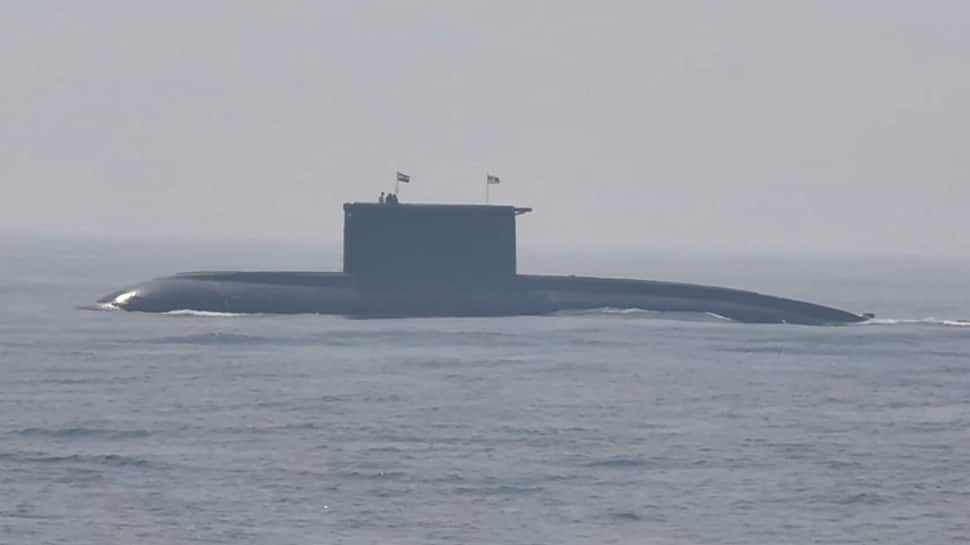
Indian Navy is set to expand its dominance beyond Indian Ocean and Arabian Sea with third nuclear-powered ballistic missile submarine. This might cause a concern within the quarters of India’s enemies. At a time when India faces persistent maritime challenges from Pakistan in the Arabian Sea and an increasingly assertive Chinese presence across the Indian Ocean Region, the Indian Navy is preparing to significantly strengthen its nuclear deterrent, said reports.
While the second Arihant-Class submarine ‘INS Arighaat’ was commissioned into the Indian Navy on August 29, 2024 at Visakhapatnam, India’s third nuclear-powered ballistic missile submarine (SSBN), INS Aridhaman, is expected to enter service in the coming months. The 7,000-tonne submarine will join INS Arihant and INS Arighaat as part of the Arihant-class submarine fleet operated by the Indian Navy and deployed under the Strategic Forces Command, which oversees the country’s nuclear arsenal, said mutliple reports.
A Silent but Potent Deterrent
Unlike conventional submarines, SSBNs are designed for one overriding mission — strategic deterrence. Powered by a nuclear reactor, INS Aridhaman can remain submerged for extended durations, enhancing survivability and secrecy. In the high-stakes environment of modern naval warfare, invisibility is power.
The submarine is capable of carrying:
Up to 8 K-4 submarine-launched ballistic missiles (SLBMs) with a range of approximately 3,500 km, or
Up to 24 K-15 Sagarika missiles with a range of about 750 km.
This flexibility strengthens India’s sea-based nuclear leg of its triad — a critical component of credible minimum deterrence.
Strategic Context
China already operates a fleet of nuclear submarines and continues to expand its footprint in the Indian Ocean through port access arrangements and naval deployments. Pakistan, meanwhile, has been working to bolster its own sea-based deterrent capability.
In this environment, the induction of INS Aridhaman reinforces India’s assured second-strike capability — the guarantee that even after absorbing a first strike, it retains the ability to respond decisively. This capability is considered the bedrock of nuclear deterrence stability.
Only a handful of nations — the United States, Russia, the United Kingdom, France and China — possess operational nuclear missile-armed submarines. With INS Aridhaman, India further consolidates its position in this elite group.
Expanding Undersea Shield
India commissioned INS Arihant in 2016, followed by INS Arighaat in 2024. With Aridhaman set to join the fleet, the underwater deterrent force is steadily maturing. Additional submarines under development are expected to further enhance range, payload capacity and endurance in the years ahead.
In strategic terms, SSBNs rarely make headlines — and that is by design. Their true strength lies in remaining undetected. But their very presence alters the calculus of conflict.
As regional security dynamics grow more complex, the quiet induction of INS Aridhaman signals that India’s nuclear deterrent at sea is becoming deeper, stealthier and far more formidable.


