
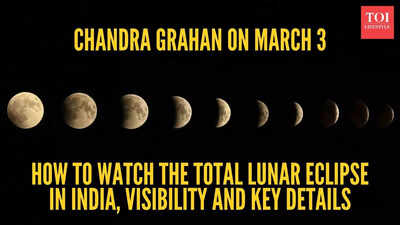
This March, if you enjoy looking up at the sky now and then, there’s something worth marking on your calendar. On March 3, 2026, the first lunar eclipse of the year, also known as Chandra Grahan, will take place. It’s one of those simple sky events that doesn’t require any planning or special gear, just a clear evening and a few free minutes.
Skywatchers in India will be able to catch a glimpse of it, though only the final phase will be visible here. Even if it is for a short time, it is still worth watching.
March 3 lunar eclipse timings in India (IST)
Start of penumbral phase: 4:58 PM IST
Start of totality: 4:58 PM IST
End of totality: 5:32 PM IST
End of penumbral phase: 7:53 PM IST
The most noticeable part will be around sunset, and the visible window will last roughly 20 minutes as the Moon gradually comes out of the Earth’s shadow.
So you won’t need to stay up late. Just step out around dusk and look up.
What happens during a lunar eclipse?
A lunar eclipse occurs when the Earth moves between the Sun and the Moon. As a result, the Earth’s shadow falls on the Moon, making it appear darker. In some cases, the Moon can even look slightly reddish.
While lunar eclipses happen a few times every year, not all of them are visible from India. That is what makes this one a little special.
How to watch it
No special equipment is required. Unlike a solar eclipse, a lunar eclipse is completely safe to view with the naked eye. If the sky is clear, simply step outside and look at the Moon.
Binoculars can enhance the view, but they are not necessary.
Why it matters
Apart from being a visual treat, lunar eclipses are a reminder of how precisely the Sun, Earth, and Moon move in space. For many, they also hold cultural and traditional significance.
The March 3 eclipse may be brief in India, but it is still a good opportunity to pause, look up at the sky, and witness a natural celestial event.
Do not forget to check the weather. Clear skies will make all the difference.


