Key Takeaways
- Indian scientists discovered that weak solar eruptions can explode into major storms if trapped in a “magnetic cage”.
- This finding changes how we predict space weather, shifting focus to the Sun’s magnetic environment.
- Better forecasts are crucial to protect satellites, power grids, and communication systems on Earth.
An Indian research team has uncovered a critical mechanism that turns minor solar eruptions into violent space storms, a breakthrough that could significantly improve space weather forecasting and protect vital technology on Earth.
The Danger of “Magnetic Cages”
Scientists from the Indian Institute of Astrophysics (IIA), Bengaluru, along with collaborators from ARIES, Nainital, and the University of Helsinki, found that even subtle solar eruptions can escalate into full-blown coronal mass ejections (CMEs) when confined by complex magnetic fields. These magnetic structures act as cages, holding back plasma until they rupture.
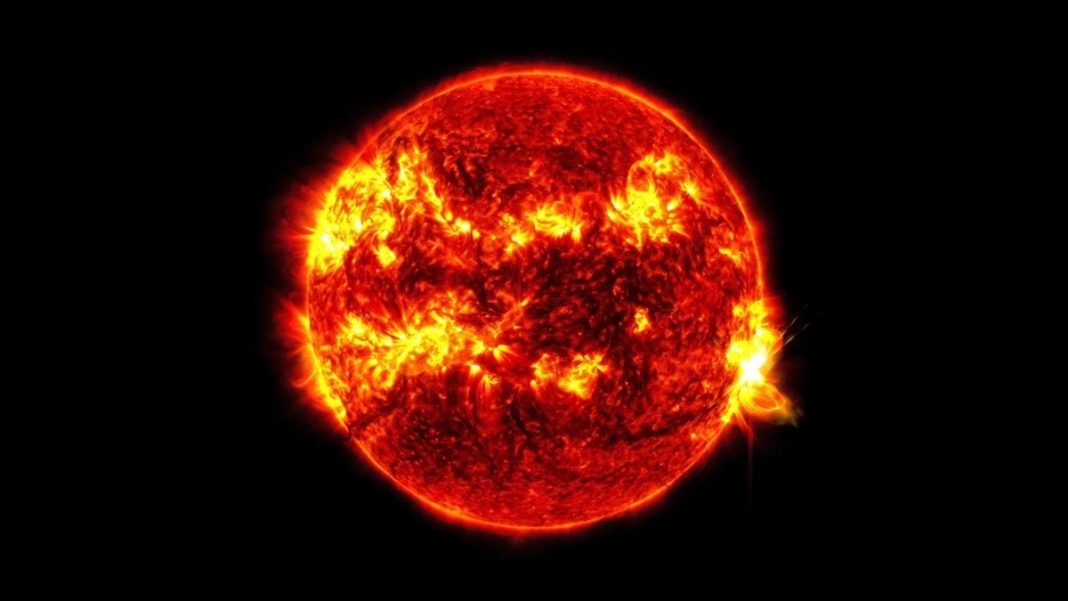
Solar storms are violent bursts of charged particles and magnetic fields from the Sun’s atmosphere. When directed at Earth, they trigger geomagnetic storms that can disrupt satellites, GPS, radio communications, and even cause widespread power outages by overloading grids.
Unlocking the July 2017 Eruption
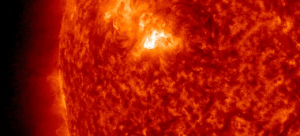
The study, published in Monthly Notices of the Royal Astronomical Society, analyzed a relatively weak eruption from July 20, 2017, observed by NASA’s Solar Dynamics Observatory and other spacecraft. It began as a slow plasma flow but exploded into a fast CME.
“We found that the magnetic field lines form a sort of cage around the erupting plasma. Initially, this cage is strong enough to resist the eruption, so it only leaks out slowly,” said lead author Dr. Ritesh Patel.
“But as the eruption continues, it pushes and stretches these magnetic field lines until the cage distorts and breaks. Once that happens, the plasma is no longer confined and erupts violently outwards as a CME,” Patel added.
A Paradigm Shift in Space Weather Prediction
This discovery suggests current prediction models, which focus on large eruptions, must also account for the magnetic environment around smaller events. The strength and configuration of this “cage” determine the threat level.
“Our study reveals the importance of the magnetic environment in the Sun’s corona in determining whether an eruption will fizzle out or become a space weather hazard. A weak eruption in a complex magnetic field can be just as dangerous as a strong one,” explained co-author Prof. Dipankar Banerjee, Director of ARIES, Nainital.
Implications for a Technology-Dependent World
With society increasingly reliant on satellites and power grids, accurate space weather forecasts are vital. This Indian-led research provides a crucial new piece in understanding solar storm triggers, paving the way for more reliable early warnings to safeguard critical infrastructure.