
Key Takeaways
- Eight scientists sealed themselves inside a 3.14-acre artificial Earth, Biosphere 2, for two years in the 1990s.
- The mission faced critical crises: oxygen depletion, food shortages, and severe psychological stress.
- Despite not achieving full self-sufficiency, the experiment yielded crucial data for future space colonization.
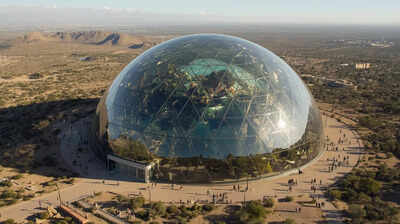
In September 1993, eight scientists emerged from a two-year isolation experiment after surviving oxygen starvation, food crises, and internal conflict. This was the dramatic conclusion of Biosphere 2, a bold attempt to build a sealed, self-sustaining replica of Earth’s ecosystems in the Arizona desert.
The Sealed World of Biosphere 2
The 3.14-acre complex was a technological marvel, completely sealed from the outside world. It housed miniature versions of Earth’s key biomes:
- A rainforest
- An ocean with a coral reef
- A mangrove wetland
- A savanna grassland
- A fog desert
The goal was a closed-loop system where air, water, and food were entirely recycled by the internal ecosystems and the crew’s farming.
Crisis in the Closed Ecosystem
The “biospherians” encountered severe, unanticipated problems within months.
Oxygen Emergency
Oxygen levels plummeted mysteriously to those found at 13,400 feet altitude. The crew suffered chronic fatigue and sleep apnea. Scientists later found oxygen was being absorbed by the structure’s concrete and consumed by soil microbes.
Battle for Food
Food production was a constant struggle. The crew survived on a sparse, mostly vegetarian diet they grew, losing significant weight. Pests like crazy ants and cockroaches thrived. Morning glory vines overran the savanna, and the ocean turned too acidic, killing corals.
The Psychological Toll
Confinement under pressure and global scrutiny fractured the group. Factions formed, arguments erupted over management, and the mission split into two camps that reportedly stopped speaking. The isolation and survival struggle took a heavy mental toll.
Legacy of a Chaotic Experiment
Despite the hardships, the crew completed their mission. While not fully self-sufficient—oxygen had to be pumped in—Biosphere 2 was far from a failure.
It generated an unprecedented dataset on closed ecological systems, plant-animal interactions, and mini-biosphere management. The experiment starkly highlighted the complexity and fragility of our own planet, Biosphere 1.
The lessons on resource recycling, atmospheric management, and group dynamics in isolation now directly inform plans for long-term Moon and Mars missions. Biosphere 2 remains a bold, chaotic, and invaluable chapter in the quest to live beyond Earth.


