
24.1 C
Delhi
Monday, December 1, 2025

Antarctica’s Ocean May ‘Burp’ Heat, Delaying Climate Recovery by Centuries

Antarctica’s Ocean May ‘Burp’ Stored Heat, Delaying Climate Recovery

New research warns the Southern Ocean could abruptly release vast amounts of stored heat centuries after emissions are cut, causing a sudden warming pulse that could last over a hundred years.

Key Takeaways:

  • The Southern Ocean has absorbed over 90% of Earth’s excess heat and a quarter of human CO2.
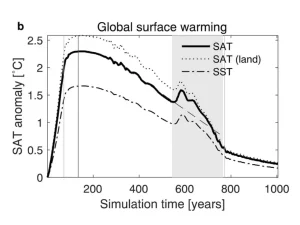
  • Climate models suggest this heat could be released in a sudden ‘burp’ long after global cooling begins.
  • The warming pulse would be strongest in the Southern Hemisphere and comparable to current human-driven rates.
  • Scientists stress this underscores the urgency of cutting emissions now, not relying on future carbon removal.
The ‘burp’ is marked by gray shading Photograph: (AGU Advances)

How the Oceanic ‘Burp’ Works

The mechanism hinges on the ocean’s layered structure. As reported by Phys.org, surface water becomes colder and saltier as Antarctic sea ice forms, making it denser. Meanwhile, warm water remains trapped deep below.

Over centuries, this imbalance can destabilise the entire water column. “At some point, the water column becomes unstable, and that’s when we have the deep convection event,” explained Svenja Frey of the GEOMAR Helmholtz Centre. This event would allow the buried heat to rise rapidly to the surface.

The resulting warming would primarily be a thermal event, not a chemical one, though some CO2 might also be released.

Implications for Climate Policy

While this ‘burp’ scenario is a projection, not a certainty, it reveals potential long-term climate surprises. Climate researcher Kirsten Zickfeld notes Earth’s response to net-negative emissions is still poorly understood.

Crucially, the overall model still shows global temperatures falling due to carbon removal. “To be clear, in this scenario, removing atmospheric carbon significantly reduces global temperatures, even factoring in the burp,” a Live Science report states. “And the faster we move away from fossil fuels, the less CO2 we’ll have to remove down the line.”

Professor Ric Williams of the University of Liverpool adds a stark warning: “Rather than do negative emissions, it’s better not to do the positive emissions in the first place.” This finding reinforces that immediate, deep emission cuts are the most reliable climate strategy.

Latest

Thailand Accelerates Net-Zero Target to 2050, Overhauls Energy Policy

Thailand brings net-zero target forward by 15 years, requiring major energy transformation including renewable scale-up and nuclear power adoption.

Delhi Air Quality Improves Slightly But Stays Poor; Protests Planned

Delhi's AQI drops to 268 after 24 days of hazardous air, but several areas remain 'very poor' as citizens plan December 3 protest for clean air.

Scientists Urge India to Reject ‘Unjust’ Plant Genetic Treaty Proposal

Indian scientists warn against compromise deal at Peru meeting that favors agribusiness corporations over farmers' rights and genetic resource control.

India’s First Coral Reef Research Centre Approved for Andaman Islands

India will establish its first National Coral Reef Research Institute in Andaman with ₹120 crore investment to protect coastal ecosystems and marine biodiversity.

Cyclone Ditwah: Red Alert in Tamil Nadu, Landfall Expected Tomorrow

IMD issues red alert as Cyclone Ditwah approaches Tamil Nadu coast with heavy rainfall, 90 kmph winds, and significant damage risk to crops and property.

Topics

Rupee Hits Record Low, Nears ₹90 Amid Trade Deficit & RBI Hold

Indian rupee plunges to historic low as trade deficit, FPI outflows, and RBI non-intervention push it toward ₹90. Key levels and market outlook explained.

India Mandates Preloaded Cyber Safety App on All New Smartphones

Smartphone makers must preinstall India's undeletable Sanchar Saathi app in 90 days, a move challenging Apple's policies and aiming to curb phone theft.

Sitharaman Tables Two Bills for Tobacco Cess in Lok Sabha

Finance Minister introduces bills to levy a cess on tobacco to fund national security and public health, facing opposition over health warnings and citizen burden.

Sensex, Nifty Hit Record Highs as GDP Growth Boosts Markets

Indian stock markets surge to fresh lifetime highs after strong 8.2% GDP growth. Get the latest on top gainers, expert analysis, and market drivers.

HSBC Partners with Mistral AI to Supercharge Banking with Generative AI

HSBC signs multi-year deal with Mistral AI to deploy generative AI tools for automation, productivity gains, and enhanced client services across global operations.

RBI MPC Meeting: Will RBI Cut Rates or Hold on December 5?

RBI to announce monetary policy decision Friday. Experts split between rate cut and status quo amid strong 8.2% GDP growth and low 0.25% inflation.

India Mandates Undeletable Govt Security App on All New Smartphones

Smartphone makers have 90 days to pre-install India's Sanchar Saathi app. Users cannot delete it, raising privacy and compliance concerns, especially for Apple.

Govt Plans Mega PSB Merger to Trim State Banks to 4 by FY27

India plans to consolidate 12 public sector banks into 4 large entities by FY27 to boost lending capacity and global competitiveness. SBI, PNB, BoB, and a merged Canara-Union Bank will be the anchors.
spot_img

Related Articles

Popular Categories

spot_imgspot_img

