
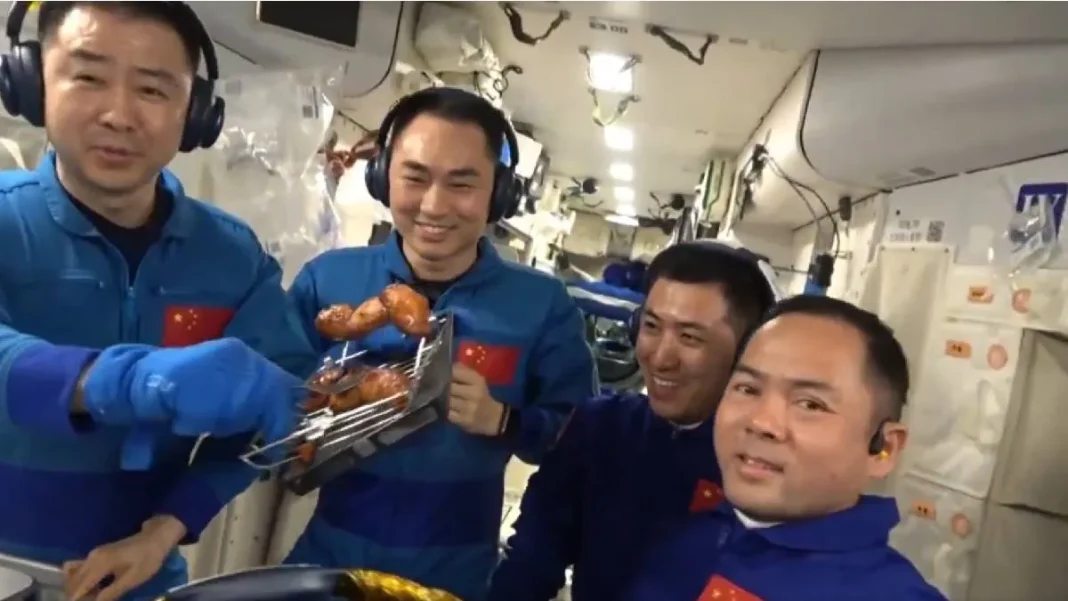
China’s Space Station Crew Cooks First Full Meal in Orbit
In a major advancement for long-duration space missions, Chinese astronauts aboard the Tiangong space station have successfully cooked a complete meal using a specialized hot air oven. This marks a significant step beyond simply reheating pre-packaged food in microgravity.
Key Takeaways
- Chinese astronauts cooked chicken wings and black pepper steak on the Tiangong station.
- A new smoke-free oven using high-temperature catalysis enabled the cooking.
- The oven reaches 190°C, allowing proper baking and roasting in space.
- The Shenzhou-20 crew’s return to Earth was delayed due to suspected space debris impact.
The Historic Space Kitchen
The six crew members from the Shenzhou-20 and Shenzhou-21 missions prepared marinated chicken wings and black pepper steak using the newly delivered equipment. The chicken wings were baked for 28 minutes in the innovative oven.
Advanced Smoke-Free Oven Technology
The specialized oven utilizes high-temperature catalysis and multi-layer filtration systems to ensure smoke-free operation that complies with the space station’s strict emission standards. According to Chinese state media reports, the oven operates without stressing Tiangong’s power grid and can function for up to 500 cycles.
The increased maximum temperature of 190°C—nearly double the previous limit—enables proper roasting and baking capabilities rather than just warming pre-packaged meals.
Previous Space Baking Milestones
Before China’s achievement, the International Space Station pioneered space baking in 2020 when astronauts used a special oven from NanoRacks and Zero G Kitchen to bake five chocolate chip cookies—the first food ever baked in orbit. Three of these cookies were returned to Earth for analysis via a SpaceX Dragon spacecraft.
Crew Transition and Return Delay
The astronauts conducted a formal handover ceremony on Tuesday, transferring the space station key to the incoming Shenzhou-21 crew. However, the planned return of the Shenzhou-20 crew faced postponement on Wednesday after the China Manned Space Agency reported a suspected impact from small space debris on their spacecraft.


