
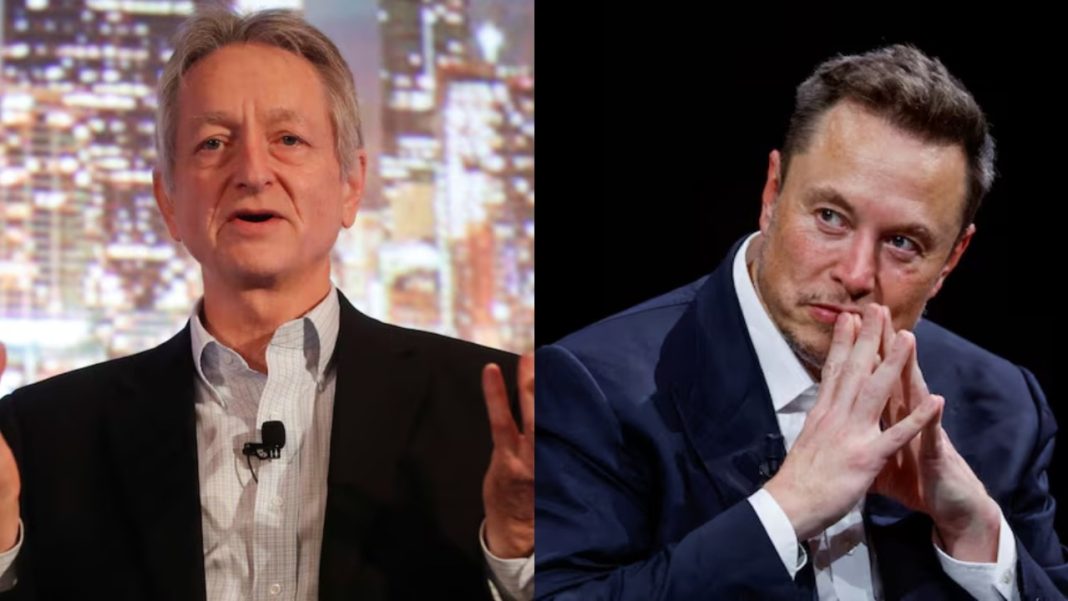
AI Godfather Geoffrey Hinton Predicts Mass Job Losses, Elon Musk’s Wealth Surge
Nobel Laureate Geoffrey Hinton, the ‘Godfather of AI,’ has issued a stark warning: the relentless development of artificial intelligence will likely make billionaires like Elon Musk significantly richer while leading to millions of job losses across industries.
Key Takeaways
- AI pioneer Geoffrey Hinton predicts massive job replacement by AI is inevitable.
- Tech giants are projected to spend over $420 billion on AI, accelerating this trend.
- Hinton clarifies the issue is a societal and economic problem, not a technological one.
- Despite the risks, Hinton acknowledges AI’s potential for tremendous good and increased productivity.
The Inevitability of Job Replacement
The tech industry has already seen major layoffs at companies like Amazon, Google, IBM, and TCS attributed to AI. Hinton believes this trend is just beginning. On Bloomberg’s Wall Street Week, he stated, “I think the big companies are betting on it causing massive job replacement by AI, because that’s where the big money is going to be.”
This bet is backed by massive investment. Microsoft, Amazon, Alphabet, and Meta are expected to spend a combined $420 billion in capital expenditure next year, with a large portion focused on AI.
When asked if progress was possible without sacrificing jobs, Hinton was unequivocal: “I believe that it can’t. I believe that to make money, you’re going to have to replace human labour.”
A Societal Problem, Not an AI Problem
Hinton specifically pointed to figures like Elon Musk as potential winners in this new economy. “People like Musk will get richer, while many others lose their jobs — and he won’t care,” he said, adding, “This isn’t an AI problem; it’s a societal problem.”
He elaborated that tech billionaires may emerge as the sole beneficiaries while the majority face replacement. “Musk will get richer and a lot of people get unemployed and Musk won’t care. I’m using Musk as a sort of stand-in. Um, that’s not on AI, that’s on how we organise society.”
Hinton consistently asserts that the core issue lies not with the technology itself but with our systems. “The problem is not ultimately due to AI itself. It’s due to how we structure our society and our economy.”
The Dual-Edged Nature of AI
Despite these warnings, Geoffrey Hinton does not advocate for halting AI development. He acknowledges its profound potential for good, explaining, “It’s a difficult decision because it can do tremendous good too and in fact, if you think about it, increasing productivity in many, many industries that should be good.”


