
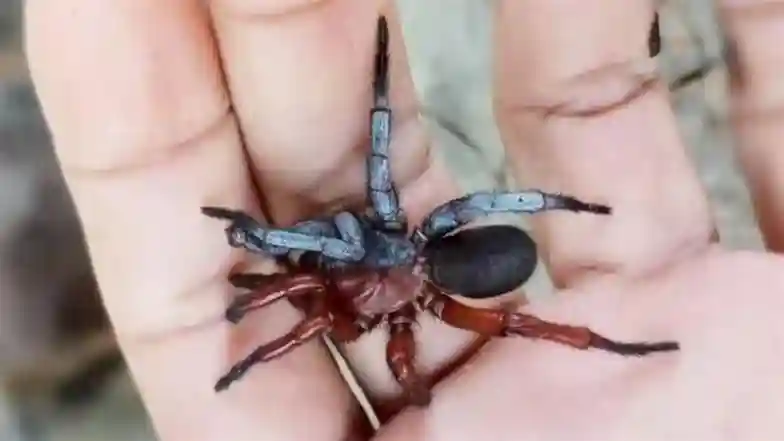
Bangkok, October 9: In a rare and remarkable discovery, a team of scientists in Thailand has identified a new species of burrowing spider that displays an extraordinary biological condition known as bilateral gynandromorphism, where one half of the body is male and the other half is female. The spider, belonging to the genus Damarchus (commonly known as “wishbone spiders”), was discovered in the forests of Kanchanaburi province, near the Myanmar border.
This newly identified species, named Damarchus inazuma, marks the first recorded instance of gynandromorphism in a member of the Bemmeridae family. The discovery offers new insights into arachnid biology and sheds light on one of nature’s rarest dual-sex conditions. Researchers say that such occurrences provide valuable clues about sex differentiation, genetic mutations, and the evolutionary development of spiders. US Professor Calls Study About Sex With Animals ‘Thought Provoking’, Encourages People to Read It; Sparks Outrage.
Discovery and Identification
Local researchers first encountered the spiders near a forest roadway in Kanchanaburi. Using careful excavation techniques, they collected specimens from underground silk-lined burrows, which are characteristic of “wishbone spiders.” During examination, one specimen stood out—it was female on its left side and male on its right. This unusual morphology led scientists at the Chulalongkorn University Museum of Natural History to collaborate on a detailed study. Dolphin Sex Scandal: When Animal Rights Activist Alan Cooper Was Accused of Sexually Assaulting Dolphin Named Freddie.
Further analysis confirmed that this individual was not only a true bilateral gynandromorph but also represented a species new to science. Researchers compared physical traits, including leg structure, coloration, and body size, to previously catalogued Damarchus species before officially classifying it as Damarchus inazuma.
Physical Features and Behaviour
Male specimens of Damarchus inazuma measure roughly 0.6 inches in body length and exhibit pale grey tones, while females are larger—about 1 inch long—and display deep orange and charcoal coloration. The gynandromorphic spider showed a perfect split appearance, with distinct male and female traits mirrored across its body.
The spider builds a “wishbone-shaped” burrow, using silk to line the tunnels from which it ambushes prey. Though no dedicated venom study has yet been conducted, related species in the same superfamily possess venom glands used for subduing insects and small invertebrates. Field observations noted aggressive defensive behaviour, such as fang-baring and droplet secretion, suggesting that D. inazuma is venomous to small prey but poses little threat to humans.
Scientific Significance
Bilateral gynandromorphism is an exceptionally rare phenomenon resulting from developmental anomalies in the early cell division stages, often influenced by chromosomal disruptions or environmental factors. Unlike hermaphrodites, gynandromorphs do not have both reproductive systems; instead, their bodies exhibit distinct male and female halves.
The discovery of Damarchus inazuma not only expands scientific understanding of arachnid diversity and evolution but also underscores the unexplored biodiversity of Southeast Asia’s forests. While the dual-sex specimen is likely sterile, it provides an unparalleled opportunity for research into genetics, embryology, and sex differentiation mechanisms in spiders. Scientists hope further study will reveal more about the species’ ecological role and evolutionary adaptations.


