
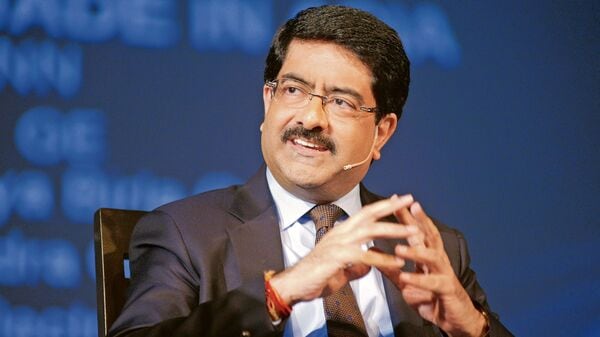
Vodafone Idea on Tuesday appointed Kumar Mangalam Birla as its non-executive chairman, the company said in an exchange filing. Birla, who returns as non-executive chairman of the company after five years, will replace Ravinder Takkar.
Takkar, who held the position of the company’s non-executive chairman since August 2022, has now been appointed non-executive vice chairman.
The change at the helm of the company comes immediately after the government reduced the adjusted gross revenue (AGR) dues of the telecom operator by ₹23,600 crore to ₹64,046 crore as of December-end, with a bulk of the instalments falling due from FY36 to FY41.
The AGR clarity, along with the reappointment of Birla as its chairman, could provide a measure of certainty that could help the company unlock critical bank financing. AGR is the revenue base used to calculate licence fees that the telecom operators need to pay the government.
To be sure, Birla stepped down as non-executive chairman and director of Vodafone Idea in August 2021. This was after the Supreme Court in 2019 did not allow any recalculation of AGR dues, which pushed the cash strapped Vodafone Idea into a severe financial crisis.
“If we are not getting anything, then I think it is the end of the story for Vodafone Idea,” Birla had said at an Hindustan Times event in 2019. On further investments at that time, Birla had said “It does not make sense to put good money after bad. That would be the end of the story for us. We will shut shop,” he had said.
Later, the government in 2021 provided a four-year moratorium on the payment of statutory dues to the telecom operators, with an option to convert interest on the dues into equity.
To restore investor confidence, in April 2023, Birla again rejoined the board of Vodafone Idea as a non-independent and non-executive additional director. He is currently part of the company’s board as a non-executive director.
Birla’s return to the board then also helped the company raise ₹18,000 crore via follow-on public offer (FPO) in 2024.
As of December end, Aditya Birla Group held 9.5% equity in Vodafone Idea, while the UK-based Vodafone Group held 16.07% of the company. The government is the single largest shareholder with 49% shareholding in the company, according to the company’s December quarter report.
Last week, the telecom department finalised the revised AGR figure after a reassessment ordered by the Supreme Court last year. Under the revised payment schedule, Vodafone Idea will pay just ₹100 crore annually from FY32 to FY35, before six larger instalments of ₹10,608 crore each kick in from FY36 to FY41, deferring the bulk of its payments by 10 years.
In addition, the telecom company’s total outgo towards AGR payments over the next six years, from March 2026 to March 2031, would be ₹744 crore, a maximum of ₹124 crore per year. These are FY18 and FY19 dues that were not part of the reassessment.
Analysts said the AGR relief may help Vodafone Idea stay afloat in the near term, but it does little to address the company’s larger debt burden of ₹1.25 trillion related to its spectrum dues.
In a note dated 3 May, analysts at brokerage house BofA Securities said the AGR risk becomes a non-issue in the near-term for the company.
“However, the spectrum debt continues to be an issue for VIL (Vodafone Idea Limited)…Despite the relief we maintain Underperform rating,” BofA said, adding that the company would need a huge capital infusion of $6-8 billion to support network rollout, close gaps on 4G, roll out 5G etc. Such a large equity infusion implies massive dilution risks as well, it said.


