
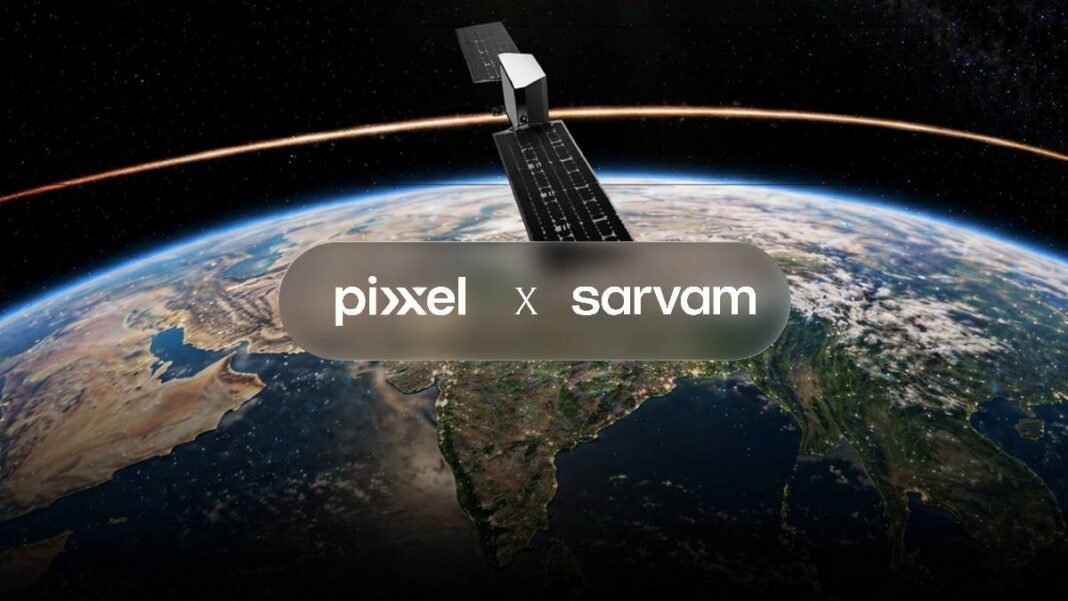
Homegrown AI company Sarvam has partnered with Pixxel for India’s first orbital data centre. This has come at a time when AI companies are looking to the sky to scale their AI technologies. While AI companies around the world want to tap space for their AI systems, all are taking different approaches. Meta recently announced partnerships to beam sunlight directly from space to Earth to power its data centres for AI even during the night, while Google has launched Project Suncatcher to develop solar-powered, AI-driven data centres in space. India’s Sarvam is taking another approach.
Under its partnership with Pixxel, Sarvam will send satellites to space that will act as orbital data centres. The AI company will use these satellites to train and run its India-built AI models, which will analyse Pixxel’s highly detailed images of Earth taken from space in real time.
Real-time analysis from space
By deploying this approach, Sarvam will help Pixxel with instant analysis of satellite imagery, which typically takes hours when the data is beamed to Earth and processed by ground systems. This system could help flag a wildfire, track a crop disease, or monitor a pipeline leak in real time as a satellite passes over them.
This approach will reduce India’s dependence on foreign cloud or ground infrastructure and will create a channel from observation to insight that will be fully under India’s control.
“Both training and inference happen directly in orbit, without any dependence on foreign cloud or ground infrastructure, creating a fully sovereign pipeline from observation to insight, end to end,” Sarvam wrote in a blog post.
Hardware and capabilities in orbit
To accomplish this, Sarvam has planned a 200 kg-class satellite that will carry datacentre-class GPUs in orbit. It will be of the same generation of hardware that powers frontier AI training and inference on the ground.
“Partnering with Pixxel allows us to extend that stack beyond terrestrial infrastructure and into orbit. Having India-built models running in orbit aboard an India-built satellite is exactly the kind of foundational capability the country needs to control its own intelligence infrastructure,” Sarvam wrote.
Challenges and timeline ahead
However, both Pixxel and Sarvam have a long way to go. Sarvam expects the satellite to reach orbit as early as the fourth quarter of 2026. After the satellite is placed, the company will have to demonstrate real-time AI inference—making predictions, decisions, and generating outputs from new, unseen data—and data processing in the harsh space environment.
There are other challenges as well, including testing performance, power management, thermal constraints, and real-time data workflows under operational conditions.


