
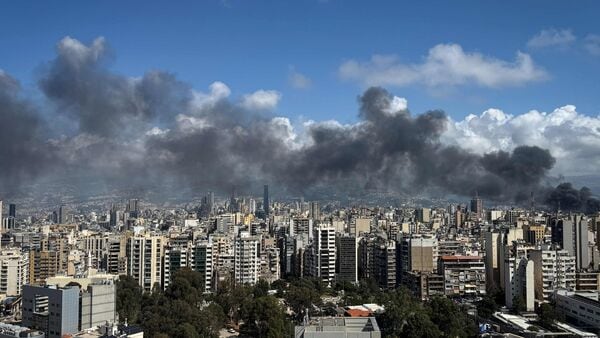
At least three Indians were reported injured on Monday (local time)after Iranian drones attacked the Fujairah petroleum site in the United Arab Emirates (UAE), Al Jazeera reported.
According to Fujairah Media Office, all three injured have been taken to the hospital, and their injuries were reported as “moderate.”
Fujairah’s Media Office said that a “large fire broke out” at the petroleum industrial site. This follows after the UAE’s Defence Ministry said that four missiles were launched from Tehran.
UAE issues missile alert
A missile alert was sounded in the United Arab Emirates (UAE) on Monday (local time) for the first time since the US and Iran agreed to a ceasefire on April 7
Authorities urged residents to immediately seek shelter. The alert was issued shortly after the United States military announced that two merchant ships had transited the Strait of Hormuz.
Earlier today, the UAE residents received a missile alert: “Due to the current situation, potential missile threats, immediately seek a safe place in the closest secure building, steer away from windows, doors, and open areas. Await further instructions.”
There were no immediate reports of casualties or damage, and an all-clear signal was later sent.
UAE bears the brunt of the US-Iran war
According to a Bloomberg report, the alert came hours after an oil tanker owned by the UAE’s state oil company, Abu Dhabi National Oil Co (ADNOC), was struck by Iranian drones in a separate incident outside the Strait of Hormuz, through which about a fifth of the world’s oil and liquefied natural gas (LNG) transited before the war commenced in late February. However, it remains unclear if the warning was triggered by projectiles aimed at the UAE or related to escalation in the Strait.
The attack on ADNOC comes after US President Donald Trump, on May 3, announced his plan to restore transit via the arterial waterway and help stranded vessels exit the Persian Gulf. The operation, which was set to begin Monday, with the US military pledging support, including guided-missile destroyers, aircraft, and drones. Two US-flagged merchant ships have so far transited the strait, the US military said, while Iran said it would attack US forces if they enter Hormuz.
Tensions continue to remain high in the blockaded Strait of Hormuz, which separates Iran from the UAE and Oman.
The Islamic Republic has fired more than 2,800 drones and missiles at the UAE since February 28 until the ceasefire on April 8, making it the most targeted country by Tehran’s retaliatory strikes.
Trump’s ‘Project Freedom’
While announcing his plans to guide stranded ships out of the Persian Gulf, known as Project Freedom, the US President said some of the vessels were running out of food, and added that several countries have asked the US for help in freeing up their ships.
In a Truth Social post, he wrote, “The Ship movement is merely meant to free up people, companies, and Countries that have done absolutely nothing wrong — They are victims of circumstance.” He added, “If, in any way, this Humanitarian process is interfered with, that interference will, unfortunately, have to be dealt with forcefully.”
However, Trump’s plan has left shipping executives perplexed, given that he has provided little to no details.
According to the Joint Maritime Information Center (JMIC), an “enhanced security” area has been established by Washington to support transits. Trump’s announcement came amid an impasse between Tehran and Washington. A shaky ceasefire has been in place since April 7, with the sides struggling to agree on peace talks. Trump, in the same Truth Social post, talked of ongoing discussions with Iranian authorities that “could lead to something very positive for all.”
- The US has initiated Project Freedom to aid stranded ships in the Persian Gulf amidst rising tensions.
- A missile alert in the UAE underscores the fragility of the current ceasefire between the US and Iran.
- Recent drone attacks highlight the ongoing threat posed by Iran in the region, raising concerns over security and humanitarian efforts.


