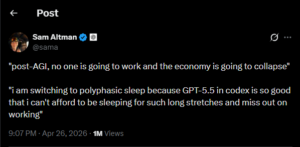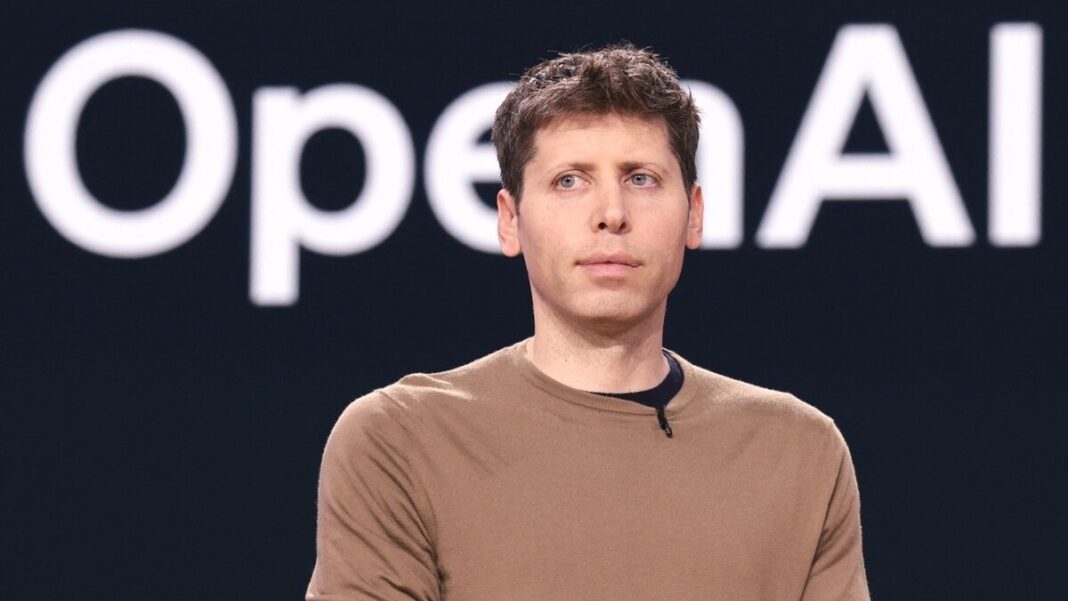
Sam Altman, in a fresh post on X, has revealed that he is “switching to polyphasic sleep” — a schedule involving multiple short sleep cycles. He said he has changed his sleep schedule due to the recently released GPT-5.5 model in Codex, which, as per Altman, “is so good that I can’t afford to be sleeping for such long stretches and miss out on working.” The remark highlights an unexpected outcome of rapid AI progress: instead of reducing work, it may actually be increasing the urgency to do more. Altman’s post has arrived at a time when there is a growing debate around the future of work and artificial intelligence.
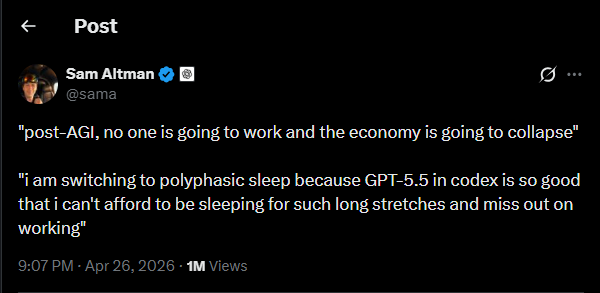
“I am switching to polyphasic sleep because GPT-5.5 in Codex is so good that I can’t afford to be sleeping for such long stretches and miss out on working,” Altman wrote in his X post.
OpenAI released GPT-5.5 in Codex, which is designed to assist developers by generating, debugging, and optimising code. As these tools improve, they are enabling faster iteration cycles, potentially raising the bar for output rather than lowering the demand for workers.
Altman’s remark is aimed at contradicting the idea that widespread automation could reduce the need for human work, a topic that has long been debated in tech and economic circles.
‘Post-AGI’ fears vs present reality
In the post, he also speculated about a “post-AGI” world, where no one might work and the economy could collapse. However, his latest remark signals that such scenarios remain far from current reality.
“Post-AGI, no one is going to work and the economy is going to collapse,” Altman wrote.
He suggested that, rather than replacing human effort entirely, advanced AI tools may actually be increasing the pace and volume of work — at least for those building and using them. By joking about cutting down sleep to keep up, Altman signals that AI is currently acting more as a productivity amplifier than a job eliminator.
OpenAI tests Codex at scale with NVIDIA
Meanwhile, after the launch of GPT-5.5, OpenAI has also experimented with Codex by rolling it out on NVIDIA infrastructure.
“We tried a new thing with NVIDIA to roll out Codex across a whole company, and it was awesome to see it work,” Sam Altman wrote in an X post.
NVIDIA, in a blog post, said that its engineers have had access to GPT-5.5 through the Codex app for a few weeks, and the gains are measurable. Codex, based on GPT-5.5, is running on NVIDIA GB200 NVL72 rack-scale systems.