
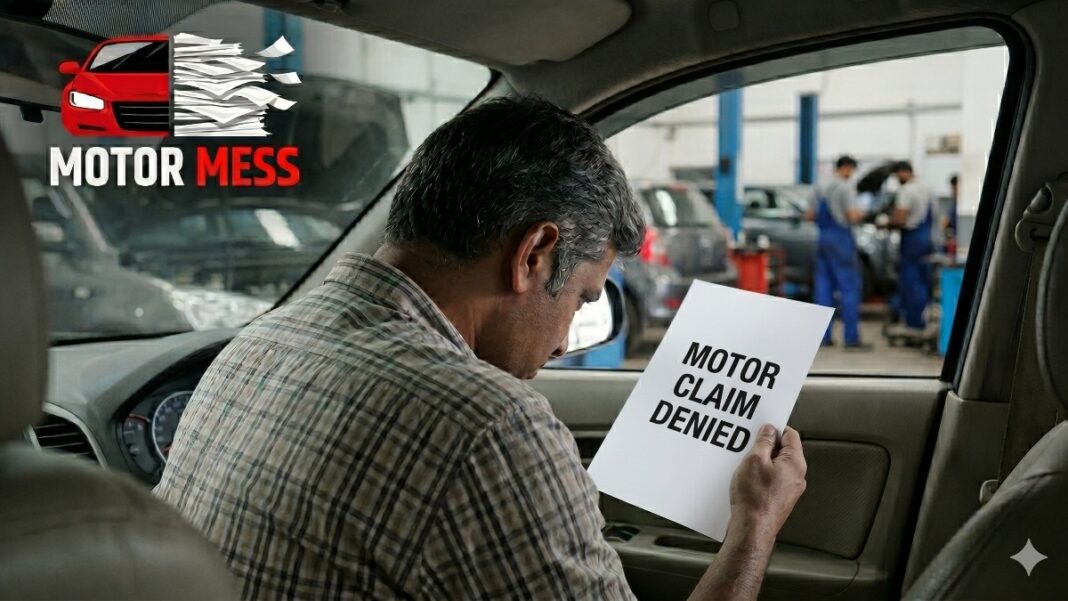
Buying motor insurance today feels simple. A few clicks, a quick payment, and the policy lands in your inbox.
But what looks like a straightforward purchase often hides a more complicated reality, one where coverage is quietly reduced, details are not fully explained, and customers end up with policies that do not match what they think they bought.
This is the third story in our Motor Mess series, which looks at the hidden gaps, fine print, and real-world risks in motor insurance that most vehicle owners only discover when something goes wrong.
Motor insurance mis-selling is not a one-off problem. It is built into how the system works.
“Motor insurance mis-selling in India is a structural problem, not an occasional one,” said Saurabh Vijayvergia, Founder and CEO of CoverSure.
“The incentives of everyone in the distribution chain, dealer, agent, broker, point away from the customer’s interest, and the customer rarely has enough information to push back.”
What this means is simple. The system rewards selling — not necessarily selling the right policy.
HOW MOTOR INSURANCE MIS-SELLING HAPPENS
The tactics are not random. They follow a pattern, one that benefits the seller upfront, while the cost becomes visible only later.
THE “COMPREHENSIVE” ILLUSION
One of the most common forms of mis-selling is selling the wrong type of policy altogether.
“Customers are sold third-party-only policies while believing they have comprehensive cover,” Vijayvergia said.
The word “comprehensive” itself creates confusion.
“It implies totality. It delivers considerably less,” he explained.
A standard comprehensive policy does not cover everything.
“What it does not cover is a long list of exclusions — engine damage due to water ingression, electrical and mechanical breakdown, consumables, and consequential loss,” he said.
But most buyers never hear this at the time of purchase.
PRICE MANIPULATION THAT LOOKS LIKE A GOOD DEAL
Motor insurance pricing can be adjusted in ways that look beneficial upfront.
“IDV is quietly lowered to make the premium look attractive, with no disclosure of what that means at claim time,” Vijayvergia said.
Lower IDV reduces the premium slightly, but it also reduces the claim payout significantly in case of total loss.
“Lowering the IDV can cut claim payouts by 50,000 or more,” he said.
Another common tactic is deductibles.
“Customers who accept high voluntary deductibles in exchange for a lower premium are effectively bearing a significant out-of-pocket cost on every future claim without realising it,” he said.
ADD-ONS: PUSHED, HIDDEN OR MISUNDERSTOOD
Add-ons are another major area where mis-selling happens.
“Add-ons are bundled in without explanation, inflating premiums without adding meaningful value,” Vijayvergia said.
At the same time, important add-ons may not even be discussed.
“A customer who doesn’t understand what engine protection or return-to-invoice means cannot evaluate whether they need it,” he said.
The result is either overpaying for unnecessary add-ons or missing critical ones.
THE CASHLESS PROMISE THAT DOESN’T HOLD
Many buyers are told they will get seamless cashless service.
“Cashless claims are promised broadly at the point of sale, with network limitations and approval conditions left unmentioned,” Vijayvergia said.
At claim time, this can fall apart.
“The customer arrives at a garage expecting cashless service, only to find the garage is not on the insurer’s network,” he said.
FORCED BUNDLING AND DEALER PRESSURE
One of the most visible forms of mis-selling happens at dealerships.
“Insurance is packaged into the on-road price, presented as non-negotiable, and signed alongside delivery documents the customer has no time to read,” Vijayvergia said.
In some cases, it goes further.
“Some providers have conditioned vehicle sales on the purchase of insurance from affiliated intermediaries,” he said.
This directly violates the customer’s right to choose — a right many are not aware of.
MIS-SELLING ONLINE IS REAL TOO
It is not just dealerships.
“Dealerships are the most visible offenders, but limiting the conversation to them lets every other channel off too lightly,” Vijayvergia said.
Online platforms also influence decisions.
“Aggregator platforms have introduced pre-ticked add-ons, non-equivalent IDV comparisons, and ‘recommended’ options that maximise revenue rather than coverage quality,” he said.
Even social media plays a role.
“Influencers often exaggerate the value of products or provide incorrect information, with little accountability,” he added.
WHAT IS NOT TOLD IS WHAT MATTERS MOST
The biggest issue is not what is said, but what is not.
“Non-disclosure is where mis-selling does its quietest and most lasting damage,” Vijayvergia said.
Exclusions are rarely explained.
“Engine damage due to water ingression is a standard exclusion. Most customers never hear this,” he said.
Depreciation is another shock.
“At claim time, customers may bear 30–50% of parts cost,” he said.
Even basic rights go unmentioned.
“The free-look period — the right to review and return the policy within 15 days — is almost never mentioned,” he said.
THE NCB GAP
The No Claim Bonus is one of the most valuable benefits — and one of the most ignored.
“NCB belongs to the policyholder, not the vehicle,” Vijayvergia said.
If not transferred, it simply lapses.
“Customers end up paying a premium they had already earned the right to discount,” he explained.
RENEWAL: THE MOST MISSED RISK
Mis-selling does not stop after purchase.
“Renewal is the most underestimated moment of risk,” Vijayvergia said.
Add-ons may disappear quietly.
“Customers renew a materially inferior policy at a slightly lower premium and consider it a good decision,” he said.
NCB can also be lost.
“If renewal is delayed beyond 90 days, the accumulated NCB resets to zero,” he said.
THE COST OF MIS-SELLING SHOWS UP AT CLAIM TIME
The impact becomes clear only when a claim is filed.
“The most common outcome is partial settlement,” Vijayvergia said.
Customers expect full reimbursement but receive much less.
“The customer experiences this as betrayal. It is often the product of mis-selling at the point of sale,” he said.
Outright rejection is another outcome.
“Water damage, undeclared modifications, or exclusions customers didn’t know about can lead to claim rejection,” he said.
THE DATA POINTS TO A BIGGER PROBLEM
The scale of the issue is significant.
“Motor insurance complaints accounted for over 26% of total insurance complaints in FY 2023–24,” Vijayvergia said.
The Insurance Ombudsman received over 10,000 complaints in recent years.
And complaints are rising.
“Insurance complaints rose 45% in a single quarter in 2025,” he said.
Behind this is a large and growing market.
“The motor insurance market is expected to grow from USD 9.37 billion in 2025 to USD 10.23 billion in 2026,” he added.
WHY MIS-SELLING CONTINUES
The answer lies in incentives.
“Commissions on new private car insurance policies ranged from 25% to 57%,” Vijayvergia said.
This creates a system where the policy that pays more is prioritised.
“It persists because the system rewards the seller, not the buyer,” he said.
WHAT YOU CAN DO TO AVOID BEING MIS-SOLD
While the system may be flawed, customers can still take steps to protect themselves.
“Start with IDV. Verify it reflects your car’s actual market value,” Vijayvergia said.
“Read the exclusion list. If it is not explained to you, that itself is a signal,” he added.
Check add-ons carefully.
“An add-on you don’t understand is almost certainly an add-on you didn’t choose,” he said.
Track your NCB.
“NCB belongs to you and can be transferred,” he said.
And most importantly, separate decisions.
“You have the legal right to buy insurance from any insurer. The dealer cannot make it mandatory,” he said.
Motor insurance mis-selling does not happen in one moment. It happens in small ways — through what is said, what is not said, and what is quietly changed.
Motor insurance may look simple when you buy it, but the real story is often hidden in the details — and by the time those details matter, the decision has already been made.


