
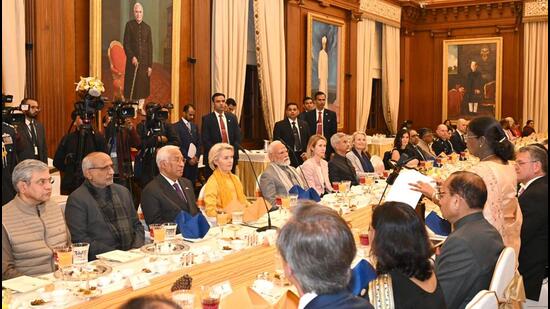
A debate has recently arisen in India over the food served at official banquets for visiting foreign dignitaries. The controversy centres on the growing tendency to offer strictly vegetarian meals, often featuring millets. Some critics argue that foreign leaders accustomed to hearty multi-course meals (and alcohol) may find such minimalist vegetarian fare unsatisfying. Ultimately, I suppose, culinary diplomacy should reflect the host’s choice, but also consider the guest’s palate, keeping in mind the ancient dictum, Atithi Devo Bhava, a guest is akin to the divine.
In my long experience as a diplomat, I have some interesting reminiscences of banquets and our leaders.
In 1982, Prime Minister (PM) Indira Gandhi made an official visit to Romania, where I was posted as a young officer. Romanian president, Nicolai Ceausescu, a repressive dictator, hosted the usual banquet in her honour. After the mandatory toasts by the two leaders, Ceausescu noticed that Mrs Gandhi was not eating. She told him that since it was a Tuesday, she was fasting. Suddenly, Ceausescu stood up and announced that, because his honoured guest was fasting, the banquet was over. The guests had a splendid menu before them and had just begun on the soup. But everybody got up immediately. It was the shortest state banquet I have ever attended!
A highlight of PM Rajiv Gandhi’s term was his State visit to China in 1988, the first by a PM after Nehru. I was part of the advance party that went to prepare for his visit. The task included visiting the cities on his itinerary, and, inter alia, eating the meals that would be served to him. The Chinese have unending 12-course meals, including all kinds of meats and delicacies like pigeon eggs.
The food was delectable and authentically Chinese, but I had eaten so much of it that I was willing to give it up forever. However, this was not to be. I was asked to return as part of the PM’s entourage. Rajiv, although weight-conscious, went through the gastronomic excess — like the true gentleman he was — with exemplary fortitude, leaving his hosts with no cause to complain.
In 1997, IK Gujral made an official visit as PM to South Africa. The legendary President Nelson Mandela hosted a banquet in his honour. A live band with foot-tapping music performed during the event. Music and beat are in the blood of Africans. Towards the end of the banquet, Mandela suddenly got up and invited Mrs Gujral to join him for a dance. She was taken aback but graciously accepted. It was incumbent on Gujral to invite Mandela’s consort, Graca Machel, whom Mandela later married. Gallantly, he did so, and as the duos danced, it was a truly memorable finale to the banquet.
Narasimha Rao, at the banquet given for him by Russian President Boris Yeltsin at the Kremlin (1994), was, on the contrary, optically a disaster. Rao, a frugal vegetarian, had already had his south Indian meal before the event. During the banquet, he hardly ate and, of course, did not drink, sitting visibly bored and slumped in his chair.
Yeltsin, by contrast, was increasingly in high spirits, as repeatedly, an aide plied him with shots of vodka, which he gulped down. The more jovial he became, the more Rao turned taciturn. Towards the end, I was genuinely afraid that Yeltsin might ask Rao’s daughter sitting next to him to dance! Fortunately, he did not, and Rao’s ordeal was finally over.
Atal Bihari Vajpayee was a true gourmet. He came to Cyprus in 2002, where I was posted as high commissioner. He had told me when I left for Cyprus: “Aap chaliye, main aata hoon: You go, I shall follow soon”. Atalji and I had a close literary rapport. I had translated—on his request—his Hindi poems into English. In Cyprus, he thoroughly enjoyed the seafood at the banquets. But he was also accompanied by top chefs from India. Breakfast with him was an experience. The table was laden with puris, parathas and aloo, dosas, idli and vadas, eggs and toast, and much more, which he ate with great relish, constantly urging me to try everything.
Banquets are about cuisine, but, as importantly, provide food for thought about people, cultures, choices and situations.
Pavan K Varma is an author, diplomat, and former Rajya Sabha MP. The views expressed are personal


