
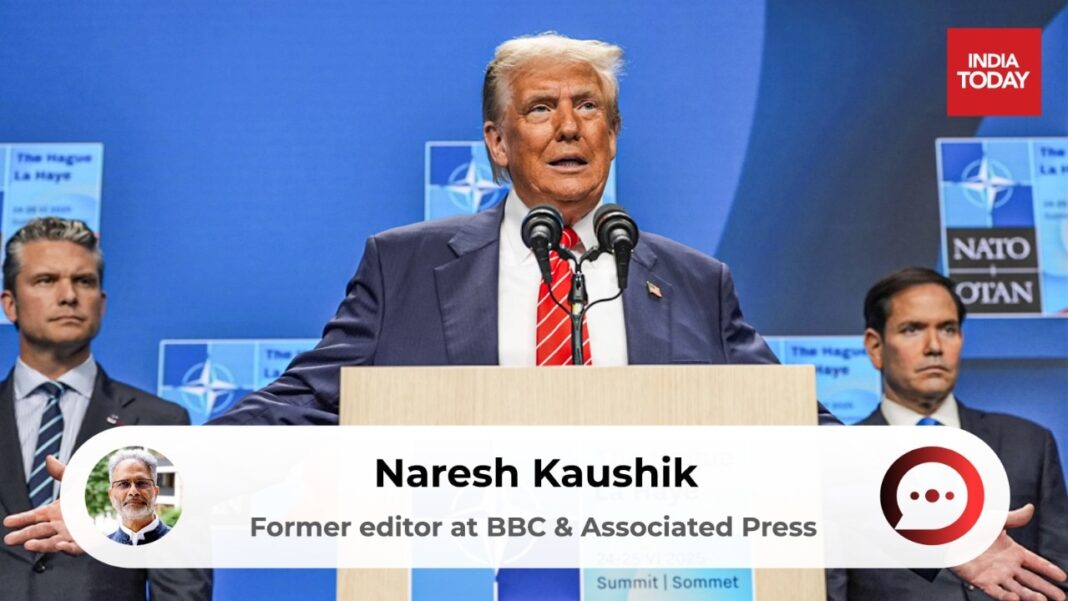
Donald Trump’s war of choice has become a war of necessity as Iran appears to be dictating its course. Tehran’s decision to escalate beyond its borders and impose economic costs on America and its allies has compelled Trump to seek help from his Nato allies. But the Europeans are in no mood to help him in the war he started — along with Israel — more than two weeks ago.
On Monday, Trump lashed out at Nato countries, saying they “greatly disappoint” him for not supporting the US, and singled out British Prime Minister Keir Starmer, who stated the UK would not be drawn into a wider war with Iran. It’s rare for Britain, one of America’s closest allies, not to join the US in a military conflict.
The clearest rejection of Trump’s call for help came from Germany. Its Defence Minister, Boris Pistorius, said the war had nothing to do with Nato. “This is not our war. We have not started it.” Britain’s former chief of the defence staff, General Nick Carter, told the BBC on Monday that Nato was not designed for one member to go to war on its own and then “oblige everybody else to follow.”
A WAR IN WHICH EUROPE HAS NO SAY
Unlike his predecessors, Donald Trump went to war without building any support at home or abroad and spelling out clear war objectives. He didn’t feel the need to consult his allies or even the US Congress. President George HW Bush in 1991 formed a coalition of more than 40 countries when he launched Operation Desert Shield to free Kuwait from Iraqi dictator, Saddam Hussein.
Two decades later, his son, President George W Bush, also got the UN Security Council approval for launching another war against Iraq (on the false premise of getting rid of weapons of mass destruction). Europe was part of both coalitions, though the second time, France and Germany didn’t join.
Trump only sought help from his Nato allies when the war had already entered its third week and was proving too difficult for the US to handle alone. On the face of it, Trump wanted help in securing the Strait of Hormuz, a tiny waterway through which a fifth of the world’s oil and gas passes, which had been almost shut by Iran, as its nuclear option to hurt the US and its Gulf allies. But Trump apparently wanted the allies to join the war effort, something they were not prepared to do.
European countries’ defiance has angered Trump. “We don’t need anybody; we’re the strongest nation in the world,” Trump said, adding that his request for assistance in reopening the Strait of Hormuz instead amounted to a loyalty test of America’s allies.
EUROPE HAS DISCOVERED ITS SPINE
This is the second time in three months that Europeans have shown some resistance to Trump. In January, when he threatened to grab Greenland — a semi-autonomous territory of Denmark, a founding member of Nato — Europe acted in unison and threatened to impose economic costs on the US. Trump grudgingly withdrew his threat.
European countries have sent military aid to their allies in the Gulf, but that aid is defensive in nature. Their most active help has been sent to Cyprus, after a drone hit the British military base of Akrotiri. But Cyprus is an EU member, so its security is important for Europeans.
There are also limits to what Europeans can do militarily, even if they want to. They have relied on the US for security for the past eight decades, and only now are they trying to be independent. For example, France, the most powerful Nato member in Europe, has dispatched a dozen ships to the Gulf, including its only nuclear-powered aircraft carrier. But that is more than half its total combat fleet. Italy sent an air defence system, but it had to withdraw it from the Baltic region, a risky move.
EUROPE’S PRIORITY IS DIFFERENT
For Europe, the priority is not the Middle East. It’s the threat from Russia they want to guard against. With the US under Trump proving ever more unreliable, they are building their defence capabilities. They fear that Russia, after a victory in Ukraine, could be emboldened to invade another European country. They also feel that the war with Iran is depleting vital military equipment, particularly air defence systems, which will only help Moscow.
Another reason for Europe’s reluctance to join the US war effort in Iran is that the military action is very unpopular among its public. Besides questions of legality, it is largely seen as Israel’s war, which has lost much support in Europe since its brutal military campaign in Gaza. Benjamin Netanyahu has avoided visiting Western Europe since an arrest warrant was issued against him by the world court over war crimes.
WHY SHOULD EUROPE DO WHAT THE US IS AVOIDING?
There are also questions about why Europeans should send their ships to escort commercial vessels in the Strait of Hormuz, when the US itself is reluctant to do so. Iran has been preparing for this situation for over twenty years. The US and Israeli militaries may have destroyed the Iranian navy. But the Revolutionary Guard Corps is believed to have hundreds of small boats equipped with thousands of mines that could be used to attack Western vessels.
Trump ignored warnings from his military commanders and Gulf leaders that Iran could block the Strait of Hormuz and might attack US bases in the region when he decided to join Israel in attacking Iran. Last year, the Trump administration removed its only remaining mine-clearing ship from the Middle East. It now has only four such vessels, but they are deployed in the Indo-Pacific to defend against China.
European leaders are unhappy with Trump for another reason. His administration last year launched a hostile ideological campaign in their countries and actively supported far-right movements. They believe the campaign aims to reduce the European Union’s political influence.
It was Trump who withdrew from the 2015 Iran nuclear agreement negotiated by the Barack Obama administration in consultation with European powers. Iran was complying with that deal. But Trump, again under the influence of Netanyahu, ended the agreement.
Europeans were not pleased when Trump decided to launch the war while Tehran was engaging in talks with the Americans. Instead of joining the war, they are demanding a diplomatic resolution to the conflict, which has also hit their economies.
(Naresh Kaushik is a former editor at the BBC and Associated Press. He is based in London. Views expressed are personal.)


