
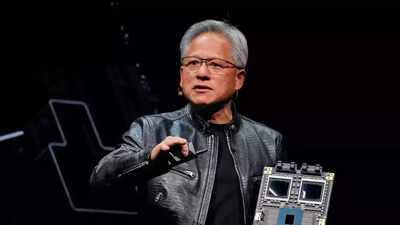
Nvidia CEO Jensen Huang is expected to outline the company’s next steps in artificial intelligence (AI) hardware, software and global partnerships during the upcoming Nvidia GTC conference. The annual developer event has become a key venue where Nvidia presents its AI roadmap, introduces new chips and discusses industry trends.
This year’s conference comes shortly after Nvidia reported strong earnings that had a limited impact on its stock price, raising questions among investors about how long current levels of AI spending can continue. Analysts and market observers are expected to focus on several themes during Huang’s keynote and related announcements. Here’s what to expect from Nvidia’s annual GTC conference:
Nvidia may introduce new inference-focused AI chip
One of the biggest announcements from Nvidia that investors will be watching is a potential inference-focused AI chip.
Inference refers to the process of running trained AI models rather than training them, an area that analysts expect to grow as AI applications expand.
Huang previously said Nvidia was preparing “several new chips the world has never seen before.” A Wall Street Journal report earlier this year indicated that Nvidia may introduce an inference chip incorporating technology from AI startup Groq, with OpenAI expected to be a customer.
The chip’s design may also reveal how Nvidia plans to address memory requirements in inference workloads. These systems often rely on high bandwidth memory (HBM), which has faced supply constraints. Observers are watching whether Nvidia will rely more on SRAM, a fast on-chip memory often used in inference architectures.
Sid Sheth, founder and CEO of d-Matrix, told Business Insider (BI) that the competitive landscape differs from training chips. According to Sheth, while Nvidia remains dominant in training workloads, “inference is a different ballgame.”
He added that CUDA, Nvidia’s programming platform widely used for training AI models, offers less of an advantage in inference. “Developers can turn to competitors other than Nvidia because running finished AI models doesn’t require the same kind of programming as training them,” he said.
Investors looking towards Nvidia’s transition beyond Rubin
Another topic likely to receive attention at the GTC conference is Nvidia’s transition to its next-generation AI infrastructure. The company has already announced its upcoming Rubin Ultra systems, which are expected to require significantly more power than earlier platforms.
Sebastien Naji, a research analyst at William Blair, told BI that investors will be watching how Nvidia manages the shift and whether cloud providers support the platform.
Analysts are also interested in what may follow Rubin, including a future architecture referred to as Feynman. One of the key technological changes expected in that generation is copackaged optics, which uses light rather than electricity to transfer data between chips. The approach could reduce power consumption and enable larger computing clusters.
Earlier this month, Nvidia announced multibillion-dollar supply agreements with optical component manufacturers Coherent Corp. and Lumentum Holdings, signalling that optical technologies may play a role in future AI infrastructure.
Nvidia may share updates about agentic AI and robotics developments
Investors are also monitoring whether new AI use cases could sustain demand for computing infrastructure. Brian Mulberry, chief market strategist at Zacks Investment Management, told BI that attention has shifted toward the durability of AI demand rather than the pace of growth.
Huang has frequently highlighted agentic AI as a source of future demand for inference. The concept refers to software agents capable of performing tasks autonomously using AI models.
Sheth said the development of agentic systems may expand further as technologies such as voice interfaces, video processing, and multimodal AI continue to evolve. “We haven’t even started,” he said of a forthcoming inference wave.
Robotics could also become part of Nvidia’s long-term strategy, according to Daniel Newman, CEO of The Futurum Group. Newman noted that Nvidia reported roughly $6 billion in robotics-related revenue during the previous quarter and has indicated plans to accelerate work on humanoid robotics.
Geopolitics of GPUs may shape Nvidia’s strategy
Policy and geopolitics are also expected to influence Nvidia’s announcements. Export controls and geopolitical tensions have increasingly affected the market for advanced AI chips.
According to a Financial Times report, Nvidia halted production of its H200 chips for China and redirected capacity to its next-generation Rubin platform.
At the same time, the US government is considering additional restrictions on exports of AI chips, which could affect how Nvidia sells its products internationally.
Newman said markets outside China remain important for Nvidia’s future growth, citing large-scale AI infrastructure investments in countries such as Saudi Arabia and the United Arab Emirates. However, conflicts in the Middle East have raised questions about supply chains, energy costs and the pace at which new data centres will be built.
As AI becomes more closely tied to national policy and economic competition, analysts say government decisions could influence Nvidia’s global strategy alongside demand from technology companies and cloud providers.


