
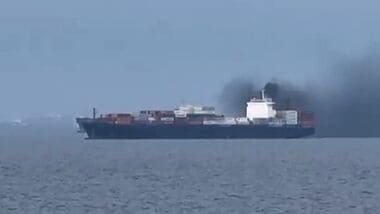
Iran new Supreme Leader Mojtaba Khamenei’s representative in India, Abdul Majid Hakeem Ilahi, said Tehran has not closed the Strait of Hormuz, though current conditions have limited ship movements in the vital energy corridor.
Ilahi stressed that Iran never intended to block the strategic waterway but acknowledged that tensions in the region have affected maritime traffic.
“Iran has not closed the Strait. It remains open; however, due to current conditions and circumstances, ships are unable to pass through the Hormuz. Otherwise, Iran never wanted the Strait to be closed or blocked. Some (ships) are still passing through,” Ilahi was quoted as saying by ANI.
Calls for global pressure on the US
Ilahi also urged global leaders to intervene and press the United States to end the ongoing conflict with Iran.
“Those who initiated this war are the very ones who must stop it… Many people across the world are suffering due to this war. World leaders must unite and exert pressure on the President of the United States, urging him to put an immediate stop to this unjust war,” he was quoted as saying by the news agency.
The remarks come amid escalating tensions in West Asia involving the United States, Israel and Iran.
Iran’s UN envoy says Strait of Hormuz will remain open
Ilahi’s comments also come a day after Iran’s UN ambassador said Tehran has no plans to shut the Strait of Hormuz, but insists it has the right to protect the waterway’s security.
Amir Saeid Iravani when asked about remarks by new Iranian supreme leader, Mojtaba Khamenei, who said that the “lever of blocking the Strait of Hormuz must continue to be used.”
“We are not going to close the Strait of Hormuz,” Iravani said. “But it is our inherent right to preserve the peace and security in this waterway.”
Iravani said that “Iran fully respects and remains committed to the principle of freedom of navigation under the law of the sea.
“However, the current situation in the region, including in the Strait of Hormuz, is not the result of Iran’s lawful exercise of its right of self-defense. Rather, it is the direct consequence of the destabilizing actions of the United States in launching aggression against Iran and undermining regional security.”
Tensions and maritime disruption
The Strait of Hormuz has been at the centre of heightened geopolitical tensions since late February, following military strikes by the United States and Israel on Iranian territory that escalated into broader conflict. In response, Iran’s Islamic Revolutionary Guard Corps (IRGC) began warning vessels that passage would be “not allowed”, prompting shipping companies to avoid the route.
While Iran’s government claims the waterway is technically open, industry and naval sources say safety cannot be assured, and many commercial ships have stayed away. Satellite tracking data showed a sharp drop in ship transits earlier this month, as insurers classified the area as a severe war risk and carriers delayed or rerouted voyages.
International and economic impact
The Strait of Hormuz handles an estimated 20% of global seaborne oil and gas flows, meaning prolonged disruption poses serious implications for global energy markets and supply chains. Several major carriers have suspended voyages through the area, adding to volatility in freight and commodity markets.


