

Following the killing of Iran’s supreme leader, Ayatollah Ali Khamenei, in the opening salvos of a devastating military campaign by the US and Israel, his son Mojtaba has reportedly been anointed as successor. It raises a fundamental question whether the Islamic Republic, which is at its weakest point since its formation, can carry on amid mounting internal unrest and relentless external attacks?
It is worth recalling that Iran’s system of rule of clerics under Khamenei’s mentor and Shia religious authority, Ayatollah Ruhollah Khomeini, was the outcome of a mass revolution in 1979 that overthrew a US- and Israel-backed absolute monarchy. Today, the boot is on the other foot, and the revolutionary regime is tottering under the double whammy of weakened domestic legitimacy and concerted foreign pressure from the same US and Israel.
The State that Khomeini built and Khamenei consolidated by mixing theocratic Shia fervour, anti-imperialistic martyrdom ideology, and civilisational exceptionalism is facing an existential crisis thanks to the erosion of domestic support within Iranian society. Three factors — political, economic and social — have contributed to the hollowing out of broad-based internal legitimacy of the Islamic Republic, leaving it vulnerable to external threats.
First, since at least 2009, an insecure Khamenei began undermining the will of Iran’s people in relatively competitive presidential and parliamentary elections via universal adult franchise. Iran’s “hybrid regime” model did privilege the unelected Ayatollahs at the top of the hierarchy, but it also delegated powers to elected politicians representing liberal, reformist, conservative and hardline camps. Over the past 15 years, Khamenei shrunk the space for these politicians who had served as safety valves for the regime, thereby leaving ordinary Iranians politically frustrated and prone to wave after wave of protests.
Second, Khamenei diverted vast sums of Iran’s economic resources to pursue a grand strategy of regional influence across West Asia and the wider Islamic world, causing anguish inside Iranian society that its own material interests were sacrificed in the name of an “axis of resistance” against the US and Israel.
The slogan, “neither Gaza nor Lebanon, I sacrifice my life for Iran”, has echoed across Iran regularly in anti-government protests since 2009 as a marker of this dissatisfaction. Ordinary Iranians feeling the pinch of a steeply depreciating rial, sky-high inflation and rampant unemployment see little value in Iran’s costly web of militant proxies, including Hezbollah, Hamas and the Houthis, and in the infinite sums of money allocated to the Islamic Revolutionary Guard Corps (IRGC) that bankroll these proxies.
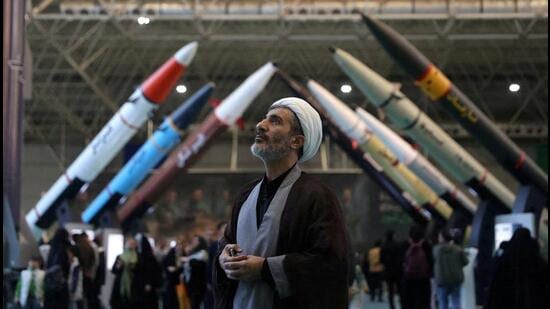
The regime’s strategic assets — its controversial nuclear programme and vast missile stockpiles — have been paraded as inalienable crown jewels of the Islamic Republic, but this posture of permanent militarisation yields few concrete gains for the Iranian people. Government propagandists blame sanctions by the US and Europe for the country’s economic woes, but moderate Iranians fault the regime for its overambitious weaponisation which leaves them economically isolated and deprived.
Vladimir Lenin quipped that “any civilisation is three meals away from a violent revolution”. When absolute poverty levels touch 30% of the population in an oil-rich country like Iran, conditions become rife for a revolution against a so-called revolutionary regime. The regime has survived repeated cycles of mass protests over the past 17 years through brute coercion and divide-and-rule tactics, but the damage has been done and there is sufficient internal alienation and fragmentation for foreign actors to exploit and penetrate.
Thirdly, the ageing but rigid Ayatollahs have built a vast gulf between themselves and the youthful demographics in Iran, where 60% of the population is below the age of 30. Khamenei allied with conservative elected politicians to impose a harsh and puritanical Islamic morality on a young and secular populace thirsty for personal freedoms. Protests in 2022 after the death of a young woman, Mahsa Amini, at the hands of Iran’s notorious morality police for not wearing the Islamic head covering, demonstrated pushback against a regime unwilling to yield to the changing times and generational shifts.
While these three factors may have rendered Khamenei’s State apparatus lacking in a reliable social base to withstand foreign aggression, it is rare for any autocracy to collapse merely under the weight of domestic discontent. The external tipping point was triggered by the October 7, 2023, terrorist attacks by Iran’s Palestinian proxy, Hamas, inside Israel. The deadly regionwide wars that Israel unleashed in retaliation dealt killer blows to Iran’s “ring of fire” across the region and left Iran exposed to direct lethal attacks by Israel and the US on its own soil.
In hindsight, Khamenei and the IRGC leadership badly miscalculated the consequences of the October 7 attacks, which planted the seeds of their destruction. Arguably, had the worst massacre of Jewish people since the Holocaust not happened on October 7, the weakened but resilient Iranian theocracy may have had better chances of extending itself.
In the course of his 36-years-long reign, Khamenei did at times compromise with the US, Europe and Sunni Arab neighbouring countries. Iran’s 2015 nuclear deal with the US, based on Khamenei’s concept of “heroic flexibility”, had raised hopes of a modus vivendi with the West. But US President Donald Trump’s abandonment of that deal in 2018, his utter disregard for international law in order to ensure Israel’s regional hegemony, and the absence of a genuine thaw between Iran and its Sunni neighbours meant that Khamenei’s game was up.
What kind of new dispensation emerges in Iran after Khamenei is anyone’s guess. The only certainty is that the Islamic revolution is effectively a spent force because it devoured its own children at home and overplayed its hand abroad.
Sreeram Chaulia is dean, Jindal School of International Affairs. The views expressed are personal