
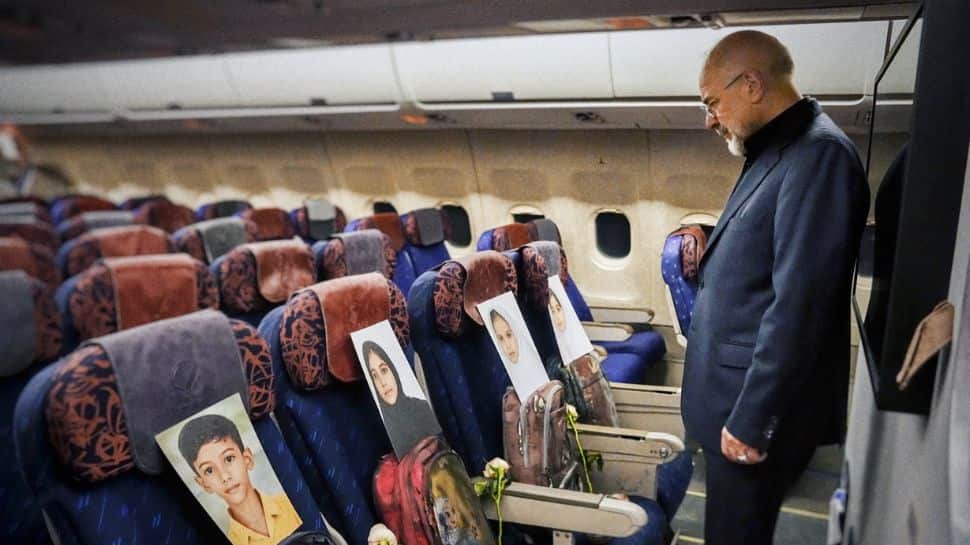
The plane carrying Iran’s delegation to the ceasefire talks in Islamabad had a name: Minab 168. It wasn’t chosen randomly.
When US and Israeli strikes hit Iran on February 28, a missile destroyed the Shahra Tayyaba school in the city of Minab. 168 people died. Most were children.
Iran’s chief negotiator and Parliament Speaker Mohammad Bagher Ghalibaf posted a photo from inside the aircraft before landing. It went viral. The seats had photos of four children placed on school bags. Beside them, bloodstained shoes. And a single white flower on each seat.
Iran’s Foreign Minister Abbas Araghchi shared the same image.
The message was clear. Iran didn’t come to Islamabad just with demands. It came with grief.
The Talks
US-Iran ceasefire negotiations are currently underway in the Pakistani capital. Iran’s 70-member delegation is being led by Ghalibaf and Araghchi. On the American side: Vice President JD Vance, Trump’s special envoy Steve Witkoff, and Jared Kushner.
Pakistan’s Prime Minister Shahbaz Sharif met both delegations separately and conveyed Iran’s red lines to the US team.
Iran laid out three non-negotiable conditions for talks to proceed.
One: the US must pay war reparations.
Two: Iran’s frozen assets must be returned.
Three: a ceasefire must cover the entire region, including Lebanon. No Lebanon ceasefire, no deal.
Araghchi was blunt before the meetings even began: “We are entering with complete distrust. America has broken promises before. We have no faith in them. But we come in good faith, for our people.”
Talks paused for a dinner break at 7 PM. The delegations were expected to meet face-to-face over the meal. But these talks aren’t about full peace. They’re about limiting strikes, starting with Lebanon. Even that remains unresolved. Israel released footage of fresh strikes on Lebanon while negotiations were ongoing.
Pakistan Playing Both Sides
While brokering peace between the US and Iran, Pakistan quietly sent a contingent of fighter jets and support aircraft to Saudi Arabia’s King Abdulaziz Air Base. Riyadh framed it as a “strategic defence agreement” to boost joint military readiness.
Iran has fired missiles at Saudi Arabia even after the ceasefire. The sight of Pakistani air force jets landing in Saudi Arabia, mid-talks, raises an obvious question: whose side is Islamabad actually on?
The UN Did Nothing
The more glaring absence from the Islamabad talks is the United Nations.
When the US and Israel attacked Iran on February 28, the UN Security Council held an emergency meeting. No resolution. Just accusations from both sides.
On March 11, the UNSC passed a resolution condemning Iran’s strikes on Gulf states. China and Russia abstained. The resolution said nothing about the US-Israel strikes that started the war.
On April 7, Bahrain brought a resolution on Hormuz shipping security to the UN. China and Russia vetoed it.
Six weeks of war. Zero ceasefire resolutions from the UN. Pakistan got a ceasefire. The UN could not.
Meanwhile, the UN’s 2026 budget stands at $3.5 billion for regular operations and $5 billion for peacekeeping, over $9 billion combined. The organisation employs more than 100,000 people, holds 27,000 meetings a year, and produces 2,300 pages of documents every single day. The cost of just those meetings and paperwork: $360 million annually.
India contributes Rs 500-600 crore to the UN every year. In return, the UN couldn’t protect the Strait of Hormuz, through which 60% of India’s LPG passes.
The ceasefire that the UN couldn’t broker is now hanging by a thread in a country that can barely govern itself.
Iran arrived with children’s photos and bloodstained shoes.
The question isn’t whether the talks will succeed.
The question is who is actually in charge of keeping the world from burning?


