

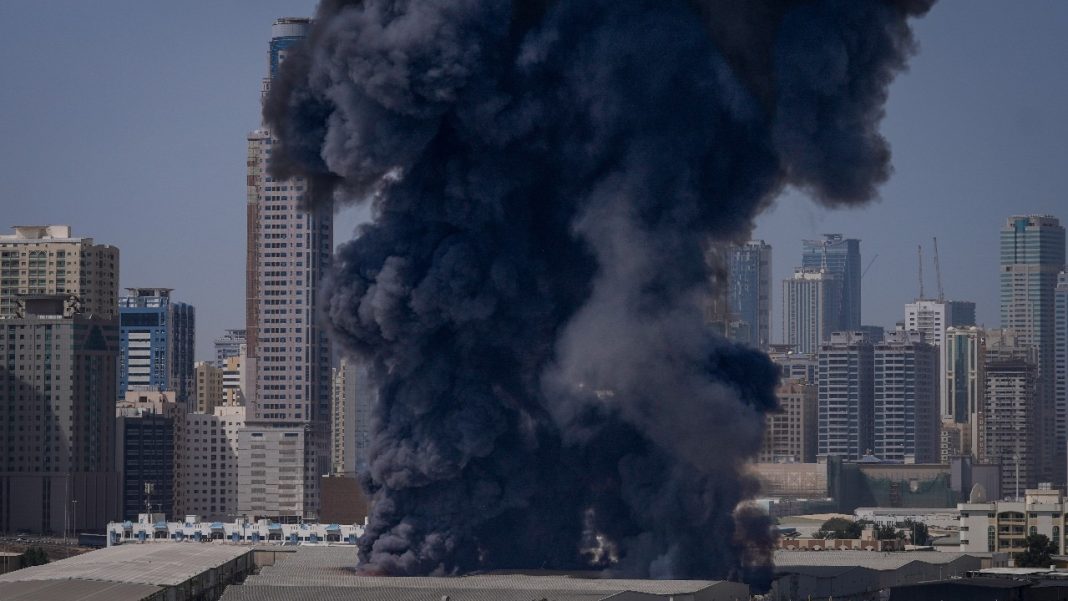
Over the last three decades, Bahrain, Qatar, Kuwait, Oman, the UAE, and Saudi Arabia built an image of stability in an otherwise volatile Middle East. But that perception about the region changed when Iranian missiles and drones struck not just US bases in the Gulf countries, but also luxury hotels and residential areas in Dubai and Abu Dhabi. Despite Iran attacking industrial and civilian sites, nearly all Arab nations have so far shown restraint and avoided Tehran. In this report, we try to analyse if the restraint is tactical or has a religious angle to it.
Iran’s firing of missiles and drones at Israel, American bases in the Middle East and Arab countries follows the killing of Iran’s Supreme Leader Ayatollah Ali Khamenei in coordinated US-Israeli airstrikes. Khamenei wasn’t just the head of the Iranian state, he was the leader of Shia Muslims worldwide.
Right now, the Arab nations face a tough choice. If they strike back at a country that is part of the Muslim Ummah, they not only risk being seen as acting against the larger Islamic community, but also as standing alongside Israel. That too after a Shia leader’s assassination.
Three days into the conflict that has engulfed nearly the entire Middle East, only one notable development has emerged in terms of military warning to Iran, from Saudi Arabia. Reports say Crown Prince Mohammed bin Salman, the monarchy’s de facto ruler, authorised the Royal Saudi Armed Forces to strike back against Iran if the attacks persist.
Despite Saudi Arabia and Iran’s long-term rivalry over dominance in the region and Iranian strikes hitting its Aramco refinery, Riyadh has so far exercised extreme caution.
The Washington Post reported on February 28, the day of Khamenei’s killing, that the Saudi crown prince, along with Israeli PM Benjamin Netanyahu, urged US President Donald Trump to launch the strikes on Iran.
Immaterial of what has taken place within closed doors, Saudi Arabia, in public, has called for a diplomatic approach to the Iran crisis.
As the cities in the otherwise commercial and peaceful Middle Eastern countries burn, the question is, will Arab nations really go against Iran?
US President Donald Trump claimed on Monday that several Arab countries were now pushing to join the military offensive after coming under Iranian attack. However, it appears unlikely, and might well be yet another instance of misinformation from the US President.
IS THE MUSLIM UMMAH A FACTOR FOR ARAB COUNTRIES’ RESTRAINT?
Let us first examine how the Muslim Ummah comes into play.
The Muslim Ummah is the collective community of Muslim nations worldwide, a concept rooted in the Quran. The Ummah has been invoked during times of external threats, such as colonial rule or conflicts involving non-Muslim powers, to rally Muslims against common enemies.
But there is also the Shia-Sunni split. While all Arab countries have a majority Sunni population, Iran is a Shia country. Other than Iran, there’s a sizeable Shia population in Iraq, Lebanon and Pakistan.
However, the Shia-Sunni differences have been put aside at certain key moments earlier too.
One of the biggest examples of this is when Ayatollah Ruhollah Khomeini, the founder of the Islamic Republic of Iran and its first Supreme Leader, died on June 3, 1989. Iraqi President Saddam Hussein, a Sunni, expressed official condolences despite the recent Eight-Year War with Iran.
Syria too declared seven days of mourning, with President Hafez al-Assad praising Khomeini as an “honourable scholar” who “crushed the Shah’s regime” and defended Muslim causes, according to the journal, Washington Report on Middle East Affairs. Lebanon too announced three days of mourning, the Washington Report on Middle East Affairs says.
There have been other instances of unity too. During the 1979 Iranian Revolution, led by Khomeini, some Sunni groups initially supported it as a stand against Shah Mohammad Reza Pahlavi’s Western influence.
In recent decades, shared opposition to Israel has brought Sunnis and Shias together, as seen in protests over Gaza.
The centuries of rivalry between Muslims and Jews, exacerbated by the creation of Israel in 1948, has been another rallying point. Israel’s actions are frequently portrayed as attacks on the broader Muslim world. Primarily, Israel has overshadowed the Shia-Sunni split.
A case in point would be the signing of the Abraham Accords. The UAE and Bahrain signed the Trump-led agreement to normalise ties with Israel. However, Iran’s proxy Hamas staged the October 7, 2023, carnage in Israel, and the Jewish nation countered by bombing Gaza. The war in Gaza made Saudi Arabia, which was all set to ink the Abraham Accords, postpone the signing.
HOW THE ARAB WORLD HAS RESPONDED TO IRAN’S ATTACKS
In the current crisis in the Middle East, Iran targeted Gulf countries only because they have US military bases. It attacked Oman, which doesn’t have a base, but was quick to offer an explanation.
Iran launched over 165 ballistic missiles at the UAE alone because it has the Al Dhafra Air Base, just south of Abu Dhabi, which is a major hub used by the US Air Force and hosts thousands of US personnel.
After the strikes, a joint statement from the US, Bahrain, Jordan, Kuwait, Qatar, Saudi Arabia, and the UAE condemned Iran’s “indiscriminate and reckless missile and drone attacks” as a “dangerous escalation” that violated sovereignty and endangered civilians.
The Gulf Cooperation Council (GCC) also held an emergency meeting, denouncing the “heinous Iranian attacks” and affirming the right to take “all necessary measures” for self-defence.
Saudi Arabia’s Foreign Ministry expressed “rejection and condemnation in the strongest terms” of the strikes on Riyadh and its eastern region, reserving the right to respond.
Qatar’s Foreign Ministry called the attacks an “unacceptable escalation”, while the UAE described them as a “flagrant violation of sovereignty”.
Despite hosting US bases, which Iran claims were the primary targets, these Sunni-majority Arab states were not active participants in the US-Israel operation. Many of them, including Jordan and Saudi Arabia, denied overflying rights for the attacks on Iran.
They had publicly supported diplomacy before the strikes and even assured Iran that their airspace was not used.
This stance aligned with the Arab countries’ interests of having friendly ties with the US for security support, and to protect their economies, especially key oil facilities and sea routes like the Strait of Hormuz. Despite being caught in the crossfire, no military retaliation has come from the Gulf countries as of now.
ACTION AGAINST IRAN MIGHT BE PERCEIVED TO BE PRO-US, PRO-ISRAEL
Saudi Arabia has for decades seen Iran as a regional rival, competing for influence in Yemen, Syria, and beyond.
However, no action has been taken even by Saudi Arabia, even as drones are landing in the kingdom, burning its oil refineries. Visuals of the Aramco oil refinery set ablaze after being hit by a drone surfaced on Monday.
So far, there is no official reason available why the Arab nations are not retaliating against Iran. They haven’t even issued official statements expressing solidarity with Iran over Khamenei’s death, though Russia and China have condemned the US-Israeli strikes. No posts from prominent Arab leaders or influencers on X explicitly back Iran due to Islamic solidarity.
There is no denying that the countries fear a targeted escalation by Iran if they hit back. Iran has made that clear.
According to an Iranian military source, “In the event of any attack by Arab regimes on Iran, the palaces of the kings of those countries will be directly targeted,” posted an X account, Iran Military Monitor. The account is not affiliated with Iran’s official armed forces, but tracks and reports on military developments in Iran.
An overriding fear must be that any strike on Iran would be perceived by Muslims across the world as countries siding with the US-Israel axis. That the Arab countries cannot afford to convey that.
Besides this, Iran has, over the years, presented itself as an Islamic champion fighting against the West. If Arab countries attack it, Tehran could portray the move as an “injustice” and a sign of “slavery to the West”, thereby gathering sympathy across the region. Arab nations do not want to give Iran that advantage at any cost.
The killings of Khamenei and other top Iranian officials have been portrayed as a “sacrifice” by the regime. A red flag was flown atop the Jamkaran Mosque in the holy city of Qom. In Shia Islam, the red flag represents the blood of martyrs. It is typically displayed atop mosques or carried during religious processions, especially during the month of Muharram.
Whatever the official position of the Arab states, Khamenei’s assassination is being perceived as the killing of an Islamic leader by Muslims across the world. It is more because of that sentiment along with Iran’s warning that the Arab countries have chosen restraint for now despite facing attacks from Tehran.


