
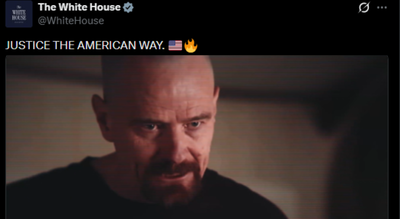
The White House has released an unusual propaganda-style montage celebrating the recent US–Israeli strikes on Iran, stitching together real drone footage from the operation with scenes and dialogue from Hollywood films, television shows, anime and video games, edited in a slick, trailer-like style that feels less like a government communiqué and more like something an amateur YouTube editor might assemble, complete with the colour tweaks and audio distortions often used online to slip past copyright filters.
Posted on the official White House account on X on 6 March, the 42-second video carried the caption: “JUSTICE THE AMERICAN WAY” alongside a US flag and fire emoji. Within hours the clip had amassed more than 12.4 million views, drawing both bewilderment and criticism online.
The video arrives less than a week after the 28 February US–Israeli air campaign against Iran, which Washington says was intended to destroy the country’s missile and nuclear capabilities.
The strikes killed Iran’s Supreme Leader Ayatollah Ali Khamenei, triggered retaliatory attacks across the Middle East and pushed the region closer to a broader conflict.
Against that backdrop, the White House montage adopts the language and aesthetics of blockbuster cinema.
A mash-up of war footage and pop-culture mythology
The montage opens with Robert Downey Jr.’s Tony Stark from Iron Man 2 (2010). declaring:
Followed by JARVIS responding:
From there, the clip rapidly cuts between fictional characters and real bombing footage from the Iran strikes.
Among the scenes and characters used in the montage are:
-
Russell Crowe as Maximus in
Gladiator
-
Mel Gibson in
Braveheart
-
Tom Cruise in
Top Gun
-
Tom Cruise again in
Tropic Thunder
-
Bryan Cranston as Walter White in
Breaking Bad
-
Bob Odenkirk as Saul Goodman in
Better Call Saul
-
Keanu Reeves in
John Wick
-
Christopher Reeve’s Superman declaring “truth and justice in the American way”
-
Adam Driver as Kylo Ren from
Star Wars
-
Optimus Prime from
Transformers
-
Deadpool
-
Master Chief from
Halo
-
Mortal Kombat
-
Yu-Gi-Oh!
-
Dragon Ball
The clips are intercut with actual aerial strike footage, explosions and drone imagery from the ongoing conflict.
The video also strings together a series of well-known lines from those characters. Among the quotations included:
Maximus in
William Wallace in
Tom Cruise in
Bob Odenkirk in
Master Chief from
Keanu Reeves in
Christopher Reeve’s Superman
Bryan Cranston as Walter White
The montage then shifts briefly to real political footage.
US Secretary of Defense Pete Hegseth appears in the sequence saying:
The final stretch moves into gaming and anime references.
Optimus Prime
Deadpool
Yu-Gi-Oh!
Dragon Ball voiceover
Mortal Kombat announcer
Hollywood, war messaging and a familiar Trump tactic
The use of entertainment imagery in official political messaging is not entirely new for the Trump administration, though critics say the tone of the latest video is unusually overt.
The post comes weeks after a separate White House social media clip used Kesha’s song under footage of a missile strike labelled “Lethality”, prompting the singer to protest online.
“Stop using my music, perverts,” Kesha wrote in response.
Artists and entertainment companies have frequently objected to the use of their work in political messaging. While studios and rights holders rarely intervene immediately, musicians and actors have repeatedly asked Trump’s campaign and administration not to use their songs, films or characters to promote policies or military actions.
The White House has also leaned heavily into superhero imagery before. When a new film released recently, the administration posted a meme showing Trump’s face edited onto Superman’s body with the caption:
“THE SYMBOL OF HOPE. TRUTH. JUSTICE. THE AMERICAN WAY. SUPERMAN TRUMP.”
Social media reactions: confusion, irony and criticism
The montage quickly spread across social media, where reactions ranged from disbelief to pointed cultural critique.
One user wrote:
Another warned about possible copyright implications:
“Wow! Had no idea you got the rights to use Braveheart and Gladiator content to promote war.
It’d be a shame if you didn’t and were sued as a govt and as the Digital Media team individually.”
A widely shared comment highlighted what the writer saw as the irony behind several of the film choices:
Another user added a similar observation about the opening clip:
Others reacted simply to the surreal tone of the post.
Another wrote:
And one commenter offered a more pointed political response:
A war framed through blockbuster language
The video arrives as President Donald Trump has suggested the conflict with Iran could last four to five weeks, with the administration pledging to do “whatever it takes” to dismantle Iran’s nuclear capabilities and prevent the regime from directing armed groups beyond its borders.
Supporters of the administration see the montage as a dramatic piece of wartime messaging.
Many, however, argue the montage trivialises real strikes, turning deadly conflict into a flashy spectacle that ignores human suffering.



