
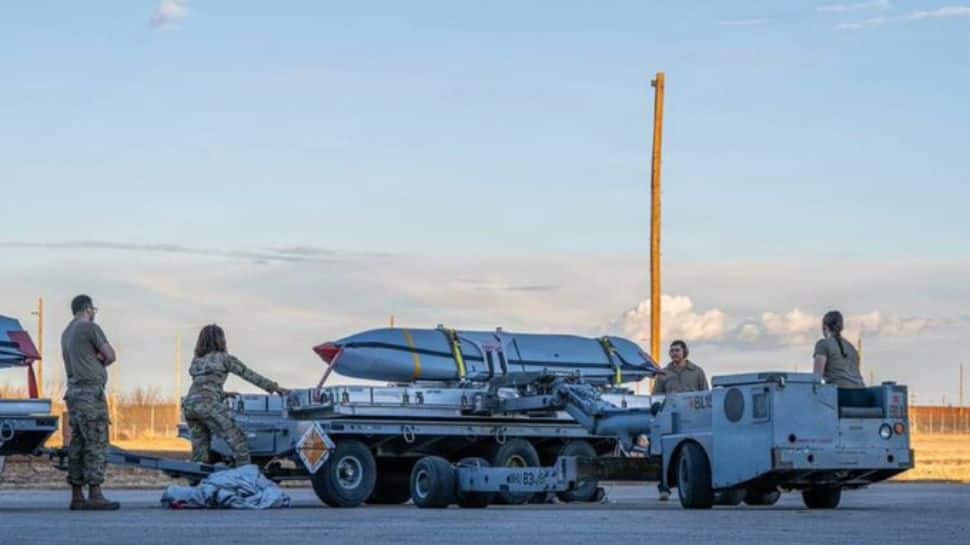
Gearing up its most brutal offensive against Iran, the United States has repositioned nearly its entire global inventory of the advanced Joint Air-to-Surface Standoff Missile-Extended Range (JASSM-ER) to support operations in the Middle East. According to reports citing US officials, an order was issued at the end of March 2026 to draw these $1.5 million missiles from Pacific stockpiles and other global sites, redirecting them to US Central Command (CENTCOM) bases and RAF Fairford in the United Kingdom.
Pre-war stocks stood at roughly 2,300 JASSM-ER missiles. More than 1,000 were expended in the first four weeks of the conflict alone, leaving only about 425 operational units available worldwide after the latest moves, Bloomberg reported. The missiles have already been launched from B-52 and B-1B bombers as well as strike fighters in strikes against Iranian targets.
What is the JASSM-ER?
The JASSM-ER, officially designated AGM-158B, is a stealthy, air-launched cruise missile developed by Lockheed Martin for the US Air Force (and compatible with certain Navy and allied platforms).
It comes under the JASSM family, specifically designed for the precision strikes on high-value, heavily defended targets-such as command centers, missile sites, air defences, and infrastructure, while keeping launch aircraft far outside enemy air-defence ranges.
Unlike shorter-range weapons, the ER (Extended Range) variant dramatically increases standoff capability, allowing bombers and fighters to strike from safer distances. It entered service in the mid-2010s as an upgrade to the baseline AGM-158A JASSM.
Key features:
Range: More than 575 miles (926 km), roughly double the baseline JASSM. Some sources cite up to approximately 1,000 km, enabling deep strikes into contested airspace.
Warhead: 1,000-pound (450 kg) penetrating warhead with blast-fragmentation capability. It is effective against hardened, buried, or reinforced targets.
Launch Platforms: Primarily B-1B Lancer, B-52H Stratofortress, F-15E Strike Eagle, and F-16 Fighting Falcon. Integration on additional aircraft (including future bombers) is ongoing.
Why it matters in the current conflict
The JASSM-ER is consider as a cornerstone of US standoff precision-strike doctrine. Its long range and stealth allow the US to degrade enemy air defences and strike critical targets early in a conflict without risking pilots in contested airspace. In the Iran campaign, it has been used to target missile facilities, command nodes, and other high-priority sites.
Having said that, the heavy usage highlights supply concerns, annual production is ramping up as Lockheed Martin is scheduled for 396 missiles in 2026, with potential to reach 860, but current consumption far outpaces output.
It redeployment from Pacific and other theaters only highlights the priority being given to the Middle East theater. Its deployment will give the US a decisive edge in long-range air campaign while minimising risk to aircrews.
According to source, the US aircraft fired 47 missiles during a raid targeting Venezuelan President Nicolas Maduro, according to a Bloomberg report. However, deploying such a large number of JASSM-ER missiles in the Iran conflict does not necessarily indicate that all of them will ultimately be used.


