

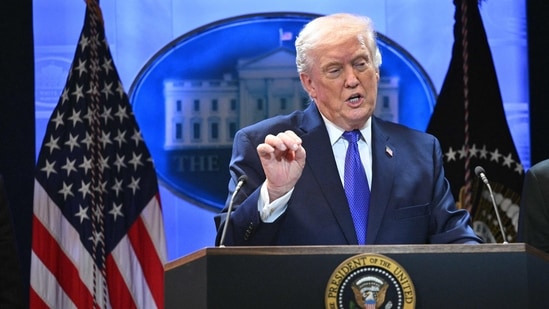
President Donald Trump has invoked an alternative tariff, Section 122 of the Trade Act of 1974, to reinstate 10% global tariff after the U.S. Supreme Court ruled against his earlier tariff actions.
The court’s 6-3 decision held that Trump exceeded his authority under the International Emergency Economic Powers Act (IEEPA) by applying sweeping levies on imports from around the world.
In response, Trump announced a 10% global tariff levy that permits the president to temporarily impose tariffs in response to “large and serious” shortfalls in the balance of payments in the U.S. or other circumstances that give rise to “fundamental international payments problems.”
What is the impact?
“Great certainty has been brought back to the economy of the United States, and actually, the economy of the world,” Trump said dramatically as he wrapped up his news conference.
In the first year of his presidency, Trump announced several tariffs, many of which still remain in place even after the Supreme Court’s ruling. Under section 122 of the Trade Act of 1974, Trump may be able to retain some of the tariffs that would be limited to just 150 days, unless they are extended legislatively.
“Effective immediately, all National Security TARIFFS, Section 232 and existing Section 301 TARIFFS, remain in place, and in full force and effect. Today I will sign an Order to impose a 10% GLOBAL TARIFF, under Section 122, over and above our normal TARIFFS already being charged…” Trump said.
What countries might get hit?
Tapping into a policy first initiated in April 2025, China is subject to an increase of 10% tariff over the existing tariff. Other major trading partners include, South Korea, Japan and the European Union, which export a range of products to the U.S like electronics and pharmaceuticals.
Some other countries include Mexico and Canada, which may face renewed trade talks over the “trafficking tariff” of 25% and 35%, respectively.
Moreover, China was also subject to a lomgstanding 10% “fentanyl tariff” before the court ruling, which may begin again under section 122.