
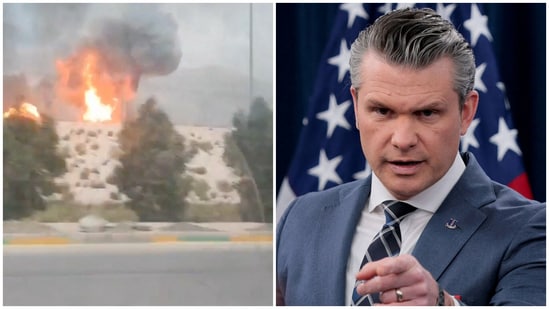
As the war in West Asia continues to rage, the United States has called for a funding of a whopping $200 billion for the ongoing conflict with Iran. This request from the Pentagon comes after US Defence Secretary Pete Hegseth said: “It takes money to kill bad guys.”
As the conflict escalates, Israel has stated it targeted Iran’s navy in the Caspian Sea on Thursday.
Meanwhile, six Western allies, including the UK, France, Germany and Japan, have stated that they will help in efforts to ensure a safe passage through the Strait of Hormuz.
The war between US-Israel and Iran escalated after Israel attacked the South Pars gas field in Iran, prompting Tehran to launch retaliatory strikes targeting energy sites in Saudi Arabia, the UAE, Qatar and Kuwait.
As the war continues to rage on, here’s the latest on what’s going in West Asia.
West Asia war | Key updates
Trump says no US troops in the region
US President Donald Trump on Thursday said that he will not be sending American troops to the region. The US president’s response comes as the war with Iran continues to escalate.
“If I were, I certainly wouldn’t tell you. But I’m not putting troops,” Trump told reporters as he met Japanese Prime Minister Sanae Takaichi in the Oval Office.
UK, France, Japan, and more to help safe passage in Hormuz Strait
The UK, France, Germany, Italy, Japan and the Netherlands on Thursday said that they were ready “to contribute to appropriate efforts to ensure safe passage through the Strait of Hormuz”.
“We welcome the commitment of nations who are engaging in preparatory planning”, read a joint statement from the six Western allies.
The declaration comes as Iran continues its blockade of the Strait of Hormuz. In their joint statement, the Western nations also called on Iran to cease its attacks – drones, missiles and mines – across the Gulf region.
“Freedom of navigation is a fundamental principle of international law, including under the United Nations Convention on the Law of the Sea,” the statement added further as the nations condemned Iran’s blockade.
Israel hits Iranian navy in Caspian Sea
Israel announced it carried out strikes in the Caspian Sea targeting Iranian naval vessels. The Israeli military added that this was its most significant strikes since the start of “Operation Roaring Lion.”
“We have been able to take out their navy capabilities in the Caspian Sea,” said Lieutenant Colonel Nadav Shoshani in an online briefing with reporters.
“That is a systematic strike on all levels of their naval capabilities in the Caspian Sea.” he said, adding that this was the first time Israel ahs struck in the Caspian Sea.
“This is the first time we have done that in our history… We were able to target their naval shipyard where they can fix or build new ships,” he added.
Pentagon seeks $200 billion from Congress as Iran war rages
With no end in sight to the war between the US, Israel, and Iran, the Pentagon has called for $200 billion in funding from Congress.
As per an AP report, which cites a senior administration official, a request has been sent to the White House for the same.
In a press conference later in the day, defence secretary Pete Hegseth did not confirm that amount but stated that the Pentagon has applied for funding.
“It takes money to kill bad guys,” Hegseth said, adding that “we’re going back to Congress and our folks there to ensure that we’re properly funded.”
This reported request from the Pentagon comes after the Trump administration continues to strike Iran without prior approval for military action from Congress.
Iran Foreign Minister vows “zero restraint”
In a new statement, Iran’s Foreign Minister Abbas Araghchi on Thursday said that Tehran will not exercise any restraint if energy facilities are attacked in the war.
“Our response to Israel’s attack on our infrastructure employed FRACTION of our power. The ONLY reason for restraint was respect for requested de-escalation,” said Araghchi in a post on X.
“ZERO restraint if our infrastructures are struck again,’ he added.
This warning from Iran comes after Israel struck the South Pars region in Iran, which is the Iranian part of the world’s largest gas field.
US “decisively winning”, says Hegseth
Amid reports of the $200 billion ask from Congress, Pete Hegseth has maintained that the US is “winning the war”.
“Epic Fury is different. It’s laser-focused. It’s decisive. Our objectives, given directly from our America First President, remain exactly as they were on Day One…We’re winning — decisively and on our terms,” Hegseth said during a press conference on Thursday.
The war secretary further revealed that the US has struck over 7,000 targets across Iran and its military infrastructure since the war first broke out on February 28.
“To date, we’ve struck over 7,000 targets across Iran and its military infrastructure. That is not incremental. That is an overwhelming force applied with precision. And again, today will be the largest strike package yet, just like yesterday was. As I’ve said from day one, our capabilities continue to build. Iran’s continued to degrade. We’re hunting and striking, bringing death and destruction from above,” said Hegseth.
Iranian strikes on energy sites sparks Gulf response
Following the strikes on energy sties across the Gulf, Qatar, the UAE, Saudi Arabia and more have called on Iran to cease targeting energy fields and sites.
Qatar, the world’s second largest LNG exporter, said on Thursday that the Iranian attack on its Ras Laffan gas complex caused three fires and extensive damage. Meanwhile, the UAE also responded to incidents at the Habshan gas facilities and at the Bab oilfield caused by falling debris from intercepted missiles.
Saudi Arabia said it destroyed missiles and drones launched towards Riyadh and a gas facility in the eastern region. Following a meeting between foreign ministers from 12 Muslim-majority countries, Saudi Foreign Minister Faisal bin Farhan Al Saud said that Riyadh “reserves the right to take military actions if deemed necessary.”


