
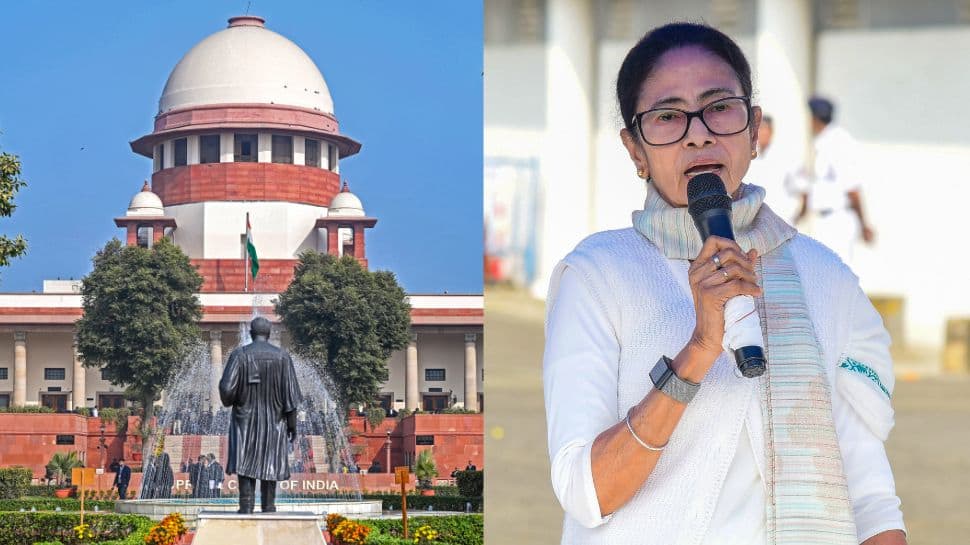
West Bengal SIR: The Supreme Court on Friday ordered the deployment of serving and retired judicial officers to oversee the adjudication of claims and objections arising from the Special Intensive Revision (SIR) of electoral rolls in West Bengal. The Court observed that in view of the “extraordinary circumstances”, it was left with little option but to involve the judiciary to ensure fairness and completion of the revision exercise.
During the hearing, sharp exchanges took place between the state government and the poll body over compliance with earlier directions of the top court over the deployment of officers for SIR duties.
In an unprecedented order, according to IANS, a Bench of Chief Justice of India (CJI) Surya Kant and Justices Joymalya Bagchi and Vipin Pancholi observed that a “trust deficit” between the state government and the Election Commission of India (ECI) had stalled the exercise at an important stage.
“There is an unfortunate blame game of allegations and counter-allegations which shows trust deficit between two constitutional functionaries,” the apex court said.
Further noting that the voters who received notices under the “logical discrepancy list” had already submitted documents supporting their inclusion in electoral rolls. The bench led by CJI Kant stressed these claims now required a fair adjudication.
The top court requested the Calcutta High Court Chief Justice to spare serving judicial officers, along with retired officers in the rank of Additional District Judge or District Judge, to assist inthe disposal and reconsideration of pending claims across districts.
“In order to ensure fairness in adjudication of genuineness of documents submitted and consequent inclusion or exclusion in voter list, we are left with hardly any other option but to request the Chief Justice of the High Court of Calcutta to spare some serving judicial officers along with some former judicial officers,” the CJI Kant-led Bench stated.
What is inside SC’s big order
According to the apex court’s order, each judicial officer will be assisted by officials deputed by the poll body as well as the West Bengal government.
The SC also allowed publication of the final electoral roll on the scheduled date of February 28 for the portion of the exercise already completed. It permitted the ECI to publish supplementary voter lists thereafter.
For smooth completion of the SIR process, the CJI Kant-led Bench directed District Collectors and Superintendents of Police to extend full logistical support to the judicial officers and their teams.
IANS reported that the West Bengal Director General of Police (DGP) was further asked to file a supplementary affidavit detailing steps taken on complaints alleging threats and intimidation faced by officials engaged in the SIR exercise.
What happened in court?
While senior advocates Kapil Sibal and Menaka Guruswamy, appearing for the West Bengal government, contended that sufficient Group B officers had been provided, senior advocate Dama Seshadri Naidu, representing the Election Commission, argued that officers competent to discharge quasi-judicial functions as Electoral Registration Officers (EROs) were not made available.
The CJI Kant-led Bench further said, “You are not providing competent Group A officers. How can incompetent officials decide the fate of the people?”
It added that there appeared to be “hesitancy on both ends”, observing that judicial officers could help take the process “to a logical conclusion”.
The Supreme Court stressed that cooperation from all stakeholders was essential, cautioning the state government to create an enabling environment for the Calcutta High Court-nominated judicial officers to function effectively.
(with IANS inputs)


