

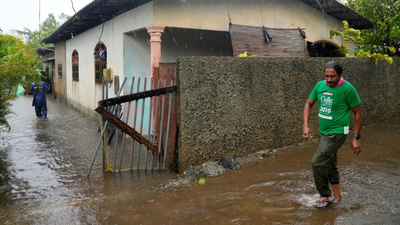
Cyclone Ditwah Claims Over 80 Lives in Sri Lanka’s Worst Disaster
Sri Lanka faces an unprecedented disaster as Cyclone Ditwah triggered catastrophic floods and landslides, killing over 80 people and displacing thousands. The storm has caused widespread destruction to infrastructure, isolating communities and prompting massive rescue operations.
Key Takeaways
- Over 80 confirmed dead, 34 missing in cyclone-related disasters
- 148,603 people affected across 44,192 families
- 14,000 people sheltering in 195 emergency centers
- Three major bridges washed away, cutting off vital transport routes
- India launches ‘Operation Sagar Bandhu’ with emergency relief supplies
Emergency Situation Worsens
The Disaster Management Centre confirmed the rising death toll as rescue operations intensify. Authorities warned of an “unprecedented disaster situation” in the Western Province due to dangerously rising water levels in the Kelani and Attanagalu rivers.
Both Colombo and Gampaha districts face severe threats, with officials urging residents in vulnerable areas to evacuate immediately.
Infrastructure Collapse
Three critical bridges – Moragahakanda Main Bridge, Elahera Bridge, and Kumara Ella Bridge – were completely washed away. This has isolated communities across Matale, Polonnaruwa, Kurunegala, and Uva provinces, severely hampering relief efforts.
Director General Ajith Gunasekara warned: “It is unlikely this situation will change. We expect the Kelani River’s water levels to exceed those recorded during the 2016 floods.”
Record Rainfall and Power Crisis
Matale district recorded 540 mm of rainfall in just 24 hours, triggering massive landslides in central hill regions. The National Building Research Organisation described the situation as “extraordinary and unprecedented.”
Widespread power outages affected 25-30% of the region after two major hydropower plants, Kotmale and Rantambe, were shut down due to cable failures.
International Assistance
India launched emergency relief mission ‘Operation Sagar Bandhu,’ delivering 4.5 tonnes of dry rations and 2 tonnes of fresh rations via Indian Navy ships INS Vikrant and INS Udaigiri.
Government Response
President Dissanayake invoked the Essential Public Services Act, declaring electricity, fuel, hospitals, water supply, and public transport as essential services. All long-distance train services were cancelled, with limited resumption only within the Western Province.
The government has designated special officers to handle inquiries about foreign tourists affected by the disaster, while several important examinations have been postponed.


