

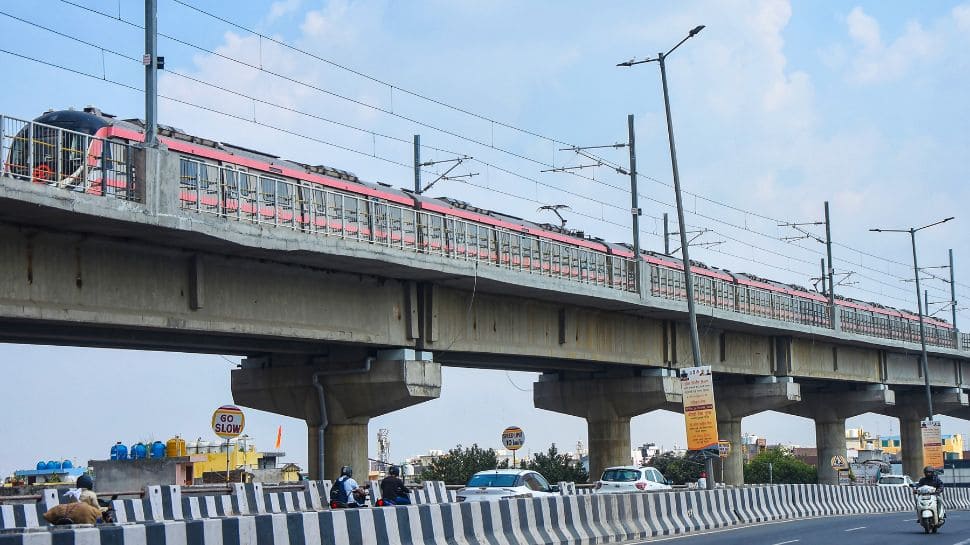
The Delhi Metro Rail Corporation (DMRC) will begin train operations at 3:30 AM on Sunday, February 22, to assist people participating in the New Delhi Marathon 2026. Three major lines, Yellow, Blue, and Violet, will see an early start.
Delhi Metro in a post on X informed, ” To facilitate participants of the New Delhi Marathon 2026 on Sunday, 22nd February 2026, Delhi Metro train services will begin early from the terminal stations at 03:30 AM and continue to operate till 06:00 AM at 30-minute intervals, followed by the regular Sunday timetable on the following lines: Yellow Line: Samaypur Badli – Millennium City Centre Gurugram, Blue Line: Dwarka Sec-21 – Noida Electronic City / Vaishali, Violet Line: Kashmere Gate – Raja Nahar Singh Metro services on all other lines will operate as per the regular Sunday timetable.”
The New Delhi Marathon is an annual running event with a full marathon distance, also termed as the National Championship, presented by NEB Sports. An opportunity to run alongside the best in the nation, NDM witnesses some fantastic performances every year. Some of these performances qualify to represent the country.
Meanwhile, the Delhi government has taken a major step towards strengthening and modernising the capital’s public transport system. The Cabinet, chaired by the Chief Minister Rekha Gupta, approved Metro Phase V(A).
Delhi CM informed that this ambitious project will develop three new corridors totalling 16 kilometres in length, including 13 metro stations. The estimated cost of the entire project is Rs 12,014.91 crore, with the Delhi Government’s budgetary share being Rs 2,940.46 crore. The project is targeted for completion in 2028, according to a release from the Delhi CMO.
The Chief Minister thanked Prime Minister Narendra Modi for his support and said the project is a significant step toward implementing his “7-C Vision” for transportation — Common, Connected, Convenient, Congestion-free, Charged, Clean, and Cutting-edge mobility. She emphasised that strengthening public transport is essential for achieving environmental protection and net-zero emission goals.


