
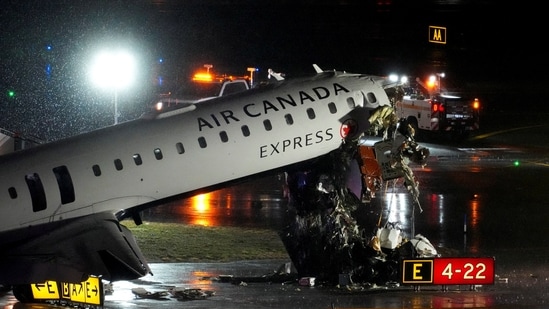
A deadly runway collision at LaGuardia Airport that killed two pilots and injured over 40 people could have been prevented, according to an expert from the Department of Transportation.
The crash occurred late Sunday when an Air Canada Express CRJ-900 struck a fire truck while landing. The aircraft was carrying 72 passengers and four crew members. Both pilots died in the impact, while dozens were hospitalized.
Former US Department of Transportation inspector general Mary Schiavo said the incident was “entirely avoidable,” pointing to a critical breakdown in coordination between ground control and the control tower.
Schiavo told the New York Post that the aircraft had the right of way once it was cleared to land.
“Once that aircraft was cleared to land … it owned that runway,”
She explained that there appeared to be confusion between air traffic control teams responsible for managing aircraft and those handling ground vehicles.
“There are two parts here, there’s the control in the tower, also called local control, and there’s ground control. And those two air traffic control entities are supposed to coordinate with each other,” she said.
“Who gave the final clearance for that fire truck across the runway? It should have been the tower, but clearly … someone made a very critical mistake,” she added.
‘Controller went brain-dead,’ says former FAA official
Harvey Sconick is a retired air traffic controller with more than 38 years of experience at the FAA was equally blunt in his assessment when speaking to the New York Post.
“The controller who crossed those vehicles while the airplane was landing just went brain-dead for a minute,” he said. “There’s no explanation I can give you that would make any sense why the controller would cross those vehicles, knowing that there’s a runway, that there’s an airplane flaring out to land.”
Sconick suggested it was possible that one person was directing both air and ground traffic late at night when the airport got less busy or that controllers were working on different frequencies and were unable to communicate with each other.
He also pointed out that the fire truck driver should have questioned the instruction to cross. “Unless the fire truck driver fell asleep, he would have heard that there was an airplane landing on that runway. And when the controller cleared him to cross the runway, he would have said, ‘Hey, are you sure you want us to cross? You’ve got a guy landing,'” Sconick said.
Schiavo also drew comparisons between Sunday’s crash and the American Airlines collision in January last year when a military helicopter collided with a passenger jet over the Potomac River. She said that incident was the result of a “dereliction of duty” by the FAA.
“I think they already see this is another case of the FAA simply not doing their job, not coordinating that staffing.”
“And it’s tragic, and it’s sad. But… I have to say I’m not surprised. I’m saddened, but I’m not surprised that we have another coordination problem with air traffic control,” she added.
Officials say tower controls runway movement
Kathryn Garcia, executive director of the Port Authority of New York and New Jersey said all runway movement depends on air traffic control approval.
“The procedure is always in deference to the control tower, any time anyone is moving on any of our runways or taxiways,” she said.
“They have to get clearance from the tower to move on our runways or our taxiways.”
The crash remains under investigation.


