
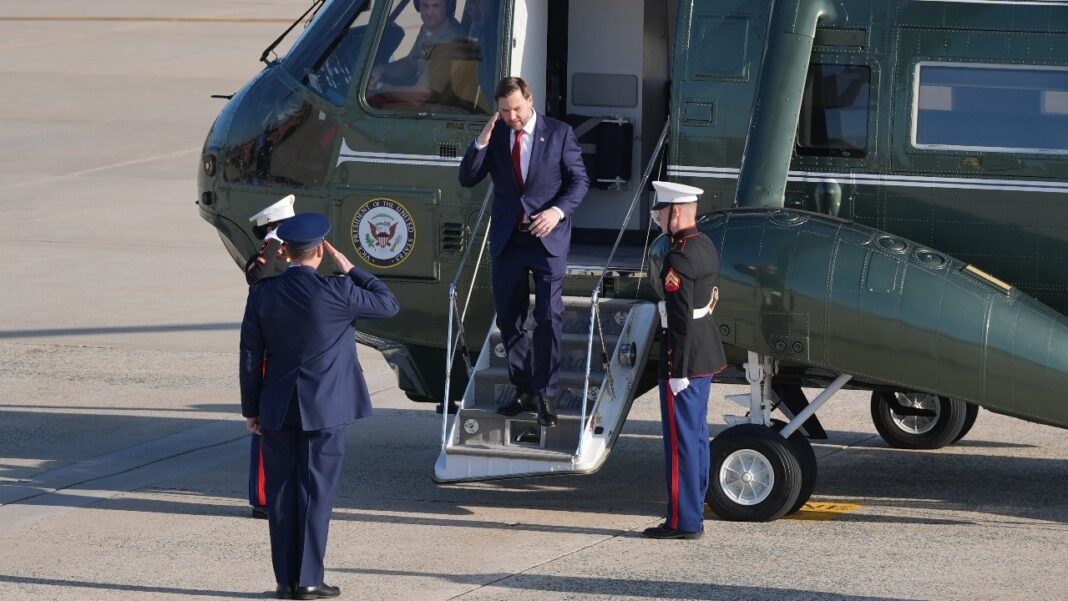
US Vice President JD Vance departed for Pakistan on Friday to lead a high-level American delegation aimed at initiating peace talks with Iran, expressing measured optimism ahead of a potentially defining diplomatic moment.
“We’re looking forward to the negotiation. I think it’s going to be positive,” Vance said prior to the departure, signalling confidence despite ongoing regional tensions.
Vance struck a firm yet hopeful tone about upcoming negotiations, saying, “If they’re going to try to play us, then they’re going to find the negotiating team is not that receptive.”
“We are looking forward to the negotiations. I think it is going to be positive. As the President said, if the Iranians are willing to negotiate in good faith, we are certainly willing to extend the open hand. If they are not then they are going to find that the negotiating team is not that receptive. We are trying to have some positive negotiations,” he stressed.
The visit to Islamabad represents one of the most significant engagements between Washington and Tehran in decades. Vance is spearheading discussions that could influence not only a fragile ceasefire but also the broader stability of the region.
He further noted that Donald Trump has set clear expectations for the talks. “The president has given us some pretty clear guidelines, and we’ll see how it goes,” Vance said.
The delegation also includes senior figures such as Steve Witkoff and Jared Kushner, highlighting the importance Washington places on these negotiations.
ALL EYES ON ISLAMABAD TALKS
The White House has offered limited clarity on the structure of the upcoming talks, leaving open whether discussions between the US and Iran will be direct or indirect, and declining to outline firm expectations.
Still, the arrival of JD Vance in Islamabad signals a rare and significant moment of high-level engagement between Washington and Tehran.
Such contact has been scarce since the Iranian Revolution, with one notable exception when Barack Obama spoke by phone with Hassan Rouhani in 2013.
Despite the diplomatic opening, tensions remain high. Shortly after both sides announced a temporary ceasefire, disagreements surfaced. Iran insisted that halting the Israeli war in Lebanon was part of the deal, while Benjamin Netanyahu and Donald Trump rejected that interpretation, maintaining that operations in Lebanon would continue.
Meanwhile, Washington pressed Iran to reopen the Strait of Hormuz, which Tehran had closed amid escalating conflict involving Hezbollah. Trump criticised Iran’s compliance, saying it was “doing a very poor job” and warning, “That is not the agreement we have!”
Administration officials, including spokeswoman Anna Kelly, emphasised coordination among key figures such as Steve Witkoff, Jared Kushner, and Marco Rubio.
Kelly underscored optimism about a breakthrough, stating, “President Trump has a proven track record of achieving good deals on behalf of the United States and the American people, and he will only accept one that puts America first”.
VANCE ASSUMES CENTRAL DIPLOMATIC ROLE
For JD Vance, the talks represent a defining and high-stakes moment. Once seen as a background figure in the Trump administration, he is now taking on a central diplomatic role despite limited experience.
Having served in the Iraq War and spent a relatively short time in national office, his leadership of such sensitive negotiations has drawn scrutiny.
Addressing speculation about Iran’s role in his involvement, Vance said, “I don’t know that. I would be surprised if that was true. But, you know, I wanted to be involved because I thought I could make a difference”.
Experts note the unusual nature of his assignment. As legal scholar Joel Goldstein observed, “I don’t recall a situation where a vice president has been sent to negotiate a ceasefire or peace in connection with a war the United States was involved with”.
Analysts also suggest that Vance’s comparatively cautious stance on foreign intervention may make him a more acceptable interlocutor for Iran.
With agency inputs


