
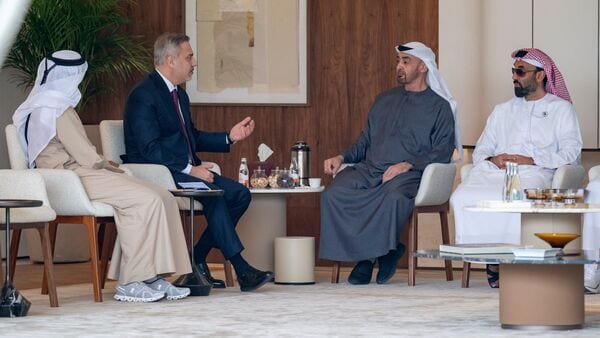
The Arab monarchies of the Persian Gulf had maintained a balancing act- quietly hosting American forces whilst publicly distancing themselves from the US and Israel’s war against Iran. That posture is now fracturing. According to a report by The Wall Street Journal, both Saudi Arabia and the United Arab Emirates (UAE) are taking concrete steps that signal a deepening, and potentially irreversible, entanglement in the Iran war.
Saudi Arabia Opens Air Base to US Forces, Crown Prince Weighs Direct Military Action
In a significant shift, Saudi Arabia has permitted US forces to operate from King Fahd air base on the western side of the Arabian Peninsula, according to a WSJ report citing people familiar with the decision.
The move potentially contradicts Riyadh’s earlier public position that it would neither allow its facilities nor its airspace to be used for operations against Iran — a stance that collapsed after Iran launched a sustained campaign of missile and drone strikes against Saudi energy infrastructure and the capital, Riyadh.
Crown Prince Mohammed bin Salman is now said to be weighing a decision to join the attacks directly, with one source describing to WSJ that his entry into the war is a matter of when, not whether.
“Saudi Arabia’s patience with Iranian attacks is not unlimited,” Saudi Foreign Minister Faisal bin Farhan told reporters last week following a series of Iranian strikes on Gulf energy infrastructure. “Any belief that Gulf countries are incapable of responding is a miscalculation.”
Five US Air Force refuelling aircraft were also struck and damaged on the ground at Prince Sultan Air Base in Saudi Arabia, according to US officials — further evidence of the direct costs the kingdom is absorbing.
UAE Shuts Iranian Institutions in Dubai, Threatens to Freeze Billions in Assets
Simultaneously, the UAE has begun targeting Iran’s financial presence on its soil. Dubai authorities recently shut down both the Iranian Hospital and the Iranian Club, with the hospital’s phone lines, WhatsApp channel, and website rendered non-operational. Dubai health authorities confirmed the facility was no longer operational.
“Certain institutions directly linked to the Iranian regime and IRGC will be closed under targeted measures after being found to have been misused to advance agendas that do not serve the Iranian people, and in violation of UAE law,” the government said, referring to the Islamic Revolutionary Guard Corps.
The UAE, which has long served as a financial gateway for Iranian businesses and individuals, has additionally warned that it could freeze billions of dollars in Iranian holdings. The move, analysts say, could significantly restrict Tehran’s access to foreign currency and international trade networks at a time when Iran’s domestic economy is already buckling under inflation and sanctions.
The UAE alone has reportedly had to withstand more than 2,000 Iranian attacks since the war began.
Iran Claims Toll Rights Over Strait of Hormuz, Alarming Gulf Monarchies
A particularly alarming development for Gulf states has been Iran’s assertion that it seeks an ongoing role in governing the Strait of Hormuz following any cessation of hostilities.
In conversations with Arab officials, Tehran reportedly proposed charging transit fees through the strait, drawing a direct parallel to Egypt’s Suez Canal toll system. Iran has already demonstrated its capacity to disrupt the waterway by attacking ships in transit, whilst selectively allowing passage to vessels it favours.
The prospect of Tehran gaining long-term leverage over the world’s most consequential oil shipping lane appears to have concentrated minds across the Gulf.
Iran Strikes Qatar’s Ras Laffan Hub, Kuwait and UAE in Widening Energy War
The pressure on Gulf leaders intensified sharply last week when Iran struck Qatar’s Ras Laffan energy hub, one of the world’s largest liquefied natural gas facilities, alongside a key Saudi Red Sea energy hub and infrastructure in Kuwait and the UAE. The strikes came in retaliation for an Israeli attack on Iran’s South Pars gas field.
Qatar condemned the strike as a dangerous escalation and a direct threat to its national security.
Arab states had previously lobbied Washington to prevent Israeli strikes on Iranian energy infrastructure following an earlier attack on fuel depots in Tehran. According to American and Israeli officials, however, the US received advance notice of the South Pars strike from Israel and allowed it to proceed regardless.
That decision has deepened frustration among Gulf leaders, who told the Journal they feel unable to exert meaningful influence over the Trump administration’s choices despite significant investment in the bilateral security relationship.
Videos Suggest Ground Missiles Launched Against Iran from Bahrain
The gap between the Gulf states’ public posture and ground reality is becoming harder to sustain.
Videos verified by Storyful indicate that some ground-based missiles used in attacks against Iran were launched from Bahrain, WSJ reported.
The US military declined to confirm or deny Arab involvement in the campaign, stating it would defer to Gulf governments to characterise their own roles.
Gulf Leaders Press Washington to Destroy Iran’s Military Before Ceasefire
According to Arab officials, the leaders of Saudi Arabia and the UAE have been lobbying the Trump administration in regular telephone calls to ensure Iran’s military capabilities are substantially degraded before any ceasefire is agreed, WSJ reported.
The UAE is also said to be actively resisting the prospect of a ceasefire that leaves Iranian military structures intact.
Analysts note that the Gulf’s rulers find themselves trapped between two uncomfortable realities. Open military engagement against Iran carries profound risks, particularly if Washington were to withdraw from the conflict abruptly. Yet continued Iranian attacks are eroding the deterrence that the Gulf’s security architecture was designed to provide.
“They’re just caught in this structural bind that weaker parties always have in an alliance with a stronger party,” said Gregory Gause, an analyst of US-Gulf relations at the Middle East Institute in Washington. “If the stronger party is taking bellicose positions, they’re worried that they’re going to be dragged into a war they don’t want to fight.”


