
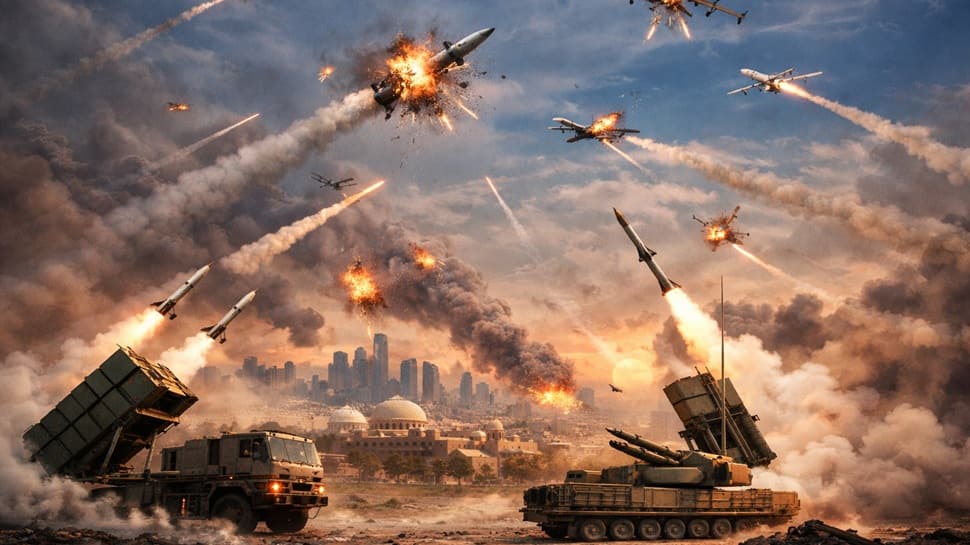
The Middle East is burning, literally. Since the US-Israel strike on Iran on February 28, Tehran has fired thousands of missiles and drones towards American bases in the Gulf nations, including the UAE, Saudi Arabia, Qatar, Kuwait and Bahrain. Over the past 10 days, the world has watched missiles and drones raining down on these countries. However, many of these are intercepted and neutralised in the air.
According to reports, Gulf nations have shot down over 2,000 missiles and more than 1,500 drones, including Shahed drones. The air defence system of GCC countries, supported by the US and Israeli systems, has successfully intercepted the majority of the threats.
The United Arab Emirates has a layered air-defence network to intercept incoming threats at different level. For the high altitude targets, the UAE uses the American Terminal High Altitude Area Defense (THAAD) system, and closer to the ground, it has deployed Patriot missile-defense batteries provided by the US firm Raytheon.
According to the UAE Ministry of Defence, Iran launched 196 ballistic missiles towards its territories, but 181 of them were downed, 13 fell short in the seas, and two hit the UAE territory.
On the other hand, Saudi Arabia uses the Patriot missile-defence system and its advanced version, the PAC-3 MSE interceptor.
Qatar is defending its territory with the Patriot missile-defense system and AN/FPS-132 radar system. Qatar had intercepted around 98 ballistic missiles, three cruise missiles, and 24 drones so far.
Kuwait’s air defence system includes the US-made Patriot missile-defence system. On the other hand, Bahrain hosts the US Navy’s Fifth Fleet, which came under attack from Iran. Bahrain also hosts the Patriot missile-defence system and PAC-3 interceptors. For its air defence, Oman relies on shorter-range systems like the Norwegian Advanced Surface-to-Air Missile System alongside radar networks.
Out of the Gulf, Israel is taking on the waves if Iranian missiles with multiple systems, including Iron Dome, David’s Sling, Arrow systems, Iron Beam, Patriot, and Barak 8. Despite these, Israel has also faced multiple hits due to large number of incoming threats.
Defending large territories from repeated waves of missiles and drones remains a significant challenge. In the GCC, radar networks, interceptor missiles, and layered air-defence systems have often prevented far greater damage. However, the past week has also demonstrated that even highly advanced defences cannot fully eliminate risk when attacks occur in successive waves across multiple countries.



