If a country lacks the ability to overpower a stronger adversary through brute force, it can instead impose costs on the aggressor and its partners. That logic appears to be shaping the escalation following coordinated US and Israeli strikes on Iran, which have drawn much of West Asia into one of the region’s widest confrontations in decades. However, as the war prolongs, Tehran appears to be struggling to maintain consistency in its attacks, with a significant number of missile launchers destroyed, directly impacting the frequency and scale of its barrages.
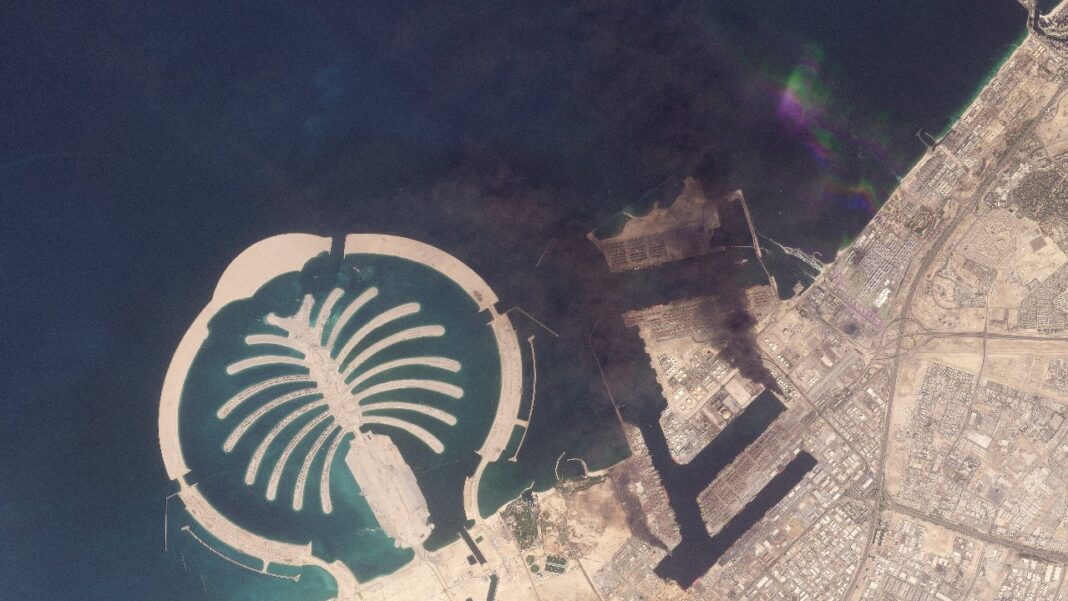
While missile barrages and Shahed drones, now observed less frequently in the battlespace, have been directed at several countries across West Asia, the United Arab Emirates has borne the brunt of the attacks. The country hosts major US military facilities and advanced air defence systems such as THAAD and Patriot, but lies well within the reach of lower-cost Iranian drones.
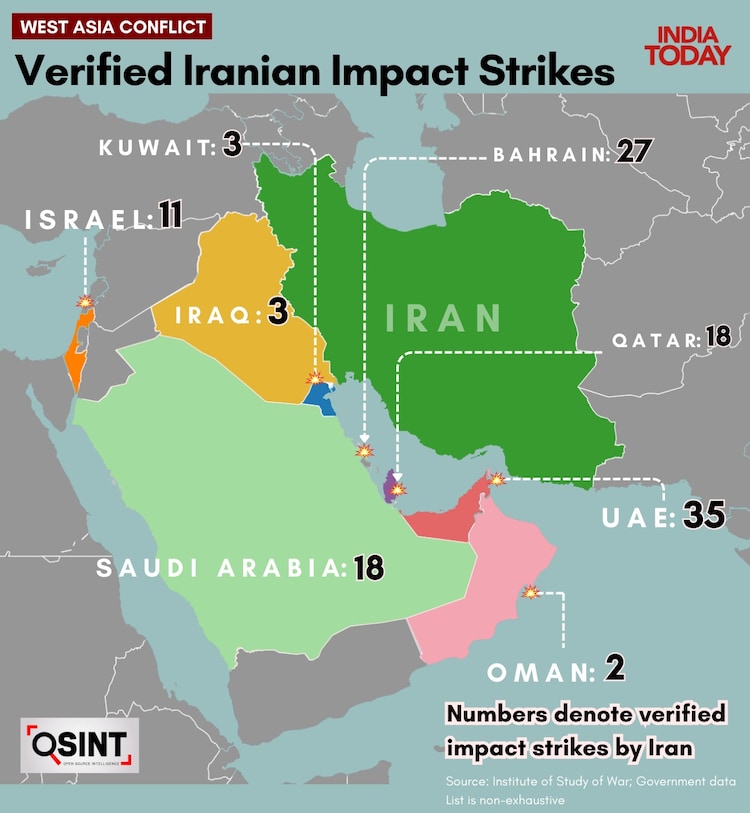
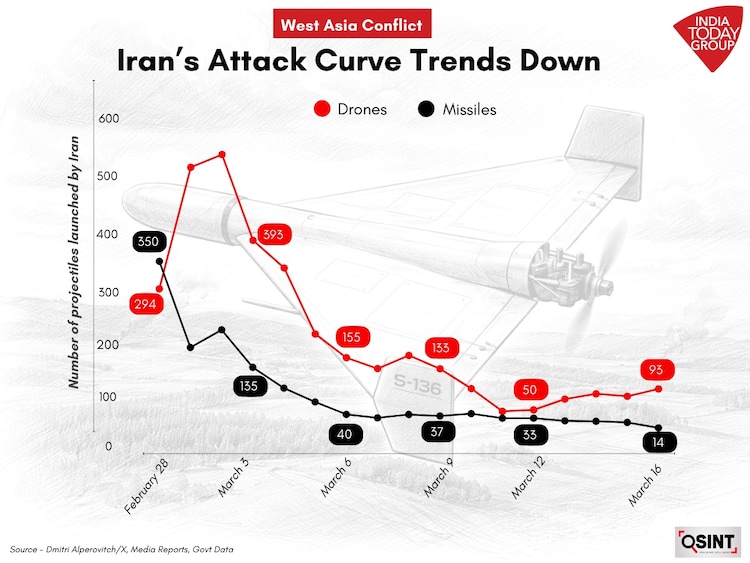
India Today’s Open Source Intelligence (OSINT) team analysed strike reports, official statements, and verified incident data from February 28 to March 16 to map high-value targets where Iranian projectiles resulted in impact strikes that caused observable damage and penetrated regional air defence systems. The analysis also tracks the number of projectiles launched by Iran per day since February 28, when the war broke out.
UAE has faced the brunt of Iranian strikes
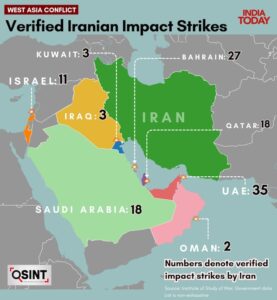
The UAE has faced the highest number of barrages, with 1,936 projectiles launched towards it, including 304 ballistic missiles and 15 cruise missiles. It also has the highest number of projectile impacts of any country during the escalation, with at least 35 missiles and drones confirmed to have struck its territory and caused verified damage. This figure is not exhaustive, as several additional projectiles are assessed to have struck but landed in open areas or waters without producing clearly verifiable damage.
As per the reports of the Institute of the Study of War (ISW), these impacts have been reported in distinct areas with at least six major locations in the UAE, including around Zayed Port in Abu Dhabi, Jebel Ali Port and commercial infrastructure in Dubai, Al Dhafra Air Base, and Fujairah Port. While other countries across West Asia have also reported strikes, the UAE stands out both in the number of projectiles that landed and the spread of impact locations.
Bahrain follows with at least 27 projectiles, causing visible damage, including at the BAPCO refinery and US Fifth Fleet facilities. Qatar saw over 18 such strikes across Ras Laffan and Al Udeid. Kuwait, Saudi Arabia, Oman, Israel, and Iraq recorded more limited but geographically distributed impact strikes.
Are Iran’s capabilities declining?
Iran frames the campaign as retaliation against US and “Zionist regime” aggression, while signalling a prolonged conflict rather than a one-time response. But the question is whether Iran has the capabilities, both offensive and defensive, to protect its assets while inflicting damage on adversaries. The answer increasingly appears to be no.
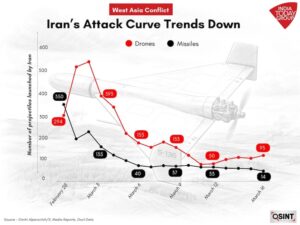
With an already thin air defence that allowed the US and Israel to strike Iran with relative ease, Tehran now also seems to be facing constraints in its launch capacity. This is reflected in recent data: Iran launched close to 650 projectiles on February 28, the day war broke out, which peaked at 708 on March 2, and has since dropped to 107 as of March 16.
In the initial phase of the war, Iran relied on volume, with drones deployed alongside ballistic and limited cruise missiles, including systems such as Emad and Ghadr, and the possible use of Kheybar Shekan or Fatah 1. Drones have remained the constant and dominant component, both at the outset of the war and even now, despite the degradation of launch capabilities.
Open source indicators, including strike pattern data, suggest a degradation in Iran’s offensive output, while its defensive posture has consistently remained a relative weakness. Donald Trump also claimed that the US has “achieved a 90% reduction in ballistic missile launches and a 95% reduction in drone attacks.” This operational shift is visible: from high volume, mixed saturation attacks to more selective ballistic missile employment, combining legacy liquid fuel systems with a limited use of newer generation platforms. This is less likely to reflect a deliberate strategy and more likely to indicate constraints in Iran’s launch capabilities.
This suggests that even as overall launch capacity declines, Iran may still be selectively deploying more advanced systems. Recent assessments indicate a potential shift in Iran’s missile employment. The ISW report notes the use of the Sejjil 2 in strikes against Israel. This is a two-stage, solid-fuel medium-range ballistic missile and is among Iran’s more advanced strategic systems.
What are Tehran’s targets?
Most Iranian strikes so far have not been precision-driven, instead relying on saturation and indiscriminate attack patterns, which explains why some drones have occasionally struck residential areas and even landed in waters and vacant zones. Tehran’s intended targets have remained consistent: US bases, energy infrastructure, including oil and LNG facilities, ports, and critical shipping lanes. This targeting pattern enables Iran to impose economic and strategic costs across the Gulf rather than confining the conflict to Israel, while still sustaining direct retaliation against it.
Iran’s targeting reflects a deliberate pressure distribution strategy. Israel continues to be targeted, but the use of smaller, fragmented barrages underscores the challenge of penetrating its dense air defence network. This helps explain why, despite using cluster munitions and ballistic and cruise missiles, so far, only 11 Iranian strikes into Israeli territory appear to have caused visible damage. Apart from a limited number of projectiles reaching the ground, only a few cluster munition strikes appear to have penetrated the much-discussed Iron Dome.
This helps explain why Iran has expanded strikes to the UAE and other Gulf states. The rationale is not rooted in tensions with neighbouring countries, but in their role as hosts to US military infrastructure and operational support hubs. By targeting and degrading these nodes, Tehran is attempting to impose costs on Washington and stretch its already expensive and finite air defence capabilities. This, in turn, could create exploitable gaps for subsequent phases of Iranian operations, but only if the capabilities allow Tehran to do so.