

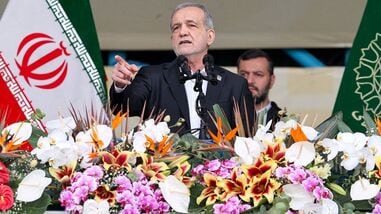
Iran’s President Masoud Pezeshkian said on Friday (March 6) that several countries have begun mediation efforts amid regional tensions, emphasizing that Iran remains committed to lasting peace while firmly defending its national dignity and sovereignty.
In a post on X (formerly Twitter), Pezeshkian stated that mediation efforts should focus on those who “underestimated the Iranian people and ignited this conflict.”
He said that Iran seeks stability in the region but “has no hesitation” in protecting its sovereignty if required.
The comments come as diplomatic efforts reportedly intensify in response to rising regional tensions, with multiple parties exploring potential pathways to de-escalation.
Israel-US strikes intensify; war enters 7th day
Fresh strikes hit Iran and Lebanon on Friday as Israel and the United States stepped up attacks in a widening Middle East conflict, with powerful explosions reported over Tehran.
The war, now in its seventh day, has drawn in global powers, disrupted energy and transport networks, and spread instability across areas that were previously relatively calm.
Explosions over Tehran as attacks escalate
Explosions rocked Tehran early Friday following warnings from Israel and the US that the next phase of the military campaign was underway.
Israel’s military chief Lieutenant General Eyal Zamir said Israel’s forces were intensifying operations. “We are now moving to the next phase of the operation,” Zamir said in a televised statement.
“We have additional surprises ahead which I do not intend to disclose.”
US Defence Secretary Pete Hegseth also warned that the scale of attacks would increase. “Firepower over Iran and over Tehran is about to surge dramatically,” Hegseth said.
US President Donald Trump ruled out sending large ground forces into Iran but said Washington would play a role in determining the country’s political future.
“It would be a waste of time” to deploy ground troops, Trump said, while adding that he would “have to be involved” in choosing Iran’s next leader.
Mourning Iran’s Supreme Leader
The strikes came as Tehran held its first Friday prayers since the death of Iran’s supreme leader Ali Khamenei, who was killed on the first day of the war.
Large crowds gathered outside the Grand Mosque of Imam Khomeini, with mourners dressed in black and carrying Iranian flags.
Lebanon fears humanitarian disaster
The conflict has expanded into Lebanon after Hezbollah launched missiles in support of Iran.
Israel carried out heavy strikes overnight on southern towns and the southern suburbs of Beirut, a Hezbollah stronghold.
Lebanon’s Prime Minister Nawaf Salam warned the displacement crisis could escalate rapidly. “A humanitarian disaster is looming,” Salam said, warning the consequences could be “unprecedented.”
Missile exchanges continue
Iran has continued launching missiles and drones at Israel, with rockets aimed at Tel Aviv and further north toward Netanya.
Blasts were heard across Tel Aviv as Israeli air defences responded to incoming launches.
At least 10 people have been killed in Israel since the war began, according to first responders. The US military has also reported the deaths of six personnel during the conflict.
War spreads across Gulf region
The fighting has increasingly affected Gulf states.
Qatar intercepted a drone targeting a US air base on its territory, while Saudi Arabia said it shot down three drones near Riyadh.
Thirteen people, including civilians, have been killed in Gulf countries since the war began.