
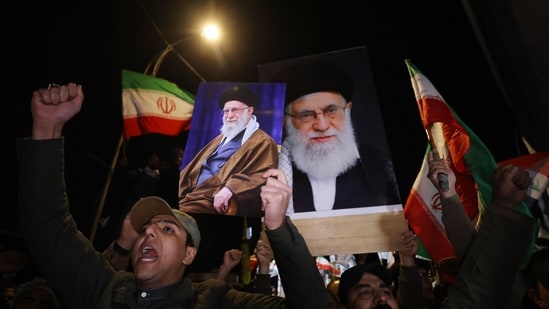
When the US and Israel struck Iran on February 28, starting what has now become a weeks- long conflict in West Asia, and killed Tehran’s military and civilian leaders, including Supreme Leader Ayatollah Ali Khamenei, they probably expected the Islamic Revolutionary Guard Corps (IRGC) to fold quickly.
This is exactly what happened in Iraq in 2003 when the US coalition toppled the Saddam Hussein regime in just 11 days. The Donald Trump administration had expected a similar playbook in Iran, but they may have hugely miscalculated one thing.
Iranian foreign minister Abbas Araghchi recently said that Tehran had spent two decades studying US wars to build a system that could keep fighting even if the capital was bombed, outlining the logic of Iran’s defence doctrine, according to a report by Al Arabiya.
Iran’s Mosaic Doctrine
At the centre of Iran’s defence doctrine is what Tehran’s military thinkers call “decentralised mosaic defence”. According to Al Jazeera, this is a concept built on one core assumption that: Iran may lose senior commanders, key facilities, communications networks and even centralised control in any war with the United States or Israel, but must still be able to keep fighting.
Under the doctrine, neither the defence of Tehran is of key importance nor is the protection of the leadership. The priority is preserving decision-making, keeping combat units operational and preventing the war from ending with a single devastating strike.
This is because after the Iraq war, Iran’s military was not built for a short war. It was built for a long one.
The origin
The concept of ‘Mosaic defence’ is most closely associated with the IRGC, particularly under former commander Mohammad Ali Jafari, who led the Iranian force from 2007 to 2019.
He worked on the idea of organising the country’s defensive structure into multiple regional and semi-independent layers instead of concentrating power in a single command chain that could be paralysed by a decapitation strike.
Components
Under the doctrine, all of Iran’s defence units, including the IRGC, the Basij, regular army units, missile forces, naval assets and local command structures, form parts of a distributed system. If one of the structures is hit, others keep functioning.
All the components are divided into 31 different parts, one for each province. Each provincial unit has its own headquarters, weapons stockpile and authority to act.
This means that the chain of the military remains intact even if senior leaders are killed, and local units still retain the authority and capacity to act even if communications with the central command are cut off.
Aims of the Mosaic defence
Iran’s Mosaic defence doctrine serves two central aims:
- Making Iran’s command system difficult to dismantle by force.
- Making the battlefield itself harder to resolve quickly by turning Iran into a layered arena of regular defence, irregular warfare, local mobilisation and long-term attrition.
Due to this doctrine and such command structure, the Iranian military thinking does not treat war primarily as a contest of firepower but as a test of endurance.
This is where Donald Trump and Benjamin Netanyahu hugely miscalculated the initial strikes, missing on such a command structure.


