
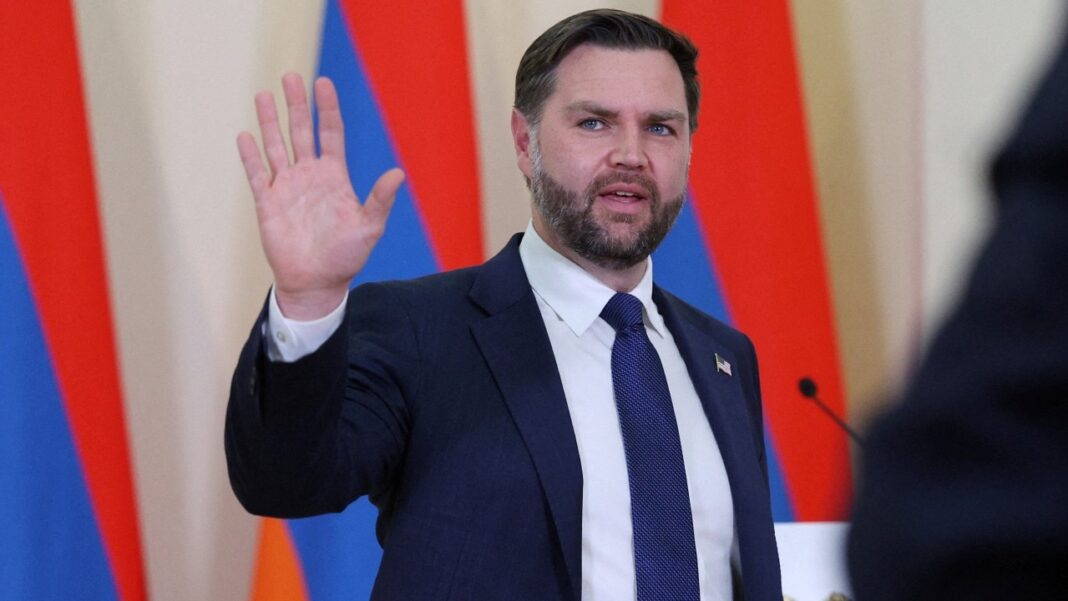
When US Vice President JD Vance arrives in Islamabad for talks with Iranian officials, it will fulfill a long-standing preference within Tehran’s leadership, some of whom had quietly pushed for him to take a leading role in negotiations to end the war, according to Reuters.
Iranian officials view Vance as one of the most anti-war voices in President Donald Trump’s inner circle, a perception that has shaped expectations ahead of the high-stakes meeting, Reuters reported, citing multiple sources familiar with the matter.
That reputation has led Tehran to believe Vance is the most likely among Trump’s close associates to seek a deal in good faith,” according to the report, though there is no indication he will adopt a softer negotiating stance than other US representatives.
The talks in Islamabad mark the first face-to-face engagement between the two sides since the war began, with both Washington and Tehran under pressure to find a path out of a costly and politically sensitive conflict.
A White House official said it was Trump’s decision alone to send Vance to Pakistan and stressed that the president would make the final call on any deal. Still, Vance’s presence — and whether Iran’s assessment of him proves accurate — could shape the trajectory of the negotiations.
“We’re certainly willing to extend the open hand,” Vance said before departure, while cautioning that any progress would depend on Iran negotiating in good faith.
The stakes are high for both sides. For the Trump administration, the talks offer a potential exit from a war that has drawn domestic criticism ahead of midterm elections. For Iran, they represent a chance to ease economic and military pressure.
Analysts say the outcome could also carry political implications for Vance, who is seen as a leading contender for the 2028 Republican presidential nomination. A successful deal could boost his standing, while failure risks tying him more closely to a prolonged conflict.
Vance will be joined by Jared Kushner and special envoy Steve Witkoff, though Iranian officials reportedly remain wary of both after previous rounds of talks failed.
On the Iranian side, Foreign Minister Abbas Araghchi and Parliament Speaker Mohammad Baqer Qalibaf are expected to lead negotiations, with Qalibaf among those who had advocated for Vance’s involvement.
Despite that alignment, deep divisions remain. Washington has ruled out further uranium enrichment by Iran, while Tehran has shown no sign of abandoning its nuclear programme.
With positions far apart and expectations mixed, Reuters noted that Vance may be stepping into what some see as either a rare diplomatic opening — or a high-risk political gamble.
With inputs from Reuters


